Friday, March 30, 2007

Lady Susan

I enjoyed this book very much; it was a pleasure to read something by Jane Austen I hadn’t read before. I’m very familiar with her six major novels, but there is still a lot of shorter stuff I haven’t yet gotten to. My edition of Lady Susan includes The Watsons and Sanditon, the first of which I’ve now finished and the last of which I’m going to read next.

I’ve heard many people talk about the limitations of the epistolary form, and it’s probably true that there’s a limited number of things you can do with it, but I do like the form anyway. Perhaps it’s all the reading in the 18C I’ve done, a time when the epistolary novel flourished. What I like about it is the way you can see different versions of a character in the letters written to different audiences, and the way reading an epistolary novel gives one the sense of the importance of words and writing and how people can do battle with language — and other, less violent things, of course. But I think of doing battle with language when I think about Lady Susan, as Susan seems to be at war with much of the world.

Here is what she says in the very first letter of the novel:

I can no longer refuse myself the pleasure of profiting by your kind invitation when we last parted, of spending some weeks with you at Churchill … I impatiently look forward to the hour when I shall be admitted into your delightful retirement.

And this is what she says in the second letter of the novel:

I take town in my way to that insupportable spot, a country village, for I am really going to Churchill. Forgive me, my dear friend, it is my last resource. Were there another place in England open to me, I would prefer it.

Already we know so much about Lady Susan. She presents herself in very different ways in these letters, but even within one letter, her language can be interpreted in multiple ways. She writes the following to her brother-in-law, the owner of Churchill:

I am determined you see, not to be denied admittance at Churchill. It would indeed give me most painful sensations to know that it were not in your power to receive me.

As this is the novel’s first letter, we might interpret this to mean that Lady Susan wants to visit Churchill very much because she is genuinely interested in seeing those who live there, and this is the meaning she expects her brother-in-law to find. Upon knowing something more about Lady Susan, however, we can see that these sentences hint at her real feelings: she must leave her current residence, Langford, home of the Manwarings, because she has gotten herself into trouble there, and if she cannot stay at Churchill, she will experience “painful sensations” because her escape route will be blocked.

It’s this kind of facility with language that makes Lady Susan a very fun heroine — or villain, rather, except that, as Margaret Drabble, author of the introduction to my edition, points out, there really is no satisfactory heroine here, so Lady Susan steals the show. She prides herself on her ability to talk herself into and out of any situation (”If I am vain of anything, it is of my eloquence”); this is how she keeps Reginald, her gullible young admirer, by her side for so long. When Lady Susan can no longer convince people to believe her version of events, the novel ends — there is no more story.

The difference between appearance and reality, and the time and trouble it takes to learn to tell the two apart is a very common plot line in 18C fiction, and Lady Susan has much going for her as she tries to fool nearly everybody. She’s beautiful, and even Mrs. Vernon, her most serious enemy, is susceptible to it:

She is delicately fair, with fine grey eyes and dark eyelashes; and from her appearance one would not suppose her more than five and twenty, though she must in fact be ten years older … Her address to me was so gentle, frank and even affectionate, that if I had not known how much she has always disliked me for marrying Mr Vernon, and that we had never met before, I should have imagined her an attached friend.

Lady Susan is a symptom of a larger problem:

One is apt I believe to connect assurance of manner with coquetry, and to expect that an impudent address will necessarily attend an impudent mind; at least I was myself prepared for an improper degree of confidence in Lady Susan; but her countenance is absolutely sweet, and her voice and manner winningly mild.

We expect people’s insides to match their outsides, in other words — to be beautiful only if their hearts and minds are beautiful, and to act mildly and kindly only if they have mild and kind minds. Someone who combines a beautiful appearance and pleasant manners with lying and deceit is dangerous.

So Lady Susan depends on her pleasing appearance and behavior to keep her out of trouble and to get her whatever she wants. Besides the appearance vs. reality theme, there’s the juxposition in the novel between public reputation and the impression a person makes in private. Lady Susan counts on the power of private impression to overrule reputation; of her enemy Mrs. Vernon she says:

I hope [she is] convinced how little the ungenerous representations of any one to the disadvantage of another will avail, when opposed to the immediate influence of intellect and manner.

The novel shows, however, that reputation does mean something, and that the “ungenerous representations” of Lady Susan are a better source of truth than anything she herself says or does. You are better off trusting public concensus than trusting your own instincts — collective wisdom outweighs the individual’s insights.

Opposed to Lady Susan’s doubleness and deception is her daughter Frederica, whose simplicity Lady Susan cannot stand:

Her feelings are tolerably lively, and she is so charmingly artless in their display, as to afford the most reasonable hope of her being ridiculed and despised by every man who sees her. Artlessness will never do in love matters, and that girl is born a simpleton who has it either by nature or affectation.

Frederica’s artlessness is held up for praise in the novel; her mother’s criticism is a sign that we are to admire her, and yet she is a boring and lifeless character. All the interest in the novel belongs to Lady Susan. So we are left to deplore Lady Susan’s cruelty and deceitfulness, and yet we can’t help but admire her energy and intelligence and, yes, her artfulness and artifice. After all, Lady Susan’s skill with language is a skill she shares with her creator.

Sunday, February 25, 2007

History of the Slaves

Since Stefanie's discovery of Emerson's association with the eminent group, there has been a widespread clamouring for more information. Much scholarship is needed to uncover the details, buried under years of lies and fears. A few people throughout the years have claimed the existence of a Secret History, though such a document has never been found. Absent of that, we can only piece together fragments and fill in the blank spots with educated guesses. In order to satisfy some of the curiosity, we plan to offer occasional posts concerning the history of the Slaves. Perhaps this will also draw out others who have additional information, and a great deal more will be learned. Until that definitive history is written, we will continue to read after Coleridge's definition, and honor the true purpose and mission of the group.

Though the Slaves of Golconda were originally and always dedicated to studied reading, the stigma that was attached to them arose by a mistaken connection to a story of romance. Stanislas Jean, chevalier de Boufflers, was studying for the priesthood at Saint-Sulpice in 1760 when he met the renowned Latin poet François-Joseph Desbillons, also a Slave. Desbillons told Boufflers a story about a young nobleman and a girl of humble origins, which Boufflers wrote down and began circulating as Aline, reine de Golconde. When the story reached Jean Couturier, director of the Society of Saint-Sulpice--evidence strongly suggests that he never read the story himself, but was told about it by an underling known by the somewhat odd name Sous-Fifre, which is sometimes translated as "slave" in Dutch--he removed Boufflers, who sought refuge with the Knights of Malta. Sous-Fifre alleged the story was a sort of manifesto for a sex cult, the worship of a woman who exercised power over the most noble of men, something the church superiors could not abide. For hundreds of years, the Slaves were maligned and persecuted as misinformation about them was widely disseminated. In some places and circles Aline is still regarded as a modern Eve. Some scholars have even suggested that Coleridge was first attracted to the group because of its association with illicit love.

Monday, February 12, 2007

Illustrious Members

Stefanie posted this on her blog today:
I was reading Emerson: The Mind on Fire and came across this passage:

Coleridge notes that there are four kinds of readers: the hourglass, the sponge, the jelly bag, and the Golconda. In the first everything that runs in runs right out again. The sponge gives out all it took in, only a little dirtier. The jelly bag keeps only the refuse. The Golconda runs everything through a sieve and keeps only the diamonds. Emerson was not a systematic reader, but he had a genius for skimming and a comprehensive system for taking notes. Most of the time he was the pure Golconda, what miners call a high-grader, working his way rapidly through vast mines of material and pocketing the richest bits.

So there we have it, Emerson was a Slave of Golconda.

Though it is not widely known, there have in fact been many other illustrious members, some whose names cannot be revealed. During the middle ages membership most likely meant death, so the Slaves had to keep a low profile. Pope Silvester III was deposed because of his alleged membership. In some areas there is still a stigma attached to the group, and so certain people wish to have their affiliation kept secret.

If you would like to join, leave your email address to receive a proper invitation. Of course, you may still participate without assuming the bonds of membership, but you will be denied the honor of identifying yourself with the revered group, and engraving your name on the Ages.

Thursday, February 08, 2007

Vote on the next Slaves of Golconda book!

It’s my turn to choose a book for the next Slaves of Golconda read, and what else can I do but pick something from one of my favorite centuries, the 18th? I thought I’d pick three things and let people vote. The group is open to everyone, so if you haven’t participated before you are free to join — all you have to do is read the book and post on it on your blog and/or participate in the discussion at Metaxu Cafe and in comments on other people’s posts. If you plan on participating let me know in the comments which book you’d like to read by, say, Sunday night (Feb. 11), and I’ll tally the votes then (you can also vote on my blog here).

So here are the possibilities I’m thinking of:

  1. Samuel Johnson’s Rasselas. I’ve read this before, but I’m happy to read it again, especially since I’m learning so much about Johnson through Boswell’s Life. Here’s the first sentence: “Ye who listen with credulity to the whispers of fancy, and pursue with eagerness the phantoms of hope; who expect that age will perform the promises of youth, and that the deficiencies of the present day will be supplied by the morrow; attend to the history of Rasselas, Prince of Abissinia.”
  2. Maria Edgeworth’s Castle Rackrent. This work is very short (it looks like about 60 pages), but if you get the edition I linked to, it comes with another novel Ennui, which could make a good bonus read. I’ve read Edgeworth’s most famous novel, Belinda, and liked it a lot, so I’m eager to read more of her work. Here’s what Wikipedia says about the book: “Castle Rackrent, a short novel by Maria Edgeworth published in 1800, is often regarded as the first true historical novel and the first true regional novel in English. It is also widely regarded as the first family saga, and the first novel to use the device of a narrator who is both unreliable and an observer of, rather than a player in, the actions he chronicles.”
  3. Jane Austen’s Lady Susan. I’ve read all of Austen’s major novels but have yet to read her earlier work. This one is also very short, and the edition I linked to includes The Watsons and Sanditon, an unfinished novel, which would also make good bonus reads. Here’s a description from Amazon: “Beautiful, flirtatious, and recently widowed, Lady Susan Vernon seeks an advantageous second marriage for herself, while attempting to push her daughter into a dismal match. A magnificently crafted novel of Regency manners and mores that will delight Austen enthusiasts with its wit and elegant expression.”

What do you think?

If we keep our current pattern, posts on the chosen book will be due on Saturday, March 31st.

Wednesday, January 31, 2007

A fencing master of imagination


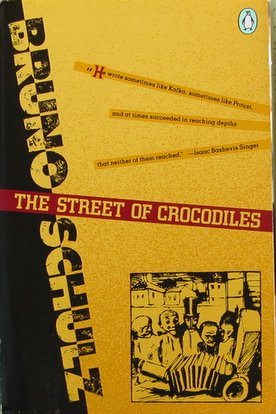
The Street of Crocodiles is a collection of semi-autobiographical short stories (or novel, depending on who you talk to) originally published in 1934 under the title Cinnamon Shops, set in the small town of Drohobycz in southern Poland, where Bruno Schulz, its author, lived his entire life. The collection quickly won the Golden Laurel of the Polish Academy of Letters. Schulz died in 1942, at the age of 50, gunned down in the street by an SS agent. No one knows where he was buried. An unfinished manuscript titled The Messiah that he was known to be working on was either destroyed or lost.

The description "semi-autobiographical short stories" seems a misnomer. "My soul sings of metamorphoses," Ovid tells us; Schulz's does as well. An uncle can become an electric bell. A calendar can "grow a thirteenth freak month," one that is "a hunchback month, a half-wilted shoot, more tentative than real." A father can transform into a cockroach, one that merges completely with the "crazy black zigzag of lightning" that pours from the cracks and chinks in the floor; a bird; a miracle worker, a "fencing master of imagination," and a grand heretic pontificating on the need for a second race of men "in the shape and semblance of a tailor's dummy." In short, the surreal permeates this more mythologized than remembered year of childhood, waging war, as the father did, as Schulz himself does, "against the fathomless, elemental boredom that strangled" their lives and their town. Banality is the true evil, the commercial Street of Crocodiles, for Schulz's characters. The cinnamon shops, as a counterpoint, represent the exotic, the extraordinary, the fantastic.

Schulz wrote in a letter to a friend: "It seems to me that the world, life, is important for me solely as material for artistic creation. The moment I cannot utilize life creatively--it becomes either terrible and dangerous, or morally vapid for me."

As someone who constantly found faces and creatures in linoleum patterns and knotty pine paneling while growing up, I delighted in passages such as this:

"Who knows," he said, "how many suffering, crippled, fragmentary forms of life there are, such as the artificially created life of chests and tables quickly nailed together, crucified timbers, silent martyrs to cruel human inventiveness. The terrible transplantation of incompatible and hostile race of wood, their merging into one misbegotten personality.

"How much ancient suffering is there in the varnished grain, in the veins and knots of our old familiar wardrobes? Who would recognize in them the old features, smiles, and glances, almost planed and polished out of all recognition?"

and I marvelled at the mind who could create a character who would glorify matter and creativity in such a provocative, perverse manner:

"Deprived of all initiative, indulgently acquiescent, pliable like a woman, submissive to every impulse, it is a territory outside any law, open to all kinds of charlatans and dilettanti, a domain of abuses and of dubious demiurgical manipulations. Matter is the most passive and most defenseless essence in cosmos. Anyone can mold it and shape it; it obeys everybody. All attempts at organizing matter are transient and temporary, easy to reverse and to dissolve. There is no evil in reducing life to other and newer forms. Homicide is not a sin. It is sometimes a necessary violence on resistant and ossified forms of existence which have ceased to be amusing. In the interests of an important and fascinating experiment, it can even become meritorious. Here is the starting point of a new apologia for sadism."

(Also interesting in light of that passage is knowing that Schulz, who made his living as an art teacher in a high school, often drew himself in positions of submission and humiliation with women.)

This is a book read for its poetic language and imagery. I'm looking forward to reading Sanatorium under the Sign of the Hourglass, which continues the story of Schulz's family, and then returning to Street of Crocodiles; I don't believe I can possibly grasp all that Schulz intended on a first (or second attempt); it's much too rich.

I was cautiously happy to discover that The Drawing of Bruno Schulz was in our library (I say cautiously because I was afraid the masochism alluded to in articles about Schulz might be a little more than I could stomach--that didn't prove to be the case).

I learned that Schulz made a series of drawings to illustrate Cinnamon Shops and considered placing woodcuts within the text as was done in the early 19th century, but the collection was published without embellishment to keep production costs down. Schulz glued his original drawings into a copy of the book and presented it to his friend, the Polish novelist Zofia Nalkowska, who had first brought Cinnamon Shops to the publisher's attention. Unfortunately, this copy of Cinnamon Shops was destroyed. Schulz's pen and ink drawings were included in Sanatorium under the Sign of the Hourglass when it was published three years later; stories and illustrations from the work were published in magazines as well.

Schulz began mailing manuscripts, letters, engravings and drawings from the ghetto in Drohobycz to others elsewhere Poland who he considered under less threat from the Nazis mere months before he was killed. Most of the work that survived has been gathered at the Museum of Literature in Warsaw. Much was undoubtedly destroyed, but there's still a possibility that some of his lost material will still be recovered.

Below are two illustrations from Sanatorium:

Father Jacob, at times dead or transformed into a cockroach in The Street of Crocodiles, is alive (or in limbo) in Sanatorium, as are the other main characters. Here he is, flying over a table, in a story called "Eddie."


And here's Joseph, the narrator, with his father in a sketch for the story "Spring." The automobile-telescope that's on the cover of the most recent edition of The Street of Crocodiles --the one I believe most of us have--is also from Sanatorium.

My apologies for such a choppy post--I hab a cold and wondered for awhile if I'd manage one at all.

(Cross posted at pages turned)

The Street of Crocodiles

I have very mixed feelings about this book; at times I hated it and at others I laughed or admired the writing or felt I could appreciate what Schulz was doing. Sometimes I was horrified by it.

It’s a series of short stories, sort of — I think of the chapters as being on the boundary line between stories and sketches. Some of them actually told a story with a plot, while others were more descriptive, without much, or any, narrative. They are about a young boy’s family and his city; I think we are safe in assuming that the main character is at least partly based on Schulz himself.

These stories are often fantastical. They might start off in a realistic mode, but most of them eventually veer off into the dream-like and the impossible. I wasn’t expecting this, and so I spent a lot of time figuring out what Schulz was doing and how I supposed to approach his stories. I found the reading experience to be disorienting — which isn’t a bad thing, really, although it wasn’t purely pleasure, either. As I was describing the stories to the Hobgoblin, he asked if they might be called “magical realism,” and I thought not, because to me magical realism is more about describing the fantastical or the magical as though it were real — to treat it matter-of-factly — when what Schulz does is the opposite; he takes the real and makes it strange and otherworldly.

My favorite chapters were the ones that had more narrative, such as “Birds” or “Cinnamon Shops.” The more descriptive chapters drove me crazy; I felt like I was drowning in Schulz’s incredibly dense language. As I look over the book trying to find a passage to show you what I mean, I realize that this isn’t bad writing really, not bad in the sense that Schulz loses control of it and his meaning gets away from him. Here’s an example:

Once Adela took me to the old woman’s house. It was early in the morning when we entered the small blue-walled room, with its mud floor, lying in a patch of bright yellow sunlight in the still of the morning broken only by the frighteningly loud ticking of a cottage clock on the wall. In a straw-filled chest lay the foolish Maria, white as a wafer and motionless like a glove from which a hand had been withdrawn. And, as if taking advantage of her sleep, the silence talked, the yellow, bright, evil silence delivered its monologue, argued, and loudly spoke its vulgar maniacal soliloquy. Maria’s time — the time imprisoned in her soul — had left her and — terribly real — filled the room, vociferous and hellish in the bright silence of the morning, rising from the noisy mill of the clock like a cloud of bad flour, powdery flour, the stupid flour of madmen.

I’m fine with the passage for the first two sentences, and even the third, although I do wonder what kind of “chest” Maria is lying in. I like the description of her as “white as a wafer and motionless like a glove.” Then we get the silence talking, and I feel like we’re entering into deeper waters, but I like the idea of silence talking, and even arguing and being loud. The last sentence begins to lose me, though — Maria’s time is filling the room? I sort of get it, if I stretch a bit. I like the image of the cloud of flour filling the room, but why the “stupid flour of madmen”? This book is full of language you can struggle with for a long time, if you want. Or, I suppose, you can refuse to struggle with it and just let it wash over you.

The sections that describe the father were the most powerful; it was these sections that horrified me. He goes back and forth between sanity and insanity, and during his insane times, he does things like keeping a flock of birds in the attic and crawling across the floor like a cockroach. And the family can’t really do anything about it. They often act as though he’s not there, as though there weren’t a completely insane man living in their midst. I wonder if some of the book’s mixing of fantasy and reality is the boy’s response to his father’s madness; in the world the boy lives in, how is he supposed to distinguish what is real and what is not? What does he have to hold on to that’s solid and certain?

The Street of Crocodiles

Cross-posted at So Many Books


Where to begin in writing about The Street of Crocodiles by Bruno Schulz? It is a beautiful and amazing book filled with joy and sorrow, mystery and wonder. It is poetry disguised as prose. It is imagination changing the everyday into something more.

The book is composed of stories told by a boy about his family and life. The central character in the boy's life is his father, a merchant who sells fabric that, in the story of "The Night of the Great Season," turns into a natural landscape as shoppers call for, unroll, and drape fabric on themselves and around the shop. The father, we are given to believe, is also not quite sane. He disappears for days in some part of the house and no one misses him until he turns up looking smaller, and then they all realize he's been gone. But oh, how I love this father character who discourses on the genesis and rights of tailors' dummies and raises exotic birds in the attic. Everyone thinks him daft, but the boy later comes to realize something else:
Only now do I understand the lonely hero who alone had waged war against the fathomless, elemental boredom that strangled the city. Without any support, without recognition on our part, that strangest of men was defending the lost cause of poetry. He was like a magic mill, into the hoppers of which the bran of empty hours poured, to re-emerge flowering in all the colors and scents of Oriental spices. But, used to the splendid showmanship of that metaphysical conjurer, we were inclined to underrate the value of his sovereign magic, which saved us from the lethargy of empty days and nights.
Magic and poetry fill this book. And always there is the father who is engaged in an argument with God:
But at night these voices rose with greater passion. The demands were made more clearly and more loudly, and we heard him talk to God, as if begging for something or fighting against someone who made insistent claims and issued orders.
This argument might have something to do with creative will:
For too long the perfection of his creation has paralyzed our own creative instinct. We don't wish to compete with him. We have no ambition to emulate him. We wish to be creators in our own, lower sphere; we want to have the privilege of creation, we want creative delights, we want--in one word--Demiurgy.
As the father's curiosity and experiments and ideas get wilder and wilder, the family reaches a point when they can't take it any longer:
It was not because there was no grain of truth in Father's discoveries. But truth is not a decisive factor for the success of an idea. Our metaphysical hunger is limited and can be satisfied quickly. Father was just standing on the threshold of new revelations when we, the ranks of his adherents and followers began to succumb to discouragement and anarchy...we were fed up with miracles and wished to return to the old, familiar, solid prose of eternal order. and Father understood this. He understood that he had gone too far, and put a rein on the flights of his fancies.
One of the many things I loved so much about this book is the fantastic descriptions and events that suddenly take flight from mundane reality. One of my favorite of these is in the story "The Gale" where the wind as it gathers up its forces and fury is partly described thus:
There, in those charred, many-raftered forests of attics, darkness began to degenerate and ferment wildly. There began the black parliaments of saucepans, those verbose and inconclusive meetings, those gurglings of bottles, those stammerings of flagons. Until one night the regiments of saucepans and bottles rose under the empty roofs and marched in a great bulging mass against the city.
Brilliant writing, this. You will guaranteed find nothing even vaguely approximating a cliche in this book.

I feel as though I have quoted too much, but I couldn't help myself. I read this book for the latest Slaves of Golconda discussion. You can read what the other Slaves thought in one convenient location, and either eavesdrop at the forum at metaxucafe or, better yet, give your two-cents worth.

Monday, January 29, 2007

Bruno Schulz: Three Self-Portraits

A reminder that we'll begin discussing Schulz' The Street of Crocodiles on Wednesday.


ca. 1919


ca. 1920


ca. 1920

(Artwork taken from The Drawings of Bruno Schulz, edited by Jerzy Ficowski, and published by Northwestern University Press.)

Saturday, November 11, 2006

Manumission

The surest way to incite revolt is to neglect one's slaves. I haven't driven any of you nearly hard enough, and so have failed as a good slavedriver. Though I enjoy this endeavor, I find it difficult to keep up in the manner fitting--see how the blog still mentions HG Wells as the current read. Therefore you are all granted your freedom. I hope to continue to participate, and that the group may carry on in the same manner. What I will do, then, is to grant administrative functions to the Slave who is making the next book selection, so that Slave may remodel the blog accordingly, with updated links and all the decorative stuff that should rightfully appear in the sidebars. Be crazy and make it your own! SFP, the whip is now in your hands.

Thanks all for your good service. We will meet again in January on the Street of Crocodiles. Now go and be free.

Friday, November 03, 2006

A modern classic next time?

I've been tagged by Danielle for the next Slaves selection, but before I throw out a few titles for the group's consideration, I wanted to say that I hope we can modify our schedule and put off discussion until late January instead of at the end of December. That would give us all time to make some headway with our own out-of-control reading lists between now and the end of the year, and maybe, possibly some of our errant members or others who'd like to read along with us for the first time will resolve to take part if they have a bit more time to plan for it.

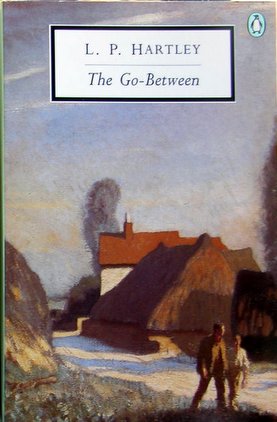
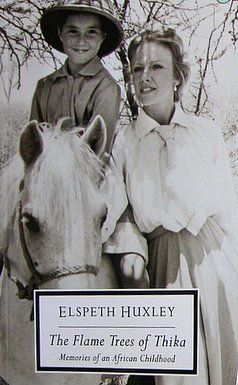
At any rate, there are three books I'd enjoy reading with the group: Bruno Schulz's The Street of Crocodiles; L.P. Hartley's The Go-Between; and Elspeth Huxley's The Flame Trees of Thika. I assume we're all considering taking part in the Classics Challenge in January and February, and any of these titles count would count toward that as a modern classic.


The Street of Crocodiles is a novella by a Polish writer who was killed by the Nazis during WWII. If you're a fan of Calvino or Garcia Marquez, if you like your stories Kafkaesque, if you're in the mood for something poetic and odd, then this appears to be your baby. I've wanted to read it since Nicole Krauss referenced it in The History of Love last year.

First paragraph:

In July my father went to take the waters and left me, with my mother and elder brother, a prey to the blinding white heat of the summer days. Dizzy with light, we dipped into that enormous book of holidays, its pages blazing with sunshine and scented with the sweet melting pulp of golden pears.


The prologue to The Go-Between begins with a line I'm sure you've heard before: The past is a foreign country: they do things differently there.

An old man looks back half a century to the adolescent summer that changed the course of his life. Proustian memories triggered by the unearthing of an old diary. The loss of innocence at the height of Empire. An Ian McEwan plot and an Evelyn Waugh setting. The Heinemann Foundation Prize of the Royal Society of Literature and an internationally successful film.

'Has the twentieth century,' I should ask, 'done so much better than I have? When you leave this room, which I admit is dull and cheerless, and take the last bus to your home in the past, if you haven't missed it--ask yourself whether you found everything so radiant as you imagined it. Ask yourself whether it has fulfilled your hopes. You were vanquished, Colston, you were vanquished, and so was your century, your precious century that you hoped so much of.'

Elspeth Huxley's family moved to Kenya when she was six to start a coffee plantation.

We were going to Thika, a name on a map where two rivers joined. Thika in those days--the year was 1913--was a favorite camp for big-game hunters and beyond it there was only bush and plain. If you went on long enough you would come to mountains and forests no one had mapped and tribes whose languages no one could understand. We were not going as far as that, only two days' journey in the ox-cart to a bit of El Dorado my father had been fortunate enough to buy in the bar of the Norfolk hotel from a man wearing an Old Etonian tie.

Have any of you already read this memoir? I can't remember. I read Huxley's novel Red Strangers a couple years back and loved it.

Leave your preferences in comments.

Monday, October 30, 2006

Not an Indiana fan

Judging from everyone else's reponse, I appear to be the only one who did not like Indiana. I started the book convinced that I'd enjoy it immensely--George Sand! At last!--but I quickly grew so annoyed that I never would have finished if it hadn't been for the Slaves.

Sand's prefaces inform me that the novel is about societal oppression of the individual, the injustice of marriage laws, and can be regarded as a way of fighting against the public opinion that slows the modification of these. Well, yes. Indiana is sorely oppressed--she's had no education and she's married off to a much older man whom she detests-- and society turns against her when she attempts to leave her husband for the silver-tongued devil who's stolen her heart. But I evidently require my fictional victim of society to make more of an attempt to better her lot in life than Indiana can manage. Indiana's primary problem is she lives long before she can be prescribed a lengthy course of antidepressants. Her depression is the true oppressor, and it appears to be genetic in origin, since her cousin Ralph's solution to problems usually involves an attempt at suicide.

And since I've brought up the subject of suicide, may I just say how weird I found Ralph and Indiana's great plan to end their lives? They hit upon the notion in Paris, travel by slow boat to Bourbon Island, and it never once crosses either of their minds during all this time that the "angel of Abraham and Tobias" does not condone suicide, that the eternity they plan to spend together is not going to be "in God's bosom." I'm assuming based on the mention of Tobias that they are Catholic; depression is clearly preventing them from thinking the least bit clearly.

And sometimes I wonder just how clearly Sand was thinking. At times Indiana seems lacking in inner consistency. We begin the novel believing M. Delmare, Indiana's husband, to be very abusive and violent; she begs him not to kill Ralph's dog when he complains that the dog needs to be put outside in the kennel: "Had anyone then observed Madame Delmare closely, he might have guessed the painful secret of her whole life in the trivial, commonplace incident." Yet later much time is spent establishing that Indiana could have had total control over her husband if she'd made the least effort to do so. By the time M. Delmare finds and reads Indiana's cache of love letters from Raymon, I'd begun to feel rather sorry for him. He's gruff and possibly verbally abusive, but he's clearly never even had relations with his young wife (why couldn't she have her marriage annulled, by the way? Was this simply not done in France at the time?) and suffers from so many ailments of the old and afflicted, that I was rather inclined not to find his subsequent act of violence against Indiana nearly as horrific as I expect I ought to have done. Dementia patients aren't held accountable for their violent outbursts in the same way a younger person's would be, and when M. Delmare collapses and dies soon after, I felt a bit sorry for him. He'd been acting childish for quite some time.

Indiana is described as such a wet noodle that I was surprised when she's presented as an enthusiastic hunter: how can she gallop and presumably jump a hunter (an unknown one at that) when she's so weak and frail? And if she's such an expert, why ever was she so disturbed that her husband had killed a hunting dog (that she wasn't fond of) when it proved unmanageable? We learn a lot about the characters on the hunt, and M. Delmare's fall provides an opening for Raymon to ingratiate himself into the family, but this is the point when I really wanted to abandon the book--why couldn't Sand have established earlier that Indiana loved to ride, it wouldn't have taken more than a sentence or two to do so. I lost confidence in her here.

And why are we supposed to believe in the narrator, when it is finally revealed to us who the narrator is? Raymon's thoughts and motivations, the same as Noun's, could never be known by such a narrator, nor from the character who told the story to him. Much of the story we've been told is undermined by revealing who the narrator is, yet I don't believe we're meant to regard him as unreliable.

I don't believe I'll be reading any more George Sand, but I feel like such a philistine since everyone else liked this one!

(Cross posted at pages turned)

Sunday, October 29, 2006

Cross posted at A Work in Progress

To truly appreciate George Sand's novel, Indiana, I feel as though I need to have read at least some of Balzac's novels as well as some of Sand's later works, have some background knowledge of French politics and society ca. 1830, knowledge of realist French literature, and a basic understanding of Freudian theory (sheesh this man pops in literature all over the place...I must read up on him, I guess). Well, upon reading the introduction to the novel and some criticism, I feel that way anyhow. What you would think is simply a novel of romance and betrayal has so many undercurrents and themes running through it, it is leaving my head spinning. I wish I could say now I am going to annotate these various subjects to you, in easy understandable prose, but alas, I don't think I am entirely up to that. I couldn't even find a decent picture of Bourbon Island to snatch and share with you here (where part of the novel is set).

So, instead, let me tell you a little bit about this thin little novel. I will try not to give too much away, but if you plan on reading Indiana, beware of possible spoilers.

Indiana is a young woman, born on Bourbon Island and married off to a much older man (your basic loveless marriage). I'm not sure what happened to her mother or her father, but she has been raised primarily by an older cousin, Ralph. She also is very close to Noun, her maid, who was raised alongside her. Both are Creoles. When we meet Indiana she is living in France with her husband and the phlegmatic (as he is described in the book), Ralph. There is an intruder on the estate--M. Delmare (Indiana's husband) goes off to investigate and perhaps "do away" with the villain. The villain, wounded, is brought into the house--enter stage left, Raymon--our seducer. Not to worry. Surely he is no villain. He gives a rather corny excuse as to why he was there, but really he is their aristocratic and very attractive neighbor. Shall I tell you why he really was there? He doesn't just seduce Indiana, he has already done the dirty with her maid. Indiana doesn't know this, and by the time she finds out, it is already too late and she will be in love with him. It took me until the end of the novel to figure out (and later confirm in the introduction) that Indiana actually remains virginal all the way to the end.

What I found interesting about this novel was the "mirroring" of themes--(thanks to Litlove for the heads up). Indiana and Noun are almost twins/two parts of a whole.

"Noun was Madame Delmare's 'milk sister'; brought up together, these two young women loved each other tenderly. Noun was tall, strong, beaming with health, alert, and full of ardent, passionate Creole blood; her shining beauty eclipsed the pale and frail charms of Madame Delmare; but the goodness of their hearts and the strength of their mutual attachment eliminated all feeling of rivalry."

According from my extra readings that is not the only parallel. Indiana and Ralph are considered "doubles" as well. Ralph, M. Delmare and Raymon are considered a set and the mirror of them is Indiana, Noun and Laure de Nangy. How does an author fill one small novel with so much "stuff"? Do they set out to do this intentionally? Or is it the critics who later dig it all up pick it apart and infuse the meaning they think they see? Sand didn't have the benefit of Freud to know some of this stuff, but I guess whatever it is that we all have swimming around in our subconscious is there (we just don't know about it). I didn't like the idea that Indiana and Ralph's coming together at the end was considered incestuous. I know he was meant to be brother-like throughout much of the novel, but they weren't really, so I'd rather not go there. And I haven't even mentioned the whole theme of marriage and subjugation of women in this enterprise (I can't leave out the feminists). You see, there is simply too much to tackle in one short post.

But I can say I enjoyed this novel. I might have eventually read Sand, but then again I might not have gotten around to reading her anytime soon. I thought she would be a good choice for the Slaves to read and discuss, and it seems like there will be lots to discuss! I liked the character, Indiana, but why do women always fall for these jokers? I suppose he seemed decent enough. The reader got to see his other side, and every time I would just shake my head! I am glad that it didn't end badly, as I suspected in that last chapter. And I agree with Stefanie about poor Ophelia. I hate it when authors let bad things happen to animals! You can read more about Indiana here! And maybe there will be discussion here (not sure how we get a forum set up?)?

Selfish

Cross-posted at So Many Books


What a whirlwind of a book Indiana is! Illicit love, running away, suicide, silent suffering and more. The book is about a lot of things but what sticks with me most is the selfishness. All the characters are selfish in one way or another and they all suspect each other of it but never themselves. The only one who is honest about his selfishness is M. Delmare. He admits it pretty early in the book when arguing with Sir Ralph:
I'm selfish; that's well known. I've got used to not being ashamed of that any more and, after analysing all the virtues, I've discovered self-interest to be the basis of them all. Love and devotion, which are apparently two generous emotions, are perhaps the most self-interested of all, and patriotism is no less, you may be sure. I've no great love for mankind, but I wouldn't want to make that obvious for anything in the world; for my fear of men is in proportion to the little esteem I have for them. So we're both selfish, but I admit it and you deny it.
M Delmare doesn't know how he has hit the nail on the head with this one. Sir Ralph has been secretly in love with Indiana since they were children. He considers his silent devotion all for her benefit. But Indiana describes Ralph's character to Raymon at one point as selfish. Raymon too is described as an egotist (selfish) on several occasions. His wooing of Indiana is nothing but selfish. He claims to love her but what he really loves is the conquest and is even called a "Lovelace" at one point.

The only one never considered selfish is Indiana, but I think she is the most selfish of all. She is not an educated woman but she is not stupid. She is nineteen, married to a man twice her age and supremely unhappy. She wants nothing more than to die so as to end her suffering. She is always ill and on the brink of death but makes a remarkable recovery when something of interest to her happens. Sir Ralph plays along with her illness which only encourages it. M. Delmare is highly annoyed by it, doesn't understand it but doesn't know what to do about it other than be gruff and force Indiana to do things she doesn't want to.

There is nothing more selfish than suffering unnecessarily, dragging all who are around you down with you. If Indiana is not suffering from illness she is suffering for the love of Raymon. She is pulled along by "the magnetic power of suffering." The thing is, it doesn't have to be this way. Indiana makes herself suffer needlessly. If she showed as much spirit with M. Delmare as she does with Raymon, she'd have her husband wrapped around her finger, "but Indiana was disheartened by her lot; she made no effort to try and make it better."

Emerson says, "the selfish man suffers more from his selfishness than he from whom that selfishness withholds some important benefit." The story of Indiana seems to prove that. Ralph and Indiana end up with the best lot. Even so, they are still selfish, living like hermits and spending their money on freeing slaves as though that will atone for everything.

George Sand's Indiana

I liked this book very much; unfortunately, I wasn't in the mood to focus closely as I read it or to take notes or even gather my thoughts much about it as I read, so I won't have a long or particularly intelligent post.

But I do recommend it if you haven't read it and are interested. It's a good story, and it takes up a lot of interesting ideas, chief among them, for me, about women's lot in a society run by men. Indiana doesn't get a great education and she doesn't have much experience in the world. A lot of what she learned about matters such as love and marriage come from novels -- always a sign of danger to come. It is a long and venerable tradition to use a novel to warn against novel reading.

She is married at 16 to an older man so she has no time to explore life and look around her as an adult. She lives in a time when emotional displays are valued in women, but rationality is not; Indiana seems not to have had the opportunities to develop her mind and the male characters seem lacking in the ability to value emotion. How is she to judge Raymon when he comes along? How is she to know she should stay far, far away? She has no real grounding from which to make sense of her situation.

And what an odd situation it is. She is married to Colonel Delmare, a jealous and violent man; she is watched over by the reserved and mysterious Ralph, a childhood friend; and she is pursued by the charming but untrustworthy Raymon. Her closest female friend dies early in the novel, leaving her quite alone. So the men vie for her attention and she falls for Raymon, not realizing that he is incapable of returning her love. The novel becomes the story of Indiana slowly making that realization -- that she is a much better, stronger person than the one she loves -- and dealing with the consequences.

I was shocked at the descriptions of Delmare's violence toward Indiana. This struck me as a harsher, more direct condemnation of men's power over women than I'm used to seeing in novels of the time period. Stefanie pointed out the horrifying scene when the dog Ophelia is brutally killed, and I think you can see this as an echo of what happens to Indiana herself -- she is portrayed as an innocent creature brutally struck down by a cruel world.

Ralph is an odd character, with his perfectly impassive face and his seeming heartlessness, although we learn by the end of the novel that seeing him as heartless is a mistake. But through most of the novel he hovers about, shadowing Indiana and rescuing her repeatedly, but not making clear his intentions or his role until the novel's end. And what makes Ralph an even odder character is his semi-incestuous relationship with Indiana. He's described as being her brother, her guardian, and her lover. In this sense, I'm not sure what it means that Indiana ends up with him at the end -- has she found her true love, or has she settled for something more familiar and calm and safe?

I understand that the novel's ending is controversial. The question seems to be whether we should see Indiana as subdued once again by the patriarchy -- she seems lifeless and spiritless at the end -- or whether this is actually a hopeful ending, illustrating how one woman escaped from the two men who caused her so much pain and established a comfortable life devoted to helping others. For she and Ralph decide to spend their time and energy and money buying the freedom of slaves.

I feel conflicted about this. It was my impression as I read that Indiana's voice and energy were written out of the text; in the final pages Ralph tells her story and all she seems to do is retire early to bed. This didn't seem like the Indiana of the earlier part of the novel. On the other hand, though, she has escaped, and, most importantly, escaped alive and she will live on to affect the lives of many people -- those slaves that she and Ralph are working to free. We are led through the novel to expect her death and to see death as her only option, but the novel's final word thwarts this expectation.

I'll be curious to see what others have to say about this.

Saturday, September 02, 2006

Slaves to Read Indiana Next...


Stefanie tagged me to choose the next book that the Slaves of Golconda will be reading. I posted a few reading possibilities recently, and in the end drew George Sand's Indiana out of a hat. Of course I always agonize over decisions like this. It isn't just a case of I hope I will like the book, but I am choosing something that others will read as well. Will everyone like it? Will it be a good book for discussion? The only guideline is that we have been reading classics each time around. Since we have had a good share of male authors lately, I thought it was time to read a woman author, and I had wanted it to be an international author as well (non-American, and non-British--since we have concentrated on these types books).

So it is with some trepidation that I announce the Slaves will be reading Indiana by George Sand! According to 500 Great Books by Women (a wonderful reference book by the way):

"Indiana is the first of many novels written by George Sand, a woman whose
behavior was often considered more shocking than her writing. Seen as a
denouncement of marriage when it was published, the novel is the story of a
naive, love-starved woman abused by her much older husband and deceived by a
selfish seducer."

Shall we say posts will be due October 29? Of course anyone is welcome to read along. The text of Indiana is available online here and post about the book and discuss--please consider it!. There is still a lively discussion going on at The Metaxu Forum over our latest book by H.G. Wells. You can also read individual posts on the book at The Slaves of Golconda blog.

Thursday, August 31, 2006

It was the wantonness that stirred me

When I was pregnant with my son I developed preeclampsia. The doctors determined that they'd have to take him out two months early if either of us were to make it.

He spent his first month in a neonatal intensive care unit across town before being transferred to the hospital closest to us until he'd gained enough weight to leave hospitals altogether. A NICU is, of course, a miraculous place of care and compassion, but it is also a place where much pain is experienced.

S. fought against a respirator that insisted on forcing breath in and out at a rate to which his body didn't want to conform; with his face contorting in silent screams, he was continually pricked and poked for blood samples, then transfused with fresh blood when he couldn't make enough to keep up with the amount taken (the scars on his wrists and ankles from the blood-taking did not fade away for more than a decade afterwards). Repeat.

Wired, tubed, and for several days blindered, he suffered. The painful procedures continued until eventually we--doctors, nurses, parents-- could tell that he was not only going to survive, but thrive.

Not all the babies did. There were those of two or three years of age, still in no shape to live outside NICU, abandoned by their parents, depending upon volunteers and scraps of time from the nursing staff for a bit of human contact. And there were several who lasted mere hours or days before they died.

A nurse caught me finger-stroking S.'s tiny arm on one of my first trips to the NICU. Did I not realize how much pain I was causing him? she snapped. Because he had no fat stores, the lightest touch was an assault to the nerve endings just underneath his skin. She taught me to cup my hand around him and to keep it still.

A couple weeks later I saw a new mother stroking her baby the way that I had. I waited for a nurse to correct her, but no one said a word. I knew then that her baby was going to die. No one was going to deny her the bit of comfort she could gain from touching him, even if her touch caused him distress, because these moments with the baby were going to be all that she had.

As you've maybe gathered by such an introduction, I responded to The Island of Doctor Moreau on a very personal level. If a person, if an animal, is to suffer by someone's hands in a House of Pain, it had better be for a damned good reason.

Moreau, well regarded in scientific circles in London prior to the publication of a pamphlet that exposed his cruel methods of vivisection, left England for a private island in the Pacific where he could continue his experiments outside the strictures of society. By cutting and mutilating and grafting he molds an assortment of animals into a tribe of Beast People, teaching them rudimentary language and a form of religious law designed to keep them under his control even after he has turned them out for retaining undesired animal characteristics. Imperfection really bums the man out.

Each time I dip a living creature into the bath of burning pain, I say: this time I will burn out all the animal, this time I will make a rational creature of my own.

Moreau isn't driven to mold animals into human shapes out a desire to help either man or creature, but merely because he wants "to find out the extreme limit of plasticity in a living shape." Ethics are not of interest to him: "The study of Nature makes a man at last as remorseless as Nature," he claims. Pain is immaterial; it is animalistic; intellectual desire transforms others into problems to be solved, nothing more or less.

Doctor Moreau is, in short, as psychopathic as they come despite the god-like appearance and demeanor that Wells has given him.

Edward Prendick, our narrator, is no match for him. Because Prendick, a shipwrecked gentleman taking shelter on Moreau's private island, has dabbled in natural history and studied biology under the famed T.H. Huxley, Moreau eventually reveals the truth about his experiments to someone he assumes can appreciate them and will henceforth stop hindering his work due to silly behavior. Instead Prendick is horrified, but offers weak and minimal objection. He reminds me of a journalist who lands an exclusive interview and then is afraid to ask any follow-up questions to the canned nonsense he's given. Time and again I wished the narrator were someone like Patrick O'Brian's Stephen Maturin, someone who both understood the science and was willing to argue the ethics of a situation, to insist that being human means behaving humanely toward those not on your level. Someone who could at least read the Greek and Latin classics shelved near his hammock instead of revealing yet another skill he's lacking.

Poor brutes! I began to see the viler aspect of Moreau's cruelty. I had not thought before of the pain and trouble that came to these poor victims after they had passed from Moreau's hands. I had shivered only at the days of actual torment in the hands. But now that seemed to be the lesser part. Before they had been beasts, their instincts fitly adapted to their surroundings, and happy as living things may be. Now they stumbled in the shackles of humanity, lived in a fear that never died, fretted by a law they could not understand; their mock-human existence began in an agony, was one long internal struggle, one long dread of Moreau--and for what? It was the wantonness that stirred me.

Had Moreau had any intelligible object I could have sympathized at least a little with him. I am not so squeamish about pain as that. I could have forgiven him a little even had his motive been hate. But he was so irresponsible, so utterly careless. His curiosity, his mad, aimless investigations, drove him on, and the things were thrown out to live a year or so, to struggle and blunder and suffer; at last to die painfully. They were wretched in themselves, the old animal hate moved them to trouble one another, the Law held them back from a brief hot struggle and a decisive end to their natural animosities.

In these days my fear of the Beast People went the way of my personal fear of Moreau. I fell indeed into the morbid state, deep and enduring, alien to fear, which has left permanent scars upon my mind. I must confess I lost faith in the sanity of the world when I saw it suffering the painful disorder of this island. A blind fate, a vast pitiless mechanism, seemed to cut and shape the fabric of existence, and I, Moreau by his passion for research, Montgomery by his passion for drink, the Beast People, with their instincts and mental restrictions, were torn and crushed, ruthlessly, inevitably, amid the infinite complexity of its incessant wheels.


I'd like to read more H.G. Wells and I intend to return to this one again as well, possibly in a few weeks with S. My response to it next time may not be quite as visceral. Perhaps I'll see Prendick in a more appreciative light; he does makes an excellent narrator even though his passive nature infuriated me on my first reading.

(Cross posted with pages turned)

Next Book Possibilities...

Although we are in the middle of discussing The Island of Dr. Moreau still, Stefanie has tagged me to choose the next book, and I thought I would throw out a few reading suggestions for next time around for everyone to think about. Since we seem to have read mostly male authors, I thought I would suggest a few female authors. I took a peek through 500 Great Books by Women: A Reader's Guide and found many wonderful books, however many are out of print or hard to find. I highly recommend this book if you don't mind searching for some of the lesser known titles. I added a couple of authors that are more contemporary to my list, which I found in the book, as well as older classics. In no particular order:

I had thought about adding Marguerite Duras to the list, but most of her fiction appears to be out of print here (except The Lover, which is a very slender book and would be quick to read--I had thought of The Vice Counsel with The Lover being extra credit, but oh well).

Originally I was just going to choose international women authors, but was I not looking in the right place? I can't seem the find many foreign classics by women (not contemporary authors)--is not that much translated. There seem to be plenty of male authors out there in translation. Any thoughts?

Cross-posted at Slaves of Golconda

I was talking to my father the other day about invention. From the beginning of history, people conducted their lives in similar ways. For thousands of years, news traveled the same way, wars were fought the same way, food was cooked the same way. Then in the mid-1800s, the world changed. People went to sleep one dreamfilled night in what could have been 1625 and awoke to a world that they didn't recognize. Trains, the telegraph and later indoor electricity. The Victorians were on the doorstep of the modern world. They were the first through the door. And the advent of modern science was the umbrella that covered their contemporary lives.

Yes, Darwin changed the way people thought of humans and therefore thought of themselves. His studies allowed for people to begin experiencing life like never before. Dimensions to worlds unknown opened up. Seances and spiritualism became common. Victorians were expanding their spiritual and religious realm. If what they thought about themselves had been altered by science, then maybe what they thought or knew of the dead and the soul, was different as well.

But it was writers like H.G. Wells, that uncovered hidden truths in them all. Writers like Wells made readers and the public rethink what it was to be human. Not just how they thought, but how the felt. The emotional turmoil pervading society had to be a sort of shell shock. If humans came from apes, then what does that do to our sense of who we think we are? Do we feel like humans? What does that even mean? Or could we be nothing more than wild creatures that wear clothing? What truly distinguishes us from 'them.'

Reading The Island of Dr. Moreau, these were the questions I was dealing with, repeatedly returning to. Rationalization is not the only thing that seperates us. Neither is knowledge or conscience. It must be all.

The narrator of Moreau, Prendick writes, Yet I felt an absolute assurance in my own mind that the Hyena-Swine was implicated in the rabbit-killing. A strange persuasion came upon me that, save for the grossness of the line, the grotesqueness of the forms, I had there before me the whole balance of human life in miniature, the whole interplay of instinct, reason, and fate in its simplest form.

These animal-human hybrids are humans in Prendick's estimation. Their ability to reason has changed them and has made them all too human like. However, I wonder if it was their strange mutation into human like beings that gave them reason or if they had always had reason and were now only able to communicate it. I fall into believing the latter in this case. Moreau had partly succeeded in his dungeon of science.

Prendick's experience on the lost island of mutation and vivisection, changed his way of feeling. It certainly changed the way he thought and what he thought about. Everything he thought he knew before, was turned upside down. He was left grasping.

I fell indeed into a morbid state, deep and enduring, alien to fear, which has left permanent scars upon my mind. I must confess I lost faith in the sanity of the world when I saw it suffering the painful disorder of this island.

A blind fate, a vast pitiless mechanism, seemed to cut and shape the fabric of existence, and I, Moreau (by his passion for research), Montgomery (by his passion for drink), the Beast People, with their instincts and mental restrictions, were torn and crushed, ruthlessly, inevitably, amid the infinite complexity of its incessant wheels. But this condition did not come all at once...I think indeed that I anticipate a little in speaking of it now.


This sentiment still reverberates today. I hear it echoed in Ginsberg's infamous first lines of Howl: I saw the best minds of my generation destroyed by madness, starving hysterical naked, dragging themselves through the negro streets at dawn looking for an angry fix. There's something primitive in Ginsberg's feeling of desolation and I sense the same in Prendick's lament.

As a society, we cope with watershed changes in a myriad of ways, but we have to deal with them nonetheless. But what does it mean to feel this way? Can we always change things for the better? Should we leave life, science, nature, better left untouched? I don't know.

I leave Dr. Moreau with more questions than answers...but I prefer literature that way. It is the discoveries I make on my own that validate my experiences.

Wednesday, August 30, 2006

The Writing of H.G. Wells

In an introduction to one of our many volumes of H.G. Wells, Isaac Asimov finds the earliest examples of science fiction in Johann Kepler, Cyrano de Bergerac, Mary Godwin, Edgar Allan Poe, and Jules Verne, who popularized the genre. The biggest difference for Wells seems that he wrote at a time when the studies of science and technology were increasing, expanding, and gaining more interest and acceptance than in the past. He took many subjects that were hot topics in England and explored them, turning what was then known as scientific romances into what has become the science fiction of today. Though Verne was harshly critical of Wells' work, Wells was the more imaginative, and has proven to be the more prophetic, writer.

For extra credit, in addition to the selected title, we also read The War of the Worlds (the translucent review concerning which has previously been posted) and The Time Machine. This second novel began its existence as early as 1888, and reportedly evolved from three distinct ideas into the final form, in 1895, we know today. The distinctive elements we recognise right away are the theory of time travel, the experiences of a Time Traveler, and a future vision.

Wells begins by laying out the theory of travel through time plainly and believably by comparison to travel through space. The experiences of the Time Traveler follow, recounted to a group of friends, though as an uninterrupted narrative for the reader. The vision comes at the end, when the Time Traveler goes back to the future, and beyond, millions of years hence. Instead of the great technology-driven worlds of microchips and interstellar life, Wells discloses a shrouded desolate landscape inhabited by monstrous crustaceans that, we are led to believe, has come about by some withering of man, first into placid leisure, and then into extinction. Having progressed to conquer all challenges and losing the ability to adapt, mankind doomed itself to atrophy.

In The Island of Dr. Moreau, first published in 1896, when Wells was thirty years old, we find the contemporaneous controversy of vivisection mixed with the future controversy of gene splicing; questions in morality of experimentation on animals; the hazards of sea travel; the evils of empire; evolution and creationism; and we also find the more broader issues of religion and existence. There also is the theme of transformation similar to another of his novels, The Invisible Man. The common thread in all Wells' writing seems to be a sort of debunked utopian outlook. Is the striving to reach beyond ourselves worth the trouble?
Poor brutes! I began to see the viler aspect of Moreau's cruelty. ... Before, they had been beasts, their instincts fitly adapted to their surroundings, and happy as living things may be. Now they stumbled in the shackles of humanity, lived in a fear that never died, fretted by a law they could not understand; their mock-human existence began in an agony, was one long internal struggle, one long dread of Moreau--and for what?
Prendick, the man whose discovered narrative makes up the tale, is considering the creatures that have been born of Moreau's experimentation; yet he may also be addressing Moreau's condition: as a man, Moreau was perfectly adapted to his station in life, but in trying to understand something he could not--creation--he now faced constant fear, of his own handiwork.

The novel has much of the flavor of a writer at odds with religion. Dr. Moreau is referred to by his creatures as Him. We also watched the film version of the novel, starring Marlon Brando and Val Kilmer, in which the point is taken even further, as the creatures call Moreau Father. Prendick even thinks Moreau has hypnotised the creatures into believing he is their god. For humans today who do not understand, are they not the beasts to God's Moreau? Is God nothing but a mad scientist? The screenplay makes a few adaptations to the novel, most notably the addition of a love interest for Prendick (who is also renamed), a young woman he tries to save from reverting to beasthood, a subplot which adds nothing of substance to Wells' story. In the film, Moreau uses electical implants to control his creatures, while in the book they are heeled only by the whip and the Law--a set of rules unnatural to their beastly instincts, as precarious is the Bible and other religious tracts in restraining
men from their most natural instincts of survival: fear, flight, and fight.

At the end of the novel appears a lifeboat of the ship from which Prendick had been cast off. Inside he finds dead the captain and another man from the ship. The irony is, if Prendick had not been cast off the ship and suffered the horrors of Moreau's island, he would have died. Perhaps there is a message there, that only by facing up to the darkness of men can we hope to survive. Though Prendick has seen the worst, he also nows sees hope. Wells realised much that was horrible in human nature, yet the world's worst conflicts were still far in the future. In this and other stories, he reveals the darker shades of humanity, with hope just a glimmer of possibility. That hope is fragile, as if he wishes a better fate, but has little faith in civilization. The Island of Dr. Moreau, The War of the Worlds, and The Time Machine are works of doomsday fiction.

Though not transcendent works, these novels are interesting and thought-provoking, and in many ways remarkable when considering the time during which they were written. For a reader of broad interests ploughing through two thousand pages of A la recherche du temps perdu, some other of Wells' novels, like The Invisible Man, The First Men in the Moon, and The Food of the Gods might be quick intermissions between Swann in Love and Within a Budding Grove. We will keep those books at hand confident of a good story for when the need arises.

Not a Vacation Spot


Cross posted at A Work in Progress

For all my talk of the romance of seaside villages and deserted islands, there is one place I would not like to visit--Noble's Island. H.G. Wells created a horrific place when he wrote The Island of Dr. Moreau (as a small side note, Penguin is reissuing many of Wells's works in lovely new editions with very helpful and detailed introductions).

The story of what happened to Edward Prendick when the ship he was in collided with another and sank, and the events that followed are written down in narrative form for us to read. And a dire story it is from beginning to end. How much shall I tell you? Was Edward lucky when after many days in a boat, starving, he was picked up by the Lady Vain? And what cargo was she carrying? Poor unfortunate creatures. Edward is saved by Montgomery and nursed back to health. When the ship drops Montgomery and his animals off, Edward is forced to go with them, much to his chagrin.

He isn't going to like what he finds there. And as in every story or movie where you know there are nasty things happening, what does our trusty narrator do? For sure he goes off to investigate. Actually what initially sets him off are the cries of utter pain from an animal behind closed doors. Edward cannot take it any longer, and who can blame him. However he is in for more of an education than he bargained for when he sets off across the island in search of peace and quiet. There are the most unusual people inhabiting it. Who are they and how did they come to be the way they are? What he doesn't know is that they are not humans who have been tampered with. They were once animals that have been reconstructed in man's image.
Vivisection. It is one of those words that I have heard and imagined that I knew what it meant.


viv-i-sec-tion (viv-uh-sek-shuh n) - noun.
1. the action of cutting into or dissecting a living body.


2. the practice of subjecting living animals
to cutting operations, esp. in order to advance physiological and
pathological knowledge.


I was actually enjoying this book, frightening though it may be, up until when Dr. Moreau explained and tried to justify his actions.


“But,” said I (Edward), “I still do not understand. Where is your justification
for inflicting all this pain? The only thing that could excuse vivisection to me
would be some application—”


“Precisely,” said he. “But, you see, I am differently constituted. We are on different platforms. You are a materialist.”


“I am not a materialist,” I began hotly.


“In my view—in my view. For it is just this question of pain that parts us. So long as visible or audible pain turns you sick; so long as your own pains drive you; so long as
pain underlies your propositions about sin,—so long, I tell you, you are an
animal, thinking a little less obscurely what an animal feels. This pain—” I gave an impatient shrug at such sophistry.


“Oh, but it is such a little thing! A mind truly opened to what science has to teach must see that it is a little thing. It may be that save in this little planet, this speck of cosmic dust, invisible long before the nearest star could be attained—it may be, I say, that nowhere else does this thing called pain occur. But the laws we feel our way towards—Why, even on this earth, even among living things, what pain is there?”
As he spoke he drew a little penknife from his pocket, opened the smaller blade, and moved his chair so that I could see his thigh. Then, choosing the place deliberately, he drove the blade into his leg and withdrew it.


“No doubt,” he said, “you have seen that before. It does not hurt a pin-prick. But
what does it show? The capacity for pain is not needed in the muscle, and it is not placed there,—is but little needed in the skin, and only here and there over the thigh is a spot capable of feeling pain. Pain is simply our intrinsic medical adviser to warn us and stimulate us. Not all living flesh is painful; nor is all nerve, not even all sensory nerve. There's no taint of pain, real pain, in the sensations of the optic nerve. If you wound the optic nerve, you merely see flashes of light,—just as disease of the auditory nerve merely means a humming in our ears. Plants do not feel pain, nor the lower animals; it's possible that such animals as the starfish and crayfish do not feel pain at all. Then with men, the more intelligent they become, the more intelligently they will see after their own welfare, and the less they will need the goad to keep
them out of danger. I never yet heard of a useless thing that was not ground out of existence by evolution sooner or later. Did you? And pain gets needless.


“Then I am a religious man, Prendick, as every sane man must be. It may be, I fancy, that I have seen more of the ways of this world's Maker than you,—for I have sought his laws, in my way, all my life, while you, I understand, have been collecting butterflies. And I tell you, pleasure and pain have nothing to do with heaven or hell. Pleasure and pain—bah! What is your theologian's ecstasy but Mahomet's houri in the dark? This store which men and women set on pleasure and pain, Prendick, is the mark of the beast upon them,—the mark of the beast from which they came!Pain, pain and pleasure, they are for us only so long as we wriggle in the dust."


And then it made me a tad bit sick. You should be careful what you do in life, sometimes it comes back at you and (well, to be blunt) bites you in the ass. I won't tell you about the demise of Dr. Moreau, or what happens when everyone is dead save Edward and the Beast Folk. You'll need to read the book yourself to find out and fill in the details. And I do recommend this book. While it wasn't always pleasant reading, it was a very good and a very sort of--edge of your seat story.

For a slim, little volume, and a very quick read, this book is packed with ideas. But then Wells, himself was packed with ideas. I would love to read more about him. Last year I read his The Time Machine, which was just as bleak, and now I will have to follow up with War of the Worlds (they were written in this order). This is a book that screams for discussion, which you can follow here (once the forum is set up), and you can read all the Slaves's posts here.

Horrible!

Cross-posted at So Many Books


What a horrible book! That's horrible as in causing horror, not as in the glib way we use it to mean something is bad. The Island of Dr. Moreau made my stomach turn at times. The cries of the puma being vivisected, "such and exquisite expression of suffering," almost made me stop reading, so clearly could I hear them in my head. Prendick's reaction, to escape the cries rather than to do something to stop the animal's suffering, made me so angry I wanted to do something to hurt him, after, that is, I stormed Moreau's fortress, set all of the suffering animals free, and hung Moreau by his toes from the highest tree. What a horrible, excruciating, gut-wrenching book!

The book has a sort of Heart of Darkness feel to it for me. But instead of Kurtz being worshipped by the natives, Moreau makes his own to worship him. Moreau is God on his little island, molding animals into the semblance of humans, giving them The Law, and meting out punishment to those who break The Law. Moreau's level-headed explanation to Prendick of what he is doing is seductive in its cool, scientific reasoning. That Moreau thinks he can, by "dip[ping] a living creature into the bath of pain [...] burn out all the animal" and be left with a rational creature reveals his madness. What is even more frightening is that Moreau has no purpose for his work other than personal. His intentions are not to improve the lives of animals or humans. He wants, but I am not entirely sure what he wants, maybe only to marvel in his own power. He is the scientist we all fear, the one who lives in a self-created, self-driven universe where ethics and morals do not have a role. He is the doctor we are afraid will experiment on us just to see what happens; the scientist who would clone a human being or create a toxin without an antidote. This being a book, we have the satisfaction of Moreau getting what he deserves. The book plays on our fears of science in such a way, however, that I am left with a creepy feeling that there are real-life Moreaus who are, at this moment, far away from justice.

Wells's writing style is reporterly and unadorned. Here are the facts and just the facts. We are not told how we are to think or feel about what is going on. It is like the reader is a jury and the text presents the various sides of the case for our consideration. Everyone gets a turn to speak, Moreau, his assistant Montgomery, Prendick the narrator, even the "beast people." We do not get to decide their fates, they take care of that themselves. We only get to decide their guilt.

The book also asks us to think about what is human. When the book was written, Darwin's theory of evolution was turning society upside down. No longer could we be so certain that we were created by God. Nor could we say for sure that we were not animals. Even in the twenty-first century the repercussions of Darwin continue to play out. What is animal? What is human? When once we were certain we were the top of the pyramid, with evolution we are only one more step in the development of the species and we don't know what is in the future. So what do we do? Do we abdicate, and become animals? Or do we become Moreau-like and attempt to turn ourselves into gods? Wells does not try to suggest an alternative to either and I am glad he didn't, it would have given the novel a false note and tempered the horror. Instead we are forced to look in the mirror and try and answer some tough questions.

Everyone is welcome to joine the Slaves of Golconda discussion of this book at MetaxuCafe

The Island of Dr. Moreau

Cross-posted at Of Books and Bicycles

I’m not sure if I’m supposed to be posting on this today or tomorrow, but I figure that if it’s supposed to be tomorrow, you all can come back and read this then. I’m also not going to do this book justice, since I read it in a rather distracted state of mind. I felt as I was reading that I should re-read in order to fully appreciate it, but I didn’t have the time.

At any rate, I enjoyed the novel very much. This is my first experience of Wells, and I’m tempted to read the two other novels in my edition, The Time Machine and War of the Worlds. I’m curious what people make of the frame narrative – is there something complicated going on here, or is it simply by way of explaining and setting up the narrative to follow? Wells participates in an old tradition of frame narratives, whether it’s the frame story of escaping the plague in Boccaccio’s The Decameron or the multiple frame narratives that encircle the creature’s narrative in Frankenstein, or the explanation Defoe gives at the beginning of Robinson Crusoe that the narrative is a true one that Defoe had stumbled upon and decided to publish. Wells’s use is certainly not as complicated as Mary Shelley’s was, but the frame does give the reader a sense of the mysteriousness to come in the main narrative, and it tells us the interesting fact that Prendick “subsequently … alleged that his mind was a blank from the moment he escaped from the Lady Vain.” Did he find that his attempts to explain what he saw on the island were so impossible that he gave it up and simply said his mind was blank to avoid explanations entirely?

I’m reminded of Hawthorne’s story “Young Goodman Brown” where Brown journeys into the woods, discovers the horrors that (supposedly) exist in the human heart, and returns home a changed man, unable to live at peace with his family again. And also Gulliver, who after his travels becomes a bitter, cynical man. In both of these books, and in Wells’s novel too, one of the central questions is about what it means to be human: are humans like the houyhnhnms or the yahoos, or neither? The ending of the novel is moving; Prendick lives in fear and horror of his fellow humans and isolates himself from people, devoting his time to scientific studies. He writes:

They say that terror is a disease, and anyhow, I can witness that, for several years now, a restless fear has dwelt in my mind, such a restless fear as a half-tamed lion cub may feel. My trouble took the strangest form. I could not persuade myself that the men and women I met were not also another, still passably human, Beast People, animals half-wrought into the outward image of human souls, and that they would presently begin to revert, to show first this bestial mark and then that.

At the heart of the novel, I think, is the conversation between Prendick and Dr. Moreau where Moreau explains the nature of his experiments. This dialogue is all about the relationship of human beings and animals – a topic that has fascinated writers since the time of Gilgamesh, another work that tries to define humanity by considering how people differ from the gods on the one hand and the beasts on the other. The question in Wells’s novel centers around pain – what it means to be able to feel pain and how we should respond to our own pain and that of others. Moreau says:

For it is just this question of pain that parts us. So long as visible or audible pain turns you sick, so long as your own pains drive you, so long as pain underlies your propositions about sin, so long, I tell you, you are an animal, thinking a little less obscurely what an animal feels … A mind truly opened to what science has to teach must see that [pain] is a little thing.

Pain is an aspect of animal experience, not human, according to Moreau; as humans separate themselves from the animal world, pain will carry less and less significance. That he brushes aside Prendick’s objections to his cruelty shows that he has lost something essential to his humanity and has become much less than an animal, which would never behave as cruelly as he has. By working so horribly on animal bodies and denying the significance of the pain they experience, Moreau shows his abhorrence of bodies in general – he desires to leave the body and all its weaknesses behind. But in denying the body, he perverts human nature into something it’s not – the body is as central to human experience as the mind.

Moreau cannot succeed in turning animals into humans to his satisfaction because he misunderstands what it means to be human and animal both. He says of his animal/human creations that:

Least satisfactory of all is something that I cannot touch – somewhere – I cannot determine where – in the seat of the emotions. Cravings, instincts, desires that harm humanity, a strange hidden reservoir to burst suddenly and inundate the whole being of the creature with anger, hate, or fear.

He wants to drive what he sees as the beast out of the human, and yet what he considers “beast” – the body that feels pain and experiences instincts and cravings – is inseparable from the human. Prendick separates himself morally from Moreau when he recognizes the humanity of one of Moreau’s creations:

It may seem a strange contradiction in me – I cannot explain the fact --, but now, seeing the creature there in a perfectly animal attitude, with the light gleaming in its eyes, and its imperfectly human face distorted with terror, I realized again the fact of its humanity.

This is a redeeming moment for Prendick, who, rather than allowing this creature to enter Moreau’s torture chamber once again, shoots it. This is an act of mercy.

Okay – there is so much more going on in this novel, but I’ll leave it up to my fellow Slaves to point those things out.

Tuesday, August 29, 2006

Are we not Men?

Crossposted at Bookworm

I wonder what Darwin would have thought of The Island of Dr. Moreau? That giant of science who showed, among other things, that humans share a common ancestry with "lower animals," might have been interested in a novel about the boundaries between ourselves and our animal cousins. As a nature-lover myself, the idea of being akin to all the wonderful animals on this planet is far from disturbing. I see no malice in predators, as Prendick the unfortunate castaway does, and no shame in an animal's fear of pain, as Moreau the pitiless vivisector does. But reading this book makes me think that a generation after The Descent of Man, English society was still deeply troubled by the thought that they might be of the same substance as creatures they had thought of as soulless, inferior, and created solely for our own use and benefit.

The book gives us three different perspectives on animals. Dr. Moreau, the real monster of the story, clearly possesses a deep hatred for animal qualities, so much so that he is willing to endure exile to continue his horrific experiments.

Each time I dip a living creature into the bath of burning pain, I say, This time I will burn out all the animal, this time I will make a rational creature of my own.

Montgomery, Moreau's right hand man, represents the other extreme. He does not try to control his urges, he befriends and sympathizes with Moreau's creatures, and in the end destroys himself by instigating a sort of anti-human Bacchanalia. Prendick observes:

I felt that for Montgomery there was no help; that he was in truth half-akin to these Beast Folk, unfitted for human kindred.

Prendick represents the middle road between having contempt for animals and becoming one. He shares some of Moreau's scientific curiosity and is not categorically against animal experimentation but, English gentleman that he is, he has his limits. Though he feels the animal in himself rise up in moments of crisis, he is still disgusted by the mixture of animal and human in Moreau's experiments. He does develop some sympathy for the plight of the Beast People, and ends up living with them for a while, but is never truly comfortable around them. He doesn't try to dominate them as Moreau did, but neither does he see them as fit companions for a man, as Montgomery did. When he finally escapes the island and returns to England, he is haunted by the irrational fear that the people around him are not entirely human, especially those of the lower classes. If anything, he clings to the distinction between human and animal even more strongly after his experiences on Dr. Moreau's island.

And what are those distinctions? Two aspects in particular, one mental and one physical, are prominent in the book. The mental distinction is, not surprisingly, rational thought. Though the Beast People do achieve a certain level of intelligence and culture, they eventually revert to their animal nature and instinct reclaims their minds. The physical hallmark of humanity in this book is the human hand. Moreau's only, and surprisingly willing, deference to the pain of his subject is with regards to hands:

…often there is trouble with the hands and claws—painful things that I dare not shape too freely.


Only the Ape Man naturally has five digits, a fact which he takes great pride in as proof of his humanity. Moreau is described as having long, dexterous fingers, with which he performs his surgeries, and which are part of the Beast People's religious litany:

His is the House of Pain
His is the Hand that makes
His is the Hand that wounds
His is the Hand that heals

When he is finally killed by one of his creatures, one of his hands is found nearly severed at the wrist. His companions hands are mentioned too. Montgomery is described as dexterously bandaging Prendicks's arm after it is broken by the escaping Puma Man. Later, Prendick gains respect among the Beast People with the weapons he wields in his hands—a hatchet and stones. They have a deeper bite and longer reach than their natural weapons, teeth and claws. Finally, after returning to England, Prendick takes solace in books, objects that are completely and unalterably human, the work of human hands.

I have withdrawn myself from the confusion of cities and multitudes, and spend days surrounded by wise books, bright windows, in this life of ours lit by the shining souls of men.

Though I don't share the book's views on animal nature, I greatly enjoyed the book itself. This was not my first acquaintance with the story—I saw the 1996 film adaptation recently—so I was not in suspense about the general outline of the story. [MOVIE SPOILER WARNING!!!] There was a significant thematic difference between the book and the movie version I saw. In the film, Moreau's goal is not "to find out the extreme limit of plasticity in a living shape" but to improve the human race by splicing in strong, animal characteristics. This was done more by biochemical than surgical means, as befits today's technological environment. This shifted the story's concern away from the fear of the animal in us to the ethical aspects of genetic engineering. In the film, Moreau's abomination was not miscegenation but playing God. It actually left me with more to think about than the book did. [END OF SPOILERS]

I greatly enjoyed Wells' clear, precise, evocative, and impeccable English. I suspect many readers might find it a bit dull, but it is a natural fit for my scientific mind. Only on one occasion did I find a sentence that didn't just roll off the page. For those who haven't read the book, here is a sample of his style, describing the moment when Prendick fully appreciates what Moreau has done:

Poor brutes! I began to see the viler aspects of Moreau's cruelty. I had not thought before of the pain and trouble that came to these poor victims after they had passed from Moreau's hands. I had shivered only at the days of actual torment in the enclosure. But now that seemed the lesser part. Before they had been beasts, their instincts fitly adapted to their surroundings, and happy as living things may be. Now they stumbled in the shackles of humanity, lived in a fear that never died, fretted by a law they could not understand; their mock-human existence began in an agony, was one long internal struggle, one long dread of Moreau—and for what? It was the wantonness that stirred me.

I haven't read any other Wells so I don't know if he adopted this style because the narrator was an amateur scientist, or if that is always his way of writing, perhaps reflecting the fact that he himself had studied biology for a time. I shall find out as I intend to read more of his work. For now it's off to the Slaves of Golconda blog and the MetaxuCafé forum to see what other readers thought of this scary little gem.

By the way, did anyone read the 1996 Modern Library edition of the book? Isn't it lovely? This is for colophon fans (I know you're out there!):

The principal text of this Modern Library edition was set in a digitized version of Bembo, a typeface based on an old-style Roman face that was used for Cardinal Bembo's tract De Aetna in 1495. Bembo was cut by Francisco Griffo in the early sixteenth century. The Lanston Monotype Machine Company of Philadelphia brought the well-proportioned letter forms of Bembo to the United States in the 1930's.