


The Island of Dr. Moreau still awaits on the horizon. Meanwhile, I have been sailing towards it on two other short novels by H.G. Wells, The Time Machine and War of the Worlds. Rather than wait to post on these extra credit books, I am going to go ahead now, and I can draw comparisons as needed later.
My first real memory of War of the Worlds was a vague impression of a probably made-for-television version of the 1938 Orson Wells radio dramatization of the book. I remember Wells wrote his script as a series of "Breaking News" interruptions of a fictional musical entertainment, and a great number of people, who had missed the introduction at the top of the program, thought the Martian invasion was real. Stefanie's selection gave me reason to pick up the book and discover the story for myself.
The context of this novel is important. Today astronomy is full of the likelihood of existence beyond our planet, as well as the possibility that life on earth is of extraterrestrial origin. But try to imagine a time before space travel, even before winged air travel. Much science was still just coming into its own, becoming something people could trust and rely upon. England was at the height of its empire, with colonies across the world. Mars had only recently been mapped, and some theorised the linear features of the planet were not naturally made. Wells combined these ingredients--Martian life, hostile colonisation, and flight--into a novel of social commentary that was ahead of its time in plot and treatment.
He begins and ends the book with stunning narrative passages that set the tone and deliver the setting and the message. Between these points we are given the first-hand account of a man who encounters and then must survive the Martian invasion. We are told that humans go about their daily lives without a care and with an air of superiority. When the capsules from Mars crash into England, people are curious but not nervous or wary or frightened. Even when men begin to die, they do not seem to take the threat seriously. Finally the Martian tripods appear and begin their takeover of the country. The narrator goes into hiding, avoids, runs away, and generally survives the ordeal to tell us about it. And when nothing particularly gripping is happening to him, he tells us about how his brother hid, avoided, and ran away. The English war machine is destroyed, and the Martians begin their colonisation of earth by growing a red weed. Imagine, if you can, that England's destiny is not to rule over other peoples from pole to pole, but to be subjugated and overthrown by another life form entirely unknown--the despair of this novel was unprecedented entertainment. Then, just when all hope is lost and total annhilation is imminent, the Martians are suddenly brought down by a germ or virus that they have no tolerance for, but which has ever lived symbiotically with man.
For me, the climax was a bit anticlimactic. This novel has never been out of print, yet I doubt it would be published today as it is written. However, let us remember the context, and the amazing (for the time) possibility that something we cannot even see could save us from certain doom when all our weapons and survival skills and superiority fail. Germs are obvious to us now, but this must have been quite a little twist to Wells' Victorian audience.
To round out my experience, I viewed the 1953 and 2005 films based on the novel. Both took liberties with their source material. In place of a priest who accompanies the narrator for some time, the early film has a helpless screeching woman, and the recent film has children. This change seems to me meant to address the lack of an active hero in the story, for now the narrator must protect the woman or save the child. It doesn't make it, though. Like so many big disaster movies that ultimately disappoint, the main character doesn't actually fight back and defeat whatever threat exists, he simply survives it. Would we ever have applauded Bruce Willis if he had merely hidden and run away from the terrorists in "Die Hard" instead of fighting back? Not bloody likely.
Thursday, July 27, 2006

Sunday, July 09, 2006
The Abbess of Crewe by Muriel Spark
Expanded from a short review at Girl Detective.
My copy of The Abbess of Crewe notes it is "a wicked satire of Watergate." The novel opens with a discussion between Alexandra, the newly elected Abbess of Crewe, and Sister Winifrede, "land of the midnight sun." Alexandra cautions Winifrede that their conversation in the avenue of meditation is not private. Winifrede pauses, then speaks.
Very little is private at the Abbey, which Alexandra oversees with a bizarre mixture of medieval religious practices combined with the study of "modern" electronics. Surrounded by her cronies Walburga and Mildred, and advised at a distance by the deep-voiced, traveling Gertrude, Alexandra was not suprised to be elected the new Abbess. She had worked hard to ensure it would be so. Alexandra's rival was Sister Felicity, and a scandal has erupted in the outside world due to the election, and something about a missing thimble of Felicity's. Like other books of Spark's, the story begins near the end, then loops back and forth in time, layering new details until a whole picture is achieved.
I assumed I would dislike tall, attractive Alexandra, who serves fine food and wine to herself and her inner circle, while the rest of the abbey dines on other, less attractive, things:
But short, homely Felicity, who is having an affair with a Jesuit and preaching free love to the other nuns, is pathetic, rather than sympathetic. By contrast, Alexandra is sharp and darkly funny, and so wickedly adept at obfuscation, that I couldn't help but root for her as the book progressed.
The Abbess of Crewe is dated, both by its subject and the electronic equipment it references. Spark nevertheless made her story timeless by setting the power struggle in the removed culture of an abbey, and expanding it far beyond a one-to-one analog to Watergate. It is filled with snarky one liners, and is much funnier than the other three Spark novels I read: The Prime of Miss Jean Brodie, The Driver's Seat, and The Finishing School.
My copy of The Abbess of Crewe notes it is "a wicked satire of Watergate." The novel opens with a discussion between Alexandra, the newly elected Abbess of Crewe, and Sister Winifrede, "land of the midnight sun." Alexandra cautions Winifrede that their conversation in the avenue of meditation is not private. Winifrede pauses, then speaks.
'You mean, Lady Abbess,' she says, 'that you've even bugged the poplars?'
Very little is private at the Abbey, which Alexandra oversees with a bizarre mixture of medieval religious practices combined with the study of "modern" electronics. Surrounded by her cronies Walburga and Mildred, and advised at a distance by the deep-voiced, traveling Gertrude, Alexandra was not suprised to be elected the new Abbess. She had worked hard to ensure it would be so. Alexandra's rival was Sister Felicity, and a scandal has erupted in the outside world due to the election, and something about a missing thimble of Felicity's. Like other books of Spark's, the story begins near the end, then loops back and forth in time, layering new details until a whole picture is achieved.
I assumed I would dislike tall, attractive Alexandra, who serves fine food and wine to herself and her inner circle, while the rest of the abbey dines on other, less attractive, things:
...a perfectly nourishing and tasty, although uncommon, dish of something unnamed on toast, that something being in fact a cat-food by the name of Mew, bought cheaply and in bulk.
But short, homely Felicity, who is having an affair with a Jesuit and preaching free love to the other nuns, is pathetic, rather than sympathetic. By contrast, Alexandra is sharp and darkly funny, and so wickedly adept at obfuscation, that I couldn't help but root for her as the book progressed.
The Abbess of Crewe is dated, both by its subject and the electronic equipment it references. Spark nevertheless made her story timeless by setting the power struggle in the removed culture of an abbey, and expanding it far beyond a one-to-one analog to Watergate. It is filled with snarky one liners, and is much funnier than the other three Spark novels I read: The Prime of Miss Jean Brodie, The Driver's Seat, and The Finishing School.
Monday, July 03, 2006
Muriel Spark
Better late than never, I suppose! The June 30 due date for Slaves of Golconda submissions coincided with an influx of new work (yay!). As well, I have to confess I didn't find either of the books all that compelling. Gushing or panning, I can do. But what do you say when you just don't have much reaction at all? Part of the problem was my fault, the same problem that led me to abandon My Life as a Fake: the problem of not having nice long stretches of time available for reading, the problem of trying to read and simultaneously care for an energetic three-year-old.
First, The Prime of Miss Jean Brodie. I'm sure by now y'all know what the story is about. Miss Jean Brodie is the schoolteacher, the charismatic schoolteacher with "advanced and seditious" teaching methods, at the Marcia Blaine School for Girls in 1930s Edinburgh. She has carefully selected a "set" (isn't that such a better word than clique?) of girls with whom she spends much time, carefully feeding them the manners, opinions and ideas that will make them the "crème de la crème." She has an affair with one of her colleagues and she tries to engineer an affair between another teacher and one of the girls. Eventually one of the other girls in the set, Sandy, secretly "betrays" her and she loses her job.
The most interesting aspect of this book is the characters, particularly Miss Brodie and Sandy. Miss Brodie: is she for real? Why does she try to set up one of her students to have an affair with a teacher? I mean, it's explained in the book ("Sandy looked at her, and perceived that the woman was obsessed by the need for Rose to sleep with the man she herself was in love with") but why does she actually do it? And Sandy: why does she betray Miss Brodie? I assume Sandy is the autobiographical character here; she has the storyteller's imagination (her flights of fancy are the best part of the book) and later converts to Catholicism, like Spark herself, and becomes a nun.
Second, Memento Mori -- a soap opera about old people! A very funny idea. A group of men and women in their 80s keep getting prank phone calls: a voice intones, "Remember, you must die!" This group of people are all interrelated a set. They're all either the spouses, the illicit lovers, or the maids of each other. As they react in their various ways to the prank calls their moldy old secrets are revealed, including love affairs, blackmail, bigamy. Pure soap opera!
Overall, Memento Mori was a bit disappointing, especially given the spectacular premise. I had trouble keeping track of the characters. I wish Spark had done in this one what she did so nicely in Jean Brodie, cueing the reader with a repeated detail (Rose, who was famous for sex; Mary Macgregor who was stupid and died a gruesome death, etc.). And although one or two characters surmise that the prank caller might actually be Death I wish the idea had been explored more fully.
I will go out on a limb here and complain that Muriel Spark has a way of treating big subjects too lightly. I find it hard to believe that she was a religious person. I know she became an R.C. and was obsessed with Cardinal Newman. Obviously religion must have been important to her, and the themes in her books reflect this (life, death, moral choice, truth, etc.) but she comes across as so callous and cynical. For example, "everyone likes to visit a nun, it provides a spiritual sensation, a catharsis to go home with, especially if the nun clutches the bars of the grille." Yuck! Though I suppose it's also possible that this nice Jewish girl with a not-so-secret infatuation with the Catholic church takes this stuff a just wee bit too seriously?
My other complaint is that none of the characters are particularly likeable. I've now read three books by Spark (here's what I wrote about Loitering with Intent last year) and out of all three books there was a grand total of one (1) character that I actually liked. That would be Fleur from Loitering, whom I liked immensely. Maybe I'm just not one of the crème de la crème, but it's hard for me to appreciate a book when I don't like any of the characters in it.
Sunday, July 02, 2006
The Prime of Miss Jean Brodie
I posted some preliminary thoughts on The Prime of Miss Jean Brodie on my blog a few weeks ago. You can read the post here.
I had originally hoped to write some more regarding this fine book, but so far, because of network connectivity problems for the last week, I've only been able to post on my 'extra credit' book: The Only Problem. I have been reading along when I could steal a few minutes at work, but posting/commenting wasn't an option. The individual posts and the discussion in the MetaxuCafe forum has been great.
I had originally hoped to write some more regarding this fine book, but so far, because of network connectivity problems for the last week, I've only been able to post on my 'extra credit' book: The Only Problem. I have been reading along when I could steal a few minutes at work, but posting/commenting wasn't an option. The individual posts and the discussion in the MetaxuCafe forum has been great.
Saturday, July 01, 2006
The Only Problem & The Book of Job
cross-posted at Cam's Commentary
To take on the book of Job is a monumental task. To refute the book of Job -- or at least to challenge some of the conventional thinking regarding the work, even suggesting that it shouldn't be part of the Bible -- is an equally daunting task. Yet, Muriel Spark, in The Only Problem does just that.
The Only Problem is a short novel (about 130 pages) about Harvey, a wealthy, self-proclaimed student (as opposed to 'scholar') who is writing a treatise on Job. He has abandoned his wife, Effie, about a year before the narrative begins, and can't be persuaded by either his brother-in-law Edward or sister-in-law Ruth to provide a cash settlement in a divorce that both he & his wife want. Ruth travels to France with Effie's illegitimate child Clara to convince Harvey to do the moral thing, but, instead, separates from Edward and becomes Harvey's lover. Soon, all are caught up in events beyond their control when Effie joins a terrorist group that incites violence throughout the region where Harvey & Ruth are living. Harvey can't reconcile the idea of the wife he used to love with the terrorist she has become; nor can he admit that while he doesn't want to live with Effie, he loves her and while he doesn't love Ruth, he wants to live with her.
Ruth flees the police surveillance and media-frenzy and returns to live with Clara's father. Retreating from the scholarly, intellectual discussions common in her life with Harvey, Ruth adapts to the environment of her new lover, Ernie, even taking on his distinctive lower-class accent. Without Ruth or Effie, Harvey's thoughts about Job become more obsessive, his perception of being tortured more pronounced. In the end, Ruth, about to give birth to Harvey's child, moves back to France to raise Clara and the new child with Harvey. A year after the narrative begins, Edward comes to visit them, Harvey has finished his work on Job, a sense of harmony in the lives of all seemingly has been restored. With his writing on Job completed and his acceptance of Effie's political actions having resulted in her death, he states he will live a 140 years with his 3 daughters -- just like Job.
In the opening pages, Edward has a theory that "people have an effect on the natural greenery around them regardless of whether they lay hands on it or not; some people, he would remark, induce fertility in their environment, and some the desert, simply by psychic force" (p 323-24). Like the comforters in Job, Edward believes that one's actions affect one's fate. Harvey, on the other hand, struggles with the 'only' problem -- how can a loving omnipotent God also be the author of suffering? Why would such a Creator allow his faithful followers to suffer through no fault of their own? It is only Job's faith that redeems him, despite the beliefs of the comforters and Job's wife, that he should turn his back on the god who has abandoned him. This is the antithesis of Edward's view: individuals don't make their environment. As much as we seek to control it, it is out of our control.
Harvey does not 'suffer' in the same way that Job suffers, but he is a 'tortured soul'. Harvey is very wealthy, yet chooses to live with only basic comforts. While he sees injustice in the world, he doesn't take action to prevent it. He regrets losing his wife, yet he is the one who walked away -- literally, on the autobahn -- from his marriage. He doesn't want people to be around him, yet cannot live completely as a hermit. He seeks to control others -- telling Edward to cut his hair; telling a maid that it is her fault that he will not bring his guest to the lunch she has prepared; wanting to be alone, but unable to tell Nathan, an unexpected guest and unknown conspirator of Effie's, to leave. Yet, the more Harvey seeks to control, the more the situation with Effie -- a situation he has no power to control at all - gets out of hand. The fallout from Effie's terrorist activities take over his life with everything from property searches, suspicions of wiretapping, constant police surveillance, lengthy interrogations, and a treatment by the media that makes him look more villainous than his terrorist-wife.
And, yet, Harvey could have controlled some of it, or at least influenced it's effect, if he had taken different actions. If he had simply granted his wife a divorce, the media and police attention would have been different. If he wasn't as self-centered as he is, he might have seen the harm he caused Effie and Ruth. He would have cared less about trivial things like the length of Edward's hair, and would have cared more about inadvertently hurting Anne-Marie's feelings by destroying a bouquet that was meant to cheer him up. If he had talked about Effie and distanced himself from her in a press conference, he wouldn't have been portrayed as he was because he chose to talk about his scholarly work on the book of Job instead of terrorism. As a result, he not only harms himself, but Ruth and Clara as well.
It is difficult for the reader to see Harvey as suffering like Job. He does suffer, but not nearly as much as he thinks he does. But, maybe that is the point -- one's sufferings are one's own. They may not be mythic like Job's, but one's miseries are one's own to endure. And that is where faith comes in.
Spark, a convert to Catholicism, does not hit the reader over the head with her thoughts on Job and religion. Harvey struggles to engage most people he meets in discussion about Job. Mostly, this fails. As Spark often does in her work, she includes in the narrative a clever bit, so brief it almost could be missed, that the French do not understand who Job is. "It was difficult to get across to them what the Book of Job was. Harvey's French wasn't at fault, it was their knowledge of the bible of which, like most good Catholics, they had scant knowledge" (p 359). Elsewhere, there is a discussion regarding the correct translation of the Bible to understand whether Job's wife admonished him to 'bless' or to 'curse' God. What Spark subtly does by including this, is to set up the difference between faith and reason. Harvey tries to figure out the 'only' problem by reason. Others don't understand because of their faith, a belief in things not seen. One can choose to believe that one's actions predetermine or influence one's fate. Or, one can choose to believe that, despite a loving God and one's faith in him, bad things can happen. The solution to the 'only' problem may be to not use Job as a moral yardstick. Rather, be ignorant of Job (or, at least ignore him), of the 'only' problem. Instead,choose to do what is right and moral, and choose to be content with it. As Harvey states at the end, he will live 140 years, like Job. He stated earlier that Job probably continued to suffer. Harvey will too, despite the sense of harmony in the final chapter.
To take on the book of Job is a monumental task. To refute the book of Job -- or at least to challenge some of the conventional thinking regarding the work, even suggesting that it shouldn't be part of the Bible -- is an equally daunting task. Yet, Muriel Spark, in The Only Problem does just that.
The Only Problem is a short novel (about 130 pages) about Harvey, a wealthy, self-proclaimed student (as opposed to 'scholar') who is writing a treatise on Job. He has abandoned his wife, Effie, about a year before the narrative begins, and can't be persuaded by either his brother-in-law Edward or sister-in-law Ruth to provide a cash settlement in a divorce that both he & his wife want. Ruth travels to France with Effie's illegitimate child Clara to convince Harvey to do the moral thing, but, instead, separates from Edward and becomes Harvey's lover. Soon, all are caught up in events beyond their control when Effie joins a terrorist group that incites violence throughout the region where Harvey & Ruth are living. Harvey can't reconcile the idea of the wife he used to love with the terrorist she has become; nor can he admit that while he doesn't want to live with Effie, he loves her and while he doesn't love Ruth, he wants to live with her.
Ruth flees the police surveillance and media-frenzy and returns to live with Clara's father. Retreating from the scholarly, intellectual discussions common in her life with Harvey, Ruth adapts to the environment of her new lover, Ernie, even taking on his distinctive lower-class accent. Without Ruth or Effie, Harvey's thoughts about Job become more obsessive, his perception of being tortured more pronounced. In the end, Ruth, about to give birth to Harvey's child, moves back to France to raise Clara and the new child with Harvey. A year after the narrative begins, Edward comes to visit them, Harvey has finished his work on Job, a sense of harmony in the lives of all seemingly has been restored. With his writing on Job completed and his acceptance of Effie's political actions having resulted in her death, he states he will live a 140 years with his 3 daughters -- just like Job.
In the opening pages, Edward has a theory that "people have an effect on the natural greenery around them regardless of whether they lay hands on it or not; some people, he would remark, induce fertility in their environment, and some the desert, simply by psychic force" (p 323-24). Like the comforters in Job, Edward believes that one's actions affect one's fate. Harvey, on the other hand, struggles with the 'only' problem -- how can a loving omnipotent God also be the author of suffering? Why would such a Creator allow his faithful followers to suffer through no fault of their own? It is only Job's faith that redeems him, despite the beliefs of the comforters and Job's wife, that he should turn his back on the god who has abandoned him. This is the antithesis of Edward's view: individuals don't make their environment. As much as we seek to control it, it is out of our control.
Harvey does not 'suffer' in the same way that Job suffers, but he is a 'tortured soul'. Harvey is very wealthy, yet chooses to live with only basic comforts. While he sees injustice in the world, he doesn't take action to prevent it. He regrets losing his wife, yet he is the one who walked away -- literally, on the autobahn -- from his marriage. He doesn't want people to be around him, yet cannot live completely as a hermit. He seeks to control others -- telling Edward to cut his hair; telling a maid that it is her fault that he will not bring his guest to the lunch she has prepared; wanting to be alone, but unable to tell Nathan, an unexpected guest and unknown conspirator of Effie's, to leave. Yet, the more Harvey seeks to control, the more the situation with Effie -- a situation he has no power to control at all - gets out of hand. The fallout from Effie's terrorist activities take over his life with everything from property searches, suspicions of wiretapping, constant police surveillance, lengthy interrogations, and a treatment by the media that makes him look more villainous than his terrorist-wife.
And, yet, Harvey could have controlled some of it, or at least influenced it's effect, if he had taken different actions. If he had simply granted his wife a divorce, the media and police attention would have been different. If he wasn't as self-centered as he is, he might have seen the harm he caused Effie and Ruth. He would have cared less about trivial things like the length of Edward's hair, and would have cared more about inadvertently hurting Anne-Marie's feelings by destroying a bouquet that was meant to cheer him up. If he had talked about Effie and distanced himself from her in a press conference, he wouldn't have been portrayed as he was because he chose to talk about his scholarly work on the book of Job instead of terrorism. As a result, he not only harms himself, but Ruth and Clara as well.
It is difficult for the reader to see Harvey as suffering like Job. He does suffer, but not nearly as much as he thinks he does. But, maybe that is the point -- one's sufferings are one's own. They may not be mythic like Job's, but one's miseries are one's own to endure. And that is where faith comes in.
Spark, a convert to Catholicism, does not hit the reader over the head with her thoughts on Job and religion. Harvey struggles to engage most people he meets in discussion about Job. Mostly, this fails. As Spark often does in her work, she includes in the narrative a clever bit, so brief it almost could be missed, that the French do not understand who Job is. "It was difficult to get across to them what the Book of Job was. Harvey's French wasn't at fault, it was their knowledge of the bible of which, like most good Catholics, they had scant knowledge" (p 359). Elsewhere, there is a discussion regarding the correct translation of the Bible to understand whether Job's wife admonished him to 'bless' or to 'curse' God. What Spark subtly does by including this, is to set up the difference between faith and reason. Harvey tries to figure out the 'only' problem by reason. Others don't understand because of their faith, a belief in things not seen. One can choose to believe that one's actions predetermine or influence one's fate. Or, one can choose to believe that, despite a loving God and one's faith in him, bad things can happen. The solution to the 'only' problem may be to not use Job as a moral yardstick. Rather, be ignorant of Job (or, at least ignore him), of the 'only' problem. Instead,choose to do what is right and moral, and choose to be content with it. As Harvey states at the end, he will live 140 years, like Job. He stated earlier that Job probably continued to suffer. Harvey will too, despite the sense of harmony in the final chapter.
Muriel Spark’s Masterpiece
(Cross-posted from Kate's Book Blog.)
One of the marks of a great book is the extent to which it bears rereading. I was bowled over by Muriel Spark’s The Prime of Miss Jean Brodie on first acquaintance many years ago. I’m now on my fourth read, and my admiration for and appreciation of it increase each time.
Having recently spent three weeks in Edinburgh, it’s no surprise that on my latest read through I was particularly struck by the sense of place that Spark evokes in the novel. You don’t have to know Edinburgh to appreciate The Prime of Miss Jean Brodie, but knowing The Prime of Miss Jean Brodie certainly helps one to more fully appreciate Edinburgh. It’s set primarily in the 1930s in the Morningside district which boasts respectable schools full of middle and upper class pupils whose mothers dress not too ostentatiously in tweed and address their daughters as “dear” rather than “darling” in clipped Edinburgh accents. Yet just a short walk across the Meadows, the squalor of the Old Town slums serves as a counter point, so distinct as to offer Sandy Stranger “her first experience of a foreign country, which intimates itself by its new smells and shapes and its new poor.”
Miss Jean Brodie, we are told, though an arresting presence at the Marcia Blaine School, is not unusual for her time and place:
These progressive spinsters co-exist with other legions, for example, the unemployed men waiting for the dole that Miss Brodie and her girls encounter on their walk through the Old Town:
This trip through the Old Town has an enduring impact on Sandy at least:
The Prime of Miss Jean Brodie doesn’t just invoke these multiple Edinburghs of the 1930s; it also situates it in the distant past, the immediate past, the immediate future, and years hence. We get a sense of Scotland’s romantic and dark history (at least the popular version thereof) in Sandy’s references to Robert Louis Stevenson’s novel Kidnapped and also in the kinship that Miss Brodie claims with the infamous Deacon Brodie, a historical figure and also the model for RLS’s Dr. Jekyll and Mr. Hyde. This Edinburgh is shaped by the recent experience of the Great War and by the current experience of the depression. It is an Edinburgh tied to Europe (“We are Europeans,” Miss Brodie proclaims) where the rise of fascism is evident. We also get a peek at a future Edinburgh from which the Old Town “slums have been cleared.”
This brings me to the second aspect of Spark’s writing on which I want to focus here. There was an interesting discussion recently on Dorothy W.’s blog about what qualifies as experimental writing. I don’t know whether Spark is lauded in the critical literature as an experimental writer; if she isn’t, she ought to be. In The Prime of Miss Jean Brodie, first published in 1961, Spark breaks many of the conventions of the novel to brilliant effect.
I’ve already hinted at the way Spark plays with time. In 1963, Frank O’Connor wrote: “[T]he element of Time is [the novelist’s] greatest asset; the chronological development of character or incident is essential form as we see it in life, and the novelist flouts it at his own peril.” Spark flouts it in dramatic fashion in this novel. The girls of the Brodie set are sixteen when the novel opens, but soon we move back to age ten when they first encountered Miss Brodie. Their ten-year-old selves are continually illuminated by what comes later (the various things that they are said to be “famous for” at age sixteen). At intervals we move forward again to sixteen, and still further forward into the girls’ adult lives. For example, as early as page 15, we learn how the entire life of poor Mary Macgregor (“whose fame rested on her being a silent lump, a nobody whom everybody could blame”) unfolds. There are various moments when suspense seems to be building (for example as to the identity of Miss Brodie’s eventual betrayer), then the ending is abruptly given away. Spark swoops back and forth through time at will and it works.
Spark similarly plays with perspective. The third person narration moves in and out like a camera with a zoom lens. The novel begins with wide-angle shot (simply boys and girls talking outside the Marcia Blaine school), zooms in a little closer (the girls in question are revealed to be the Brodie set), then closer still (to deal in turn with the individual girls by name). This is not an uncommon progression at the opening of a novel. But having thus honed in on the individual characters, Spark doesn’t stay there, but continues to move in and out to dazzling effect. To the extent that we get inside any one character’s head, that character is Sandy Stranger. But the novel doesn’t unfold simply from Sandy’s perspective. The effect of the constant shifts is to give us the opportunity to view the characters, foremost among them Miss Brodie, from multiple angles, through the eyes of different characters at different moments in time, as well as from the perspective of a distant omniscient narrator. Consider, for example, these sentences:
With each qualification, yet another perspective is opened to us.
Given Spark’s penchant for very short novels, it's tempting to describe her writing as spare or minimalist. Certainly she gets a lot of mileage out of a very few words. But the effect is not one of spareness or minimalism. On the contrary, she manages to accumulate an extraordinary level of detail. One of the ways that she does this in The Prime of Miss Jean Brodie is through repetition of key words or phrases: “the boys and their bicycles,” what each of the Brodie set is “famous for,” Miss Brodie’s “prime,” the “crème de la crème.” Each time these words and phrases are repeated, they serve to conjure up again all that has gone before and somehow add to it. The repetition gives Spark’s prose a wonderful rhythm, and also gives the novel great depth and richness.
In a 1996 interview, Spark expressed some frustration over the extent to which the success of The Prime of Miss Jean Brodie had overshadowed her other novels. She did not consider it her best work. I won’t venture to rank it against her other novels. But I have no hesitation in describing it as a masterpiece that is entirely worthy of all of the attention it has been accorded.
One of the marks of a great book is the extent to which it bears rereading. I was bowled over by Muriel Spark’s The Prime of Miss Jean Brodie on first acquaintance many years ago. I’m now on my fourth read, and my admiration for and appreciation of it increase each time.
Having recently spent three weeks in Edinburgh, it’s no surprise that on my latest read through I was particularly struck by the sense of place that Spark evokes in the novel. You don’t have to know Edinburgh to appreciate The Prime of Miss Jean Brodie, but knowing The Prime of Miss Jean Brodie certainly helps one to more fully appreciate Edinburgh. It’s set primarily in the 1930s in the Morningside district which boasts respectable schools full of middle and upper class pupils whose mothers dress not too ostentatiously in tweed and address their daughters as “dear” rather than “darling” in clipped Edinburgh accents. Yet just a short walk across the Meadows, the squalor of the Old Town slums serves as a counter point, so distinct as to offer Sandy Stranger “her first experience of a foreign country, which intimates itself by its new smells and shapes and its new poor.”
Miss Jean Brodie, we are told, though an arresting presence at the Marcia Blaine School, is not unusual for her time and place:
There were legions of her kind during the nineteen-thirties, women from the age of thirty and upward, who crowded their war-bereaved spinsterhood with voyages of discovery into new ideas and energetic practices in art or social welfare, education or religion.
These progressive spinsters co-exist with other legions, for example, the unemployed men waiting for the dole that Miss Brodie and her girls encounter on their walk through the Old Town:
A very long queue of men lined this part of the street. They were without collars in shabby suits. They were talking and spitting and smoking little bits of cigarette held between middle finger and thumb.
This trip through the Old Town has an enduring impact on Sandy at least:
And many times throughout her life Sandy knew with a shock, when speaking to people whose childhood had been in Edinburgh, that there were other people’s Edinburghs quite different from hers, and with which she held only the names of districts and streets and monuments in common. Similarly, there were other people’s nineteen-thirties.
The Prime of Miss Jean Brodie doesn’t just invoke these multiple Edinburghs of the 1930s; it also situates it in the distant past, the immediate past, the immediate future, and years hence. We get a sense of Scotland’s romantic and dark history (at least the popular version thereof) in Sandy’s references to Robert Louis Stevenson’s novel Kidnapped and also in the kinship that Miss Brodie claims with the infamous Deacon Brodie, a historical figure and also the model for RLS’s Dr. Jekyll and Mr. Hyde. This Edinburgh is shaped by the recent experience of the Great War and by the current experience of the depression. It is an Edinburgh tied to Europe (“We are Europeans,” Miss Brodie proclaims) where the rise of fascism is evident. We also get a peek at a future Edinburgh from which the Old Town “slums have been cleared.”
This brings me to the second aspect of Spark’s writing on which I want to focus here. There was an interesting discussion recently on Dorothy W.’s blog about what qualifies as experimental writing. I don’t know whether Spark is lauded in the critical literature as an experimental writer; if she isn’t, she ought to be. In The Prime of Miss Jean Brodie, first published in 1961, Spark breaks many of the conventions of the novel to brilliant effect.
I’ve already hinted at the way Spark plays with time. In 1963, Frank O’Connor wrote: “[T]he element of Time is [the novelist’s] greatest asset; the chronological development of character or incident is essential form as we see it in life, and the novelist flouts it at his own peril.” Spark flouts it in dramatic fashion in this novel. The girls of the Brodie set are sixteen when the novel opens, but soon we move back to age ten when they first encountered Miss Brodie. Their ten-year-old selves are continually illuminated by what comes later (the various things that they are said to be “famous for” at age sixteen). At intervals we move forward again to sixteen, and still further forward into the girls’ adult lives. For example, as early as page 15, we learn how the entire life of poor Mary Macgregor (“whose fame rested on her being a silent lump, a nobody whom everybody could blame”) unfolds. There are various moments when suspense seems to be building (for example as to the identity of Miss Brodie’s eventual betrayer), then the ending is abruptly given away. Spark swoops back and forth through time at will and it works.
Spark similarly plays with perspective. The third person narration moves in and out like a camera with a zoom lens. The novel begins with wide-angle shot (simply boys and girls talking outside the Marcia Blaine school), zooms in a little closer (the girls in question are revealed to be the Brodie set), then closer still (to deal in turn with the individual girls by name). This is not an uncommon progression at the opening of a novel. But having thus honed in on the individual characters, Spark doesn’t stay there, but continues to move in and out to dazzling effect. To the extent that we get inside any one character’s head, that character is Sandy Stranger. But the novel doesn’t unfold simply from Sandy’s perspective. The effect of the constant shifts is to give us the opportunity to view the characters, foremost among them Miss Brodie, from multiple angles, through the eyes of different characters at different moments in time, as well as from the perspective of a distant omniscient narrator. Consider, for example, these sentences:
This was the first winter of the two years that this class spent with Miss Brodie. It had turned nineteen-thirty-one. Miss Brodie had already selected her favourites, or rather those whom she could trust; or rather those whose parents she could trust not to lodge complaints about the more advanced and seditious aspects of her educational policy, these parents being either too enlightened to complain or too unenlightened, or too awed by their good fortune in getting their girls’ education at endowed rates, or too trusting to question the value of what their daughters were learning at this school of sound reputation.
With each qualification, yet another perspective is opened to us.
Given Spark’s penchant for very short novels, it's tempting to describe her writing as spare or minimalist. Certainly she gets a lot of mileage out of a very few words. But the effect is not one of spareness or minimalism. On the contrary, she manages to accumulate an extraordinary level of detail. One of the ways that she does this in The Prime of Miss Jean Brodie is through repetition of key words or phrases: “the boys and their bicycles,” what each of the Brodie set is “famous for,” Miss Brodie’s “prime,” the “crème de la crème.” Each time these words and phrases are repeated, they serve to conjure up again all that has gone before and somehow add to it. The repetition gives Spark’s prose a wonderful rhythm, and also gives the novel great depth and richness.
In a 1996 interview, Spark expressed some frustration over the extent to which the success of The Prime of Miss Jean Brodie had overshadowed her other novels. She did not consider it her best work. I won’t venture to rank it against her other novels. But I have no hesitation in describing it as a masterpiece that is entirely worthy of all of the attention it has been accorded.
Friday, June 30, 2006
Miss Brodie and The Finishing School
“You begin,” he said, “by setting your scene. You have to see your scene, either in reality or in imagination. For instance, from here you can see across the lake. But on a day like this you can’t see across the lake, it’s too misty. You can’t see the other side.” Rowland took off his reading glasses to stare at his creative writing class whose parents’ money was being thus spent: two boys and three girls around sixteen to seventeen years of age, some more, some a little less. “So,” he said, “you must just write, when you set your scene, ‘the other side of the lake was hidden in mist.’ Or is you want to exercise imagination, on a day like today, you can write,’The other side of the lake was just visible.’ But as you are setting the scene, don’t make any emphasis as yet. It’s too soon, for instance, for you to write, ‘The other side of the lake was hidden in the fucking mist.’ That will come later. You are setting your scene. You don’t want to make a point as yet.”
So begins Muriel Spark's last novel, The Finishing School,
 a satiric look at a private progressive institution that Miss Jean Brodie in her prime would have been quick to deem a “crank” school and would have been loathe to be associated with.
Rowland Mahler and his wife Nina Parker operate College Sunrise, a school where parents with “dire wealth” consent to send their teenagers for a year or two to get them out of the way. College Sunrise could not in any way compete with the famous schools and finishing establishments recommended by Gabbitas, Thring and Wingate in shiny colored brochures. Indeed, College Sunrise was almost unknown in the more distinctive educational circles, and in cases where it was known, it was frequently dismised as being rather shady. The fact that it moved house from time to time, that it seldom offered a tennis court and that its various swimming pools looked greasy, were the subject of gossip when the subject arose, but it was known that there had so far been no sexual scandals and that it was an advanced sort of school, bohemian, artistic, tolerant. What they smoked or sniffed was little different from the drug-taking habits of any other school, whether it be housed in Lausanne or in a street in Wakefield.
When the novel opens College Sunrise is in operation on the lake at Ouchy after previously being located in Brussels and Vienna. Nina conducts “casual afternoon comme il faut talks” with the school’s eight students ("'Be careful who takes you to Ascot,' she said, 'because, unless you have married a rich husband, he is probably a crook.'") while Rowland teaches creative writing. In fact, one of the students, 17-year-old Chris Wiley, red-haired, handsome, annoyingly self-assured, has enrolled in College Sunrise specifically so that he can write his historically inaccurate novel on Mary, Queen of Scots.
Rowland reads the opening pages of Chris' novel, finds them "quite good," and then experiences a debilitating case of writer's block where his own novel is concerned. Most of Spark's novel is thereafter concerned with the uneasy relationship between Rowland and Chris: Rowland's jealousy at first amuses Chris, who taunts Rowland with his hidden-away work-in-progress and thrives on reports that Rowland has been searching his belongings in a desperate attempt to find it. Later, after Nina is finally able to convince Rowland that his obsession with Chris' novel is bordering on insanity and he seeks a cure by temporarily checking into a monastery, Chris finds he requires Rowland's presence or else he is unable to write. Clearly, the madness goes both ways.
Nina wants Chris gone but realizes his tuition is needed less the school go under. She begins an affair with an art historian who lives in a neighboring villa. Rowland knows and doesn't care; he's busy attempting to sleep with the servant who is sleeping with Chris.
Nina, her lover, and the students all speculate whether Rowland's obsession with Chris' novel is actually a case of misplaced homosexual desire.
Finally, two of the publishers Chris has sent his novel to come to Ouchy and begin to offer a bit of perspective on Chris's talent and prospects. Chris' confidence is momentarily shaken, but he's quick to once again manipulate those around him, especially when he sees Rowland's chances at literary success wax considerably. I won't say who or how, but someone almost dies.
Now, while I loved The Prime of Miss Jean Brodie, I remained largely indifferent to The Finishing School. I read it twice to see if I could put my finger on what kept it from being a more enjoyable, a more memorable read. The best I could come up with is that Spark’s natural inclination to omit all but of vital import undercut her efforts here. Chris and Rowland discuss whether they feel their characters take on a life of their own; Chris maintains that his are firmly under his control and can do nothing he does not will. Spark’s characters here definitely fall under strict authorial control; she pushes them about to advance her story without bringing them fully to life. And why she chose to have the character whose writing is called "actually a lot of shit" by a prospective publisher, who recognizes that Chris' approaching success is based on his youth, not his talent, be the one whose methods most mimic her own is definitely beyond my understanding.
I also thought that the use of flash forwards, which I am, in general, exceedingly fond of, and found most effective in Jean Brodie (and in The Driver's Seat, which I read last month), undercut my concern in The Finishing School. While knowing that Miss Brodie is to be betrayed, that Sandy will become a nun, that Mary will be killed in a fire (or that that strange Lise is going to be murdered before morning comes), heightens the suspense and keeps me engaged with how future events are to come about, foreknowledge here deflated my interest. Why should I care now about the state of Rowland and Nina's marriage when I know she's going to be much happier as an art historian married to someone else? Why should I care now that Chris' novel is no good if he's still going to manage to get it published? Why should I care now about any of the students at the Sunrise School when I know they all have enough money or family prestige to take the rough edges off their years to come?
Based on these two books, I'd have to say that if an author can't or isn't willing to vary her style and technique from book to book, she ought to take care that the stories she has to tell will work with her style rather than against it.
I'm late getting this posted compared to everyone else, so I'll wait to discuss Jean Brodie in the Metaxu Cafe forums. I will say I'm glad this Slaves of Golconda reading gave me reason to read it again--I read it back in high school and retained very little--and that I do intend to read more by Spark. I'm going to chose titles for the most part, though, from the first half of her career when her style is economical, but not yet miserly. I don't have a problem meeting a writer halfway, but I'm not willing to do more than that.
(cross posted at pages turned)
So begins Muriel Spark's last novel, The Finishing School,
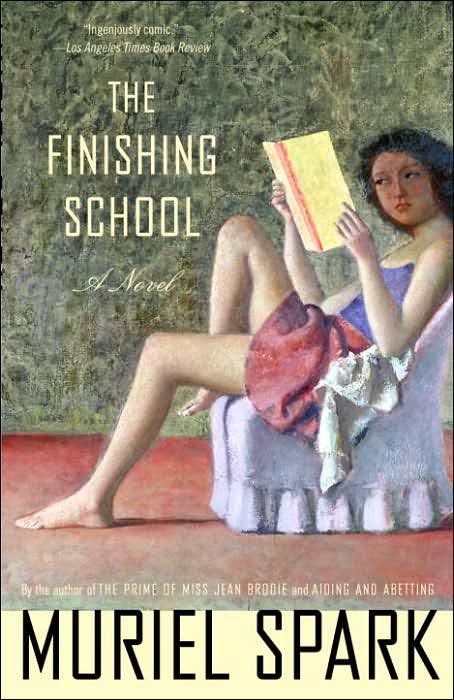 a satiric look at a private progressive institution that Miss Jean Brodie in her prime would have been quick to deem a “crank” school and would have been loathe to be associated with.
Rowland Mahler and his wife Nina Parker operate College Sunrise, a school where parents with “dire wealth” consent to send their teenagers for a year or two to get them out of the way. College Sunrise could not in any way compete with the famous schools and finishing establishments recommended by Gabbitas, Thring and Wingate in shiny colored brochures. Indeed, College Sunrise was almost unknown in the more distinctive educational circles, and in cases where it was known, it was frequently dismised as being rather shady. The fact that it moved house from time to time, that it seldom offered a tennis court and that its various swimming pools looked greasy, were the subject of gossip when the subject arose, but it was known that there had so far been no sexual scandals and that it was an advanced sort of school, bohemian, artistic, tolerant. What they smoked or sniffed was little different from the drug-taking habits of any other school, whether it be housed in Lausanne or in a street in Wakefield.
When the novel opens College Sunrise is in operation on the lake at Ouchy after previously being located in Brussels and Vienna. Nina conducts “casual afternoon comme il faut talks” with the school’s eight students ("'Be careful who takes you to Ascot,' she said, 'because, unless you have married a rich husband, he is probably a crook.'") while Rowland teaches creative writing. In fact, one of the students, 17-year-old Chris Wiley, red-haired, handsome, annoyingly self-assured, has enrolled in College Sunrise specifically so that he can write his historically inaccurate novel on Mary, Queen of Scots.
Rowland reads the opening pages of Chris' novel, finds them "quite good," and then experiences a debilitating case of writer's block where his own novel is concerned. Most of Spark's novel is thereafter concerned with the uneasy relationship between Rowland and Chris: Rowland's jealousy at first amuses Chris, who taunts Rowland with his hidden-away work-in-progress and thrives on reports that Rowland has been searching his belongings in a desperate attempt to find it. Later, after Nina is finally able to convince Rowland that his obsession with Chris' novel is bordering on insanity and he seeks a cure by temporarily checking into a monastery, Chris finds he requires Rowland's presence or else he is unable to write. Clearly, the madness goes both ways.
Nina wants Chris gone but realizes his tuition is needed less the school go under. She begins an affair with an art historian who lives in a neighboring villa. Rowland knows and doesn't care; he's busy attempting to sleep with the servant who is sleeping with Chris.
Nina, her lover, and the students all speculate whether Rowland's obsession with Chris' novel is actually a case of misplaced homosexual desire.
Finally, two of the publishers Chris has sent his novel to come to Ouchy and begin to offer a bit of perspective on Chris's talent and prospects. Chris' confidence is momentarily shaken, but he's quick to once again manipulate those around him, especially when he sees Rowland's chances at literary success wax considerably. I won't say who or how, but someone almost dies.
Now, while I loved The Prime of Miss Jean Brodie, I remained largely indifferent to The Finishing School. I read it twice to see if I could put my finger on what kept it from being a more enjoyable, a more memorable read. The best I could come up with is that Spark’s natural inclination to omit all but of vital import undercut her efforts here. Chris and Rowland discuss whether they feel their characters take on a life of their own; Chris maintains that his are firmly under his control and can do nothing he does not will. Spark’s characters here definitely fall under strict authorial control; she pushes them about to advance her story without bringing them fully to life. And why she chose to have the character whose writing is called "actually a lot of shit" by a prospective publisher, who recognizes that Chris' approaching success is based on his youth, not his talent, be the one whose methods most mimic her own is definitely beyond my understanding.
I also thought that the use of flash forwards, which I am, in general, exceedingly fond of, and found most effective in Jean Brodie (and in The Driver's Seat, which I read last month), undercut my concern in The Finishing School. While knowing that Miss Brodie is to be betrayed, that Sandy will become a nun, that Mary will be killed in a fire (or that that strange Lise is going to be murdered before morning comes), heightens the suspense and keeps me engaged with how future events are to come about, foreknowledge here deflated my interest. Why should I care now about the state of Rowland and Nina's marriage when I know she's going to be much happier as an art historian married to someone else? Why should I care now that Chris' novel is no good if he's still going to manage to get it published? Why should I care now about any of the students at the Sunrise School when I know they all have enough money or family prestige to take the rough edges off their years to come?
Based on these two books, I'd have to say that if an author can't or isn't willing to vary her style and technique from book to book, she ought to take care that the stories she has to tell will work with her style rather than against it.
I'm late getting this posted compared to everyone else, so I'll wait to discuss Jean Brodie in the Metaxu Cafe forums. I will say I'm glad this Slaves of Golconda reading gave me reason to read it again--I read it back in high school and retained very little--and that I do intend to read more by Spark. I'm going to chose titles for the most part, though, from the first half of her career when her style is economical, but not yet miserly. I don't have a problem meeting a writer halfway, but I'm not willing to do more than that.
(cross posted at pages turned)
In the Prime of Her Hubris
Cross posted at So Many Books
Where to start with The Prime of Miss Jean Brodie? On the surface the book is simple, Jean Brodie, teacher, a woman in her prime, and the six girls who are the Brodie set. Miss Brodie's methods of teaching are unorthodox but the girls are loyal to her even when headmistress Miss MaKay begins inviting the girls to tea to pump them for information she can use to get Miss Brodie fired. Eventually, when earnest encouragement has stopped, one of the girls betrays Miss Brodie.
Underneath the simple story with the simple style, is a surprising depth: the power a teacher has to shape the lives of her students and the disillusionment of the student when she realizes the teacher is only human. The book takes small leaps into the future now and then so the reader knows fairly early on that Miss Brodie will be betrayed and by whom it will be done. The how and why is left to develop with the progression of the narrative.
Miss Brodie never finds out who betrays her. She never knows the betrayal came from the one she trusted most, and still trusts after it is all over. I don't know if Miss Brodie genuinely doesn't know, or if she just doesn't want to know, refuses to believe in the truth that is before her. Miss Brodie is a likable character. I feel bad for the end of her prime. It ends, I think, because of a certain amount of hubris, too much belief in her power to hold her girls' loyalty forever. She forgets that even though the girls are young and impressionable, they grow up and they learn different ways of looking at the world--Miss Brodie cannot control their thoughts, she cannot control who the girls become. She thinks she can. And that is her downfall.
While I feel sorry for Miss Brodie I also found myself wondering how she could be so stupid. The book takes place in the 1930s. Mussolini and Hitler are just coming into power. Miss Brodie thinks fascism will make the world a better place. Maybe it is because I have the hindsight of history that her thinking makes me cringe.
I felt throughout the book an underlying sense of menace. I have tried to put my finger on it, but I am not sure what it is exactly. Perhaps it is the early knowledge that Miss Brodie will be betrayed by one of her own. Perhaps it is the personal details of her life, real and imagined, that she imparts to the girls. Maybe it's both, or something else. Whatever it was, it gave me a creepy feeling now and then.
How does Miss Brodie compare to my extra credit book, A Far Cry From Kensington? Both have the same wry humor. Sandy, one of Miss Brodie's girls, reminded me a little of Mrs. Hawkins in A Far Cry. It also had a touch of menace in it. Both books also focus on a sort of closed community--the school in Miss Brodie and a boarding house in A Far Cry. Each of them is peopled with delightfully quirky individuals. Miss Brodie, however, is definitely a deeper read.
I enjoyed both Spark books very much and after a bit of a break, plan to read more of her.
This is a Slaves of Golconda group read. All are welcome to joint the discussion at the MetaxuCafe forum.
Where to start with The Prime of Miss Jean Brodie? On the surface the book is simple, Jean Brodie, teacher, a woman in her prime, and the six girls who are the Brodie set. Miss Brodie's methods of teaching are unorthodox but the girls are loyal to her even when headmistress Miss MaKay begins inviting the girls to tea to pump them for information she can use to get Miss Brodie fired. Eventually, when earnest encouragement has stopped, one of the girls betrays Miss Brodie.
Underneath the simple story with the simple style, is a surprising depth: the power a teacher has to shape the lives of her students and the disillusionment of the student when she realizes the teacher is only human. The book takes small leaps into the future now and then so the reader knows fairly early on that Miss Brodie will be betrayed and by whom it will be done. The how and why is left to develop with the progression of the narrative.
Miss Brodie never finds out who betrays her. She never knows the betrayal came from the one she trusted most, and still trusts after it is all over. I don't know if Miss Brodie genuinely doesn't know, or if she just doesn't want to know, refuses to believe in the truth that is before her. Miss Brodie is a likable character. I feel bad for the end of her prime. It ends, I think, because of a certain amount of hubris, too much belief in her power to hold her girls' loyalty forever. She forgets that even though the girls are young and impressionable, they grow up and they learn different ways of looking at the world--Miss Brodie cannot control their thoughts, she cannot control who the girls become. She thinks she can. And that is her downfall.
While I feel sorry for Miss Brodie I also found myself wondering how she could be so stupid. The book takes place in the 1930s. Mussolini and Hitler are just coming into power. Miss Brodie thinks fascism will make the world a better place. Maybe it is because I have the hindsight of history that her thinking makes me cringe.
I felt throughout the book an underlying sense of menace. I have tried to put my finger on it, but I am not sure what it is exactly. Perhaps it is the early knowledge that Miss Brodie will be betrayed by one of her own. Perhaps it is the personal details of her life, real and imagined, that she imparts to the girls. Maybe it's both, or something else. Whatever it was, it gave me a creepy feeling now and then.
How does Miss Brodie compare to my extra credit book, A Far Cry From Kensington? Both have the same wry humor. Sandy, one of Miss Brodie's girls, reminded me a little of Mrs. Hawkins in A Far Cry. It also had a touch of menace in it. Both books also focus on a sort of closed community--the school in Miss Brodie and a boarding house in A Far Cry. Each of them is peopled with delightfully quirky individuals. Miss Brodie, however, is definitely a deeper read.
I enjoyed both Spark books very much and after a bit of a break, plan to read more of her.
This is a Slaves of Golconda group read. All are welcome to joint the discussion at the MetaxuCafe forum.
The Prime of Miss Jean Brodie
(Cross-posted at Of Books and Bicycles)
I liked this book well enough to read it twice, one time right after the other. It was well worth the re-read.
The story is about the “Brodie set,” six girls whom Brodie, a schoolteacher, takes under her wing, nurturing them and teaching them her version of culture – and sometimes the regular school lessons too. Spark sums up each of the girls in a few phrases which she repeats throughout the book. There is Monica Douglas, “famous mostly for mathematics which she could do in her brain, and for her anger which, when it was lively enough, drove her to slap out to right and left.” There is Rose Stanley, “famous for sex,” Eunice Gardiner, “small, neat and famous for her spritely gymnastics and glamourous swimming,” Jenny Gray, who will become an actress and is “the prettiest and most graceful girl of the set,” and Mary Macgregor “whose fame rested on her being a silent lump, a nobody whom everybody could blame.” Most importantly, though, there is Sandy Stranger, whom the book will follow most closely. She is famous for her squinty, disconcerting eyes.
Brodie is an unconventional teacher; she spends much class time telling stories, some of which are about her love life, and while she tells stories she sometimes asks students to hold up their books so that if the headmistress walks into the classroom they will look like they are working. She doesn’t balk at instilling her particular eccentric opinions and biases, and while she claims the sciences have their place, she makes it clear that art is what really matters.
Most importantly, she forms her “set,” the girls she cultivates particular relationships with, and who remain loyal to her even once they have passed through her classroom and moved on to higher grades. Her unconventional teaching and the loyalty of this set upset the other teachers and the headmistress, who spend the book scheming to get rid of Miss Brodie. This forms part of the tension of the novel: will she lose her job? Will the girls remain loyal to her? Who is it who finally betrayed her?
The nature of Brodie’s relationship with the girls is what’s really at the center of the novel, and this relationship changes – at first they admire her and follow her almost unthinkingly, and as the novel progresses, the girls grow up, and begin to question her, Sandy especially. And Brodie herself changes, from an idealistic, independent role model, dedicating the “prime of her life” to the girls, to something much more sinister. Sandy must separate herself from Brodie in order to figure out who she is and to become an adult. Sandy struggles with the feeling that she is too-closely identified with Brodie quite early on; in one scene when Sandy is tempted to be nice to Mary, a girl to whom almost no one is nice, she stops when she realizes Brodie is nearby:
The sound of Miss Brodie’s presence, just when it was on the tip of Sandy’s tongue to be nice to Mary Macgregor, arrested the urge. Sandy looked back at her companions, and understood them as a body with Miss Brodie for the head. She perceived herself, the absent Jenny, the ever-blamed Mary, Rose, Eunice and Monica, all in a frightening little moment, in unified compliance to the destiny of Miss Brodie, as if God had willed them to birth for that purpose.
She was even more frightened then, by her temptation to be nice to Mary Macgregor, since by this action she would separate herself, and be lonely, and blameable in a more dreadful way than Mary who, although officially the faulty one, was at least inside Miss Brodie’s category of heroines in the making.
And, ominously, Brodie admires Mussolini and the fascists. The novel is set in the 1930s, and we as readers understand just what it means to admire Mussolini. And here are Sandy’s thoughts, shortly after the passage quoted above:
It occurred to Sandy, there at the end of the Middle Meadow Walk, that the Brodie set was Miss Brodie’s fascisti, not to the naked eye, marching along, but all knit together for her need and in another way, marching alone. That was all right, but it seemed, too, that Miss Brodie’s disapproval of the Girl Guides had jealousy in it, there was an inconsistency, a fault. Perhaps the Guides were too much a rival fascisti, and Miss Brodie could not bear it. Sandy thought she might see about joining the Brownies. Then the group-fright seized her again, and it was necessary to put the idea aside, because she loved Miss Brodie.
So Sandy’s struggle with Brodie – her love for her, her admiration for her, her suspicion of her, and eventually her feeling of suffocation because of her – becomes a way of thinking about the larger cultural lure of and struggle with fascism.
The girls’ curiosity about sex is a part of the story too; they try to imagine Brodie with her lovers and figure out the mechanics of sex, and then they observe in fascination as she begins an affair with one instructor, Mr. Lowther, and falls in love with another, Mr. Lloyd. They are both thrilled and horrified. But Brodie crosses a line when she starts scheming to turn the now late-adolescent Rose into Mr. Lloyd’s lover, as a proxy for herself. Sandy is fully aware of what is going on, and reacts in her own, completely unexpected way. Near the end of the novel, she tries to come to terms with what is happening:
She thought of Miss Brodie eight years ago sitting under the elm tree telling her first simple love story and wondered to what extent it was Miss Brodie who had developed complications throughout the years, and to what extent it was her own conception of Miss Brodie that had changed.
It is when Sandy realizes that Brodie “thinks she is Providence … she thinks she is the God of Calvin, she sees the beginning and the end” that she is able to separate herself fully. Sandy is a mysterious character; I’m intrigued by her decision to become a nun, and I’m not sure I fully understand it, except that she has a longing for order, inspired in part by Brodie:
All the time they were under her influence she and her actions were outside the context of right and wrong. It was twenty-five years before Sandy had so far recovered from a creeping vision of disorder that she could look back and recognize that Miss Brodie’s defective sense of self-criticism had not been without its beneficent and enlarging effects …
Sandy seems to shuttle back and forth between longing for order and feeling stifled by an order too powerfully imposed on her. It takes her a long time, and perhaps it also takes the experience of being a nun, to learn to value a fruitful disorder. But this is something that as an adolescent she is not prepared to deal with.
The writing style is spare and economical, and Spark uses repetition – of the girls’ defining characteristics, of the phrase “the prime of life,” – which creates a sense of an incantation, as though she can conjure up a sense of her characters, not through the accretion of detail, but by dwelling on the most telling details over and over again. And she moves around in time, skipping back and forth while the story slowly reveals itself. It’s as though she’s circling around the main point, approaching it from many angles, giving us the story in a disjointed way that over time begins to come together.
I found Sandy’s artistic interests intriguing; here Spark dwells on the way the artist seeks out patterns and creates patterns out of life. Sandy realizes after a while that Brodie embellishes her stories and changes them to suit her moods. In this example, the girls are thinking about Brodie’s retelling of the story of her love affair with Hugh, an event that predates the novel:
This was the first time the girls had heard of Hugh’s artistic leanings. Sandy puzzled over this and took counsel with Jenny, and it came to them both that Miss Brodie was making her new story fit the old. Thereafter the two girls listened with double ears, and the rest of the class with single.
Sandy was fascinated by this method of making patterns with facts, and was divided between her admiration for the technique and the pressing need to prove Miss Brodie guilty of misconduct.
This is the same conflict we saw in Sandy’s response to Brodie’s “group-think,” the lure of Brodie’s cult of personality and the fear of chaos she evokes. Sandy is attracted and repelled by Brodie’s disorder, the willingness to play with facts if this makes a better story, the impulse to shape the world to meet the demands of art.
Spark’s own shaping of the raw materials of life is obvious in the novel; she draws attention through the repetition and the shifts in time to the fact that the novel is a constructed, made thing. She is not straightforwardly “realistic.” Her characters have life and interest, but she is more concerned with locating the patterns of their lives and interactions than with accumulating detail about them, in the way most novels do. Spark does brilliant things with her short form; using just a few details, she creates the sense of real, complete human beings, but her economy of detail also allows the underlying lines and patterns to shine through.
Thursday, June 29, 2006
"The Prime of Miss Jean Brodie" by Muriel Spark
Cross-posted from Bookworm
It was a bit distracting reading The Prime of Miss Jean Brodie right after reading Muriel Spark's autobiography. Just about every page of the book contains some object, setting, or event that was part of Spark's own schoolgirl experience in 1930's Edinburgh. Certainly they have been transposed, modified, reworked to fit the fiction, but it was hard not to notice them as I went along—the musquash coat, the smashing saucer, the poor of Edinburgh, the charismatic teacher enamoured of art and Mussolini.
I found myself wondering which parts not mentioned in her autobiography were also from her real life and which were invented. Spark calls her school years "the most formative years of my life" and devotes a great deal of space to them in her memoir. It's no wonder that the environment that made such an impression on her has made such an impression on readers, even in its rearranged form.
What is this book about? That is the question I had in my mind after reading it, and I confess I can't come up with a good answer. The explanations in the book, mainly given through Sandy, just seem too easy. Or am I mistaken in thinking that a good book must be difficult? Is it as it appears, a story about the dethroning of a frustrated, fascistic, self-deluded woman who wrought havoc among men and girls during her "prime"?
After reading Muriel Spark's autobiography and her descriptions of the various "utterly abnormal" people she had known, it is certainly possible that Spark just wished to create her own species of mental case (inspired by one of her own teachers) and see what would happen when she was unleashed on a variety of vulnerable people. That would be very much like the obsessive observer of human idiosyncracies that Spark was.
Though broader issues—Calvinism, fascism, Catholicism—feature in the story, I am inclined to believe that the book is more about people than ideas, or, at most, what happens when ideas impinge on personalities formed by nature and distorted by experience. Would Miss Brodie have come to admire Mussolini and Hitler had her lover not died in the war? Would Sandy have become a nun and psychologist were it not for Miss Brodie? How is that Rose was able to "[shake] off Miss Brodie's influence as a dog shakes pond-water form its coat" and the others were not?
As you can see, I seem to have more questions than answers, so I think I'd better go read the other Slaves' posts and learn a thing or two about this book. But before I do that, I'd like to announce that the next Slaves of Golconda read will be chosen by Stefanie of So Many Books. Anything but Clarissa, OK Stefanie?
For more Brodie questions, see ReadingGroupGuides.com.
Photos of Muriel Spark's Edinburgh
(Cross-posted from Kate's Book Blog)
In anticipation of the commencement of our discussion of Muriel Spark’s The Prime of Miss Jean Brodie, here are a few photos from my recent trip to Edinburgh.

“I was born in Edinburgh, at 160 Bruntsfield Place, the Morningside District, in 1918.” (Muriel Spark, Curriculum Vitae)

“From where I lived the school was a ten-minute walk through avenues of tall trees.” (Muriel Spark, Curriculum Vitae)


“I spent twelve years at Gillespie’s, the most formative years of my life, and in many ways the most fortunate for a future writer.” (Muriel Spark, Curriculum Vitae)

“They were crossing the meadows, a gusty expanse of common land, glaring green under the snowy sky. Their destination was the Old Town, for Miss Brodie had said they should see where history had been lived; and their route had brought them to the Middle Meadow Walk.” (Muriel Spark, The Prime of Miss Jean Brodie)

“They approached the Old Town which none of the girls had properly seen before, because none of their parents was so historically minded as to be moved to conduct their daughters into the reeking network of slums which the Old Town constituted in those years.”(Muriel Spark, The Prime of Miss Jean Brodie)


In anticipation of the commencement of our discussion of Muriel Spark’s The Prime of Miss Jean Brodie, here are a few photos from my recent trip to Edinburgh.

“I was born in Edinburgh, at 160 Bruntsfield Place, the Morningside District, in 1918.” (Muriel Spark, Curriculum Vitae)

“From where I lived the school was a ten-minute walk through avenues of tall trees.” (Muriel Spark, Curriculum Vitae)


“I spent twelve years at Gillespie’s, the most formative years of my life, and in many ways the most fortunate for a future writer.” (Muriel Spark, Curriculum Vitae)
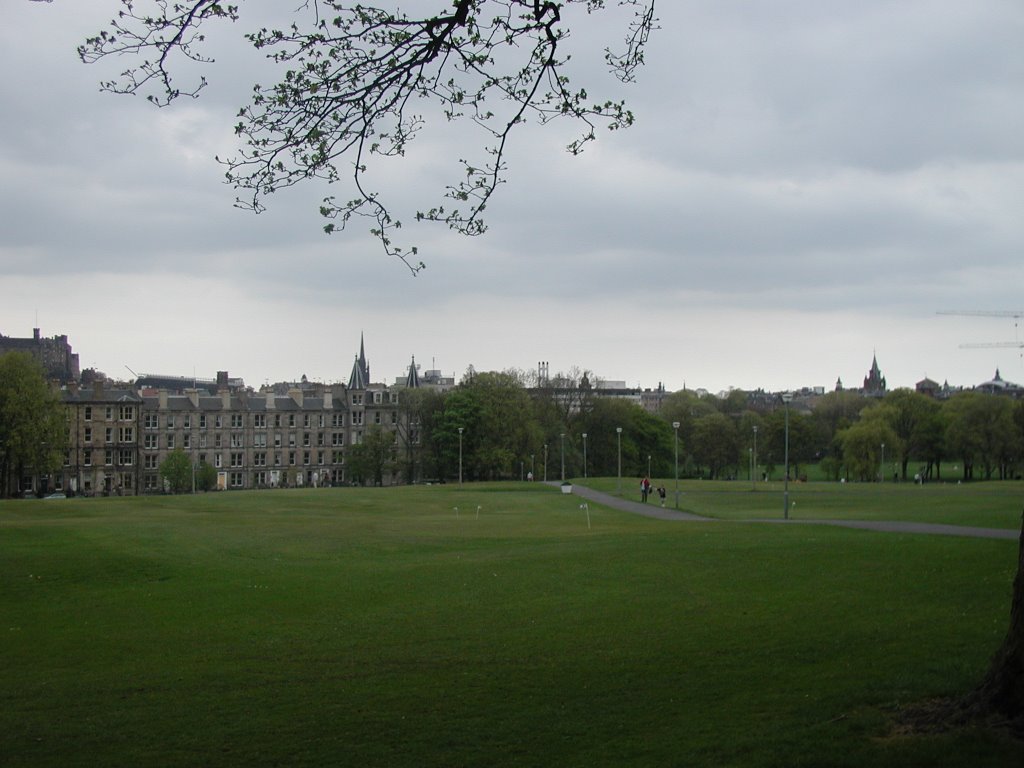
“They were crossing the meadows, a gusty expanse of common land, glaring green under the snowy sky. Their destination was the Old Town, for Miss Brodie had said they should see where history had been lived; and their route had brought them to the Middle Meadow Walk.” (Muriel Spark, The Prime of Miss Jean Brodie)

“They approached the Old Town which none of the girls had properly seen before, because none of their parents was so historically minded as to be moved to conduct their daughters into the reeking network of slums which the Old Town constituted in those years.”(Muriel Spark, The Prime of Miss Jean Brodie)


Muriel Spark's Aiding and Abetting
Cross-posted from Of Books and Bicycles
Aiding and Abetting is a very short book – almost short enough to be a novella – at 165 pages with large print and margins. But so much happens in it, and Spark manages to give you lots of characters and action without creating the feeling that things are rushed and undeveloped.
How can you not like a main character with the name Hildegard Wolf? She is a wonderful character: smart, powerful, mysterious. And also deceitful. She is a psychiatrist with some unusual methods: she spends the first few sessions telling stories to the patient instead of the other way around. The patients love this, for the most part, and she is very successful. She has always had healing powers. In an earlier episode in her life she was a fake “holy stigmatic”; every month she would take menstrual blood and smear it on at least one of the places Jesus was wounded, hands, feet, or side, and people flocked to her for healing. People sent her money in return for her “miracles,” and this is how she survives until she is exposed as a fraud and has to flee. This, of course, makes one wonder about the legitimacy of her status as psychiatrist. She insists that she really did heal some people as a stigmatic, and she really does seem to help her patients, so the book becomes a meditation on the power of belief. Is she so bad for having helped people, even if she did so under false pretenses? All this, by the way, is backstory, sketched in early on before the action begins.
The other part of the story involves two men, both Hildegard’s patients, each of whom claims to be “Lucky Lucan,” an Earl who killed his daughter’s nanny in a failed attempt to kill his wife and then went into hiding for over 25 years. Hildegard, with the help of some of the novel’s other characters, tries to figure out which one is the murderer while keeping out of danger herself. This part of story touches on issues of class: at the time Lucan committed the murder, the story as people told it was mostly about Lucan himself – it was a shocking tale of upper-class “bad behavior” and the friends who aided and abetted his escape. The nanny herself, the victim, was forgotten. As time goes on, Lucan’s high-class friends begin to realize that Lucan is a murderer, not just an Earl who had string of bad luck. They lose their sense of privilege and Lucan begins to lose his friends.
The novel is a mystery story in a number of senses. Which patient is the real Lucan and which is the pretender? Or are they both fakes? How has Lucan survived all those years without getting caught? What is it about Hildegard that people respond to so strongly so that she can perform miracles when they believe in her? Is she, as a fake stigmatic, so different from the fake Lucan? Here is what the novel says about mystery:
The case of the seventh Earl is only secondarily one of an evasion of justice, it is primarily that of a mystery. And it is not only the questions of how did he get away, where did he go, how has he been living, is he in fact alive? The mystery is even more in the question of what was he like, how did he feel, what went on his mind that led him to believe he could get away with his plan? What detective stories has he been reading? What dreamlike, immature culture was he influenced by?
Isn’t that the real mystery – what people are like, what they experience, and what shapes them?The writing here is simple and direct. It’s as though Spark knows she has a complicated story to tell in a limited space and so she must be efficient in her storytelling. The plot moves fast, the words do their job quickly, and yet somehow Spark manages to convey a completeness in those few words. She conjures up an entire world with just a few strokes.
Muriel Spark: Curriculum Vitae
Crossposted from Bookworm
Curriculum Vitae is Muriel Spark's attempt to answer what she calls the essential poet's question: Who am I? Like a true professional she researched her own life, digging up old documents and consulting friends and family to corroborate her own memories. The autobiography describes the first 39 years of her life, from her birth to the publication of her first book, The Comforters, in 1957. If there is an answer in Curriculum Vitae to the question of who she was, it is simply that she was a writer.
Muriel Spark was born in Edinburgh in 1918 to an English mother and Scottish father, and although her family was poor, her formative years were rich with experience—perfect for a future writer. Spark's parents included her in their vibrant social life, and she encountered a great variety of interesting and memorable people before starting her formal education. I suspect she picked up part of her penchant for observing people from her parents who would talk about their acquaintances in front of their daughter, often making fun of them and giving them nicknames.
The main beneficiary of Scottish philanthropy over several centuries was education, so Spark was able to go to a good school at little or no cost to her parents.
Education was held in awe, and the Scottish idea was that nobody should be denied this privilege.
At Gillespie's Girls' School she was taught by many excellent teachers, including the "exhilarating and impressive" Miss Christina Kay who was the model for Miss Brodie. Miss Kay lived a rich and adventurous life and shared it with her girls, stimulating Muriel's imagination and thirst for experience of her own.
What filled our minds with wonder and make Christina Kay so memorable was the personal drama and poetry within which everything in her classroom happened.
From a young age Spark showed an aptitude for poetry and literature, and was encouraged and supported in this at home and at school.
Miss Kay predicted my future as a writer in the most emphatic terms. I felt I had hardly much choice in the matter.
She read all the poetry and fiction she could get her hands on, and sought feedback on her poems and stories from friends and teachers. By the time she left school she was already an award-winning and published poet. Despite her obvious talent and intelligence, she did not pursue a university degree, partly due to a lack of money, and partly because she preferred to study on her own. She did take some writing and secretarial courses that enabled her to enter the working world and gain more of the life experience she was looking for.
At the age of 18 she met and married Sydney Spark and moved to Rhodesia (now Zimbabwe) where he was posted as a teacher. The marriage was "disastrous." She calls her husband "mentally ill," but what she describes, in very detached language, is a violent, abusive man. Spark never describes what he did to her or anyone else, nor does she say how she felt about it. She does say she feared for her life, which propelled her to obtain a divorce.
Spark longed to leave Africa, partly because of her domestic situation, and partly because she could not tolerate the hideous racism of the white colonists. "Life in the colony was eating my heart away." By this time the war had started and civilian transport was restricted, but with a little trickery she did secure a passage home for herself. She had to leave her son behind because children could not be transported in to the UK; indeed many were being shipped out for safekeeping. Friends and relatives questioned whether she wouldn't be safer in Africa, but she wanted to "experience" the war. In fact she chose to settle in London rather than Edinburgh in order to witness the bombing.
All women under 45 without family obligations were required to join the war effort. Spark's employment agent turned out to be an avid reader, and as they conversed about literature and poetry the agent soon realized Spark had a superior intellect. As a result she was posted to intelligence work, helping to create and distribute anti-Nazi propaganda via fake German radio stations. Spark began to feel a "definite desire" that gaining experience was no longer enough, but that she wanted to "give experience" to the reader with her writing. It was a vague feeling, however, and she didn't feel ready to try it yet.
After the war she worked in publishing, eventually becoming the editor of Poetry Review. Her attempts to raise the quality of the journal and welcome more modern poets was met with fierce and underhanded resistance and she was eventually forced out. After that she became a "hoarder" of all her records, papers, letters, etc. so that she could submit "documentary evidence" the next time she was attacked. This apparently continued for the rest of her life, and now that she has passed I imagine her archives will be of great interest to Spark scholars.
She also had another unsuccessful relationship with a possessive and vindictive man. She cobbled a living together by working for magazines and writing literary biography and criticism, but it was barely enough to keep body and soul together. A combination of post-war rationing, self-neglect, and Dexedrine (an appetite suppressant) led to malnourishment and she eventually had to leave London to convalesce. There are hints that alcohol was also a problem, but no more than hints. It was her friends that kept her afloat through all her troubles, and she remembers them with great fondness.
By the mid-50's she started making a name for herself in the literary world and was commissioned to write her first novel, an unusual thing in that day. The timing was right because she was already shifting her work towards story-telling.
I was now moving, myself, from lyric poetry to narrative verse. This was the start of my move in literature towards the short story and then the novel.
The book ends with the success of her first novel, The Comforters, which is based on the word hallucinations she had while taking Dexedrine, and also on the Book of Job. She writes of that book:
I didn't feel like 'a novelist' and before I could square it with my literary conscience to write a novel, I had to work out the novel-writing process peculiar to myself, and moreover, perform this act within the very novel I proposed to write.
As a Catholic convert myself I was looking for what she would say about her own conversion experience. I find it difficult to explain why I became a Catholic and it seems to be no different for Spark.
The simple explanation is that I felt the Roman Catholic faith corresponded to what I have always felt and known and believed. … The more difficult explanation would involve the step by step building up of a conviction. … Indeed, the existential quality of a religious experience cannot be simply summed up in general terms.
Some of those steps undoubtedly took place with Father Frank O'Malley, who counselled her during her illness, and during her convalescence at two Carmelite monasteries. Unfortunately for the curious, she keeps the details of those experiences to herself. Indeed she keeps a lot to herself, relating the facts of her experiences without much emotion or personal comment. Some crucial moments are described only through her friends' comments. She says next to nothing about her son, and as I mentioned earlier, very little about her marriage. Perhaps this reflects her Anglo-Scottish background. She writes that "It was certainly an attitude typical of Edinburgh to deny feelings for the sake of principle," and the English are not known for emotionality.
One has to read between the lines to infer where her feelings were involved. Loyal friends are clearly one thing she feels passionate about, particularly, I imagine, since her romantic relationships were so disappointing. (A friend called her "a bad picker" of men.) The book was also written in part to "put the record straight" after a former friend and writing partner wrote unauthorized accounts of her that were filled with inaccuracies. She does the research into the facts of her life that he did not, and she refutes his work through her narrative and directly in her account of her (non-romantic) relationship with him. A word to the wise: take any works about Spark by Derek Sanford (and works based on his works) with a grain of salt. She describes his "disregard for the truth" as "very uncharitable towards students and scholars," but I believe she herself felt betrayed and deeply hurt. This book is her public response to that betrayal.
In the last chapter she writes:
Since I wrote my first novel I have passed the years occupied with ever more work, many travels, and adventures. Friends, famous and obscure, abound in my life-story. That will be the subject of another volume.
Sadly for us she did not write that volume before her death this year. Let's hope her next biographer will be as scrupulous as she was in writing Curriculum Vitae. Muriel Spark, rest in peace.
Loitering With Miss Jean Brodie
If not for the Slaves of Golconda, your Bibliothecary most likely would never have picked up a book by Muriel Spark. Now, in the past two months, we have read two: The Prime of Miss Jean Brodie and Loitering With Intent. The second was not the book we had proposed to read for extra credit, but it was at hand, and the other wasn't. So, having read two novels by an author we were aware of but had never been interested in, we thank Sylvia for her choice.
We were surprised to learn Muriel Spark just died two months ago. In 1993 she became Dame Commander of the Order of the British Empire, in recognition of her services to literature. The Prime of Miss Jean Brodie is Ms. Spark's sixth novel, originally published 1961. Time magazine recently listed it among their 100 Best English-Language Novels since 1923. In her autobiography, Ms. Spark identified Miss Christina Kay and the James Gillespie School in Edinburgh as the models for Brodie and the Marcia Blaine Junior School where she teaches. Loitering With Intent is Ms. Spark's sixteenth novel, published in 1981.
Let us dispense with the second book first.
Loitering With Intent
The narrator, a novelist called Fleur Talbot, is enlisted by a wealthy old man called Sir Quentin to help ghost-write the autobiographies of his circle of friends. She finds their stories boring, and so proceeds to embellish them. The more she comes to know the members of the Autobiographical Association, the more they remind her of characters in the novel she has been writing, until she begins to suspect she has been hired merely to mine her fiction. When Sir Quentin accuses her of misusing him and his friends as models for her novel, she must quickly figure out who is on her side and who is not in order to prevent Sir Quentin from destroying the manuscript.
Fleur seems to be a good woman, befriending the elderly mother of Sir Quentin when everyone else tries to shut her away. She maintains a casual relationship with the wife of her former lover, even after she discovers the woman has betrayed her. She completes her novels, she perseveres, she is not a victim. She learns from her experience, which she marks as the end of her poverty and her youth. Still, she is just one of a strange lot of people who seem to deserve one another. None of the Autobiographical Association seem to have a purpose in life, and perhaps it is thus they are so easily lured in by Sir Quentin.
This is a novel that contains a bit of mystery, a hint of suspense, and much reference to the writing life. It was easy to fall into, quick to read, and confusing only if we tried to keep accurate track of time--Fleur is in the present, beginning her story in the near past, from where she flashes back to the distant past, and then freely refers back to the present now and again.
The Prime of Miss Jean Brodie
There is near the end of the novel a paragraph that succinctly describes Jean Brodie:
Unfortunately, it feels as if Miss Brodie goes a little too far. We had an uneasy feeling when she would speak of her personal life with her grade-school girls. And she seemed to prefer the company of these girls, who she so easily influenced, and over whom she held a position of authority, to the company of her peers, by whom she felt mainly threatened. She does engage in a love affair, yet it does not strike us as genuine, and she suggests with determination that one of her girls become the lover, in her place, of her true love interest, Teddy Lloyd. While Miss Brodie is dismissed in the end because of politics alone, and she regularly champions her strong morals, her influence over the children borders uncomfortably on exploitation.
Lurking hidden by her prime, hypocrisy clouds much of Miss Brodie's thoughts and teachings. Why does she believe it would be unseemly for her to become the lover of a married man, but it would be fine for one of her students? Why does she urge her students to be individualists, but try to keep them together under her wing--the Brodie set--and sing the praises of the fascisti?
Several things struck us about both novels. First, they are brief in length. They might be called novellas--The Prime of Miss Jean Brodie was published first in a magazine--and yet they feel to us more like an expanded slice-of-life short story, or maybe even a whole pie of life. They do not create a world, though, as most of the best novels do.
Second, Miss Brodie and Sir Quentin are both characters who aspire to gather others around them and manipulate, if not control, them. In these two cases, the end result is not in their favor. According to the Literary Encyclopedia, these are both personifications of a control figure that Ms. Spark uses frequently in her fiction.
Third, Ms. Spark's narratives moved back and forth in time. Though we began The Prime of Miss Jean Brodie with the mildest of confusion, the shifts were done extremely well. Within the space of a few sentences, even within the same paragraph, the reader would move from past to future and then back to present. For aspiring writers who desire to do the same, Ms. Spark provides a fine example of how to accomplish it smoothly, clearly, and without disruption to the story. Time is so fluid in The Prime of Miss Jean Brodie, it would require careful study to plot the events in chronological order and determine whether or not the skips are purposeful to the novel, or merely an omniscient style with which Ms. Spark is comfortable, and proficient.
Finally, Ms. Spark writes in a style in both books that to us is reminiscent of John Gardner. Both writers seem completely in control of their stories. Their books read pleasantly, with a careful workmanship flavor. The language is correct and exact. Despite all these qualities, their books stir little emotion. There are no characters we identify with or root for. We would probably not recommend them for enjoyment, yet we wouldn't offer them up at the next book burning. We struggled to find much to say beyond a synopsis of both Ms. Spark's books. Though Julie enjoyed Loitering With Intent, Suzanne commented that she had read the book but had no recollection of it at all. That is how it seems to us to be with Ms. Spark: we read her books, and then we move on to the next book in the TBR pile.
We were surprised to learn Muriel Spark just died two months ago. In 1993 she became Dame Commander of the Order of the British Empire, in recognition of her services to literature. The Prime of Miss Jean Brodie is Ms. Spark's sixth novel, originally published 1961. Time magazine recently listed it among their 100 Best English-Language Novels since 1923. In her autobiography, Ms. Spark identified Miss Christina Kay and the James Gillespie School in Edinburgh as the models for Brodie and the Marcia Blaine Junior School where she teaches. Loitering With Intent is Ms. Spark's sixteenth novel, published in 1981.
Let us dispense with the second book first.
Loitering With Intent
The narrator, a novelist called Fleur Talbot, is enlisted by a wealthy old man called Sir Quentin to help ghost-write the autobiographies of his circle of friends. She finds their stories boring, and so proceeds to embellish them. The more she comes to know the members of the Autobiographical Association, the more they remind her of characters in the novel she has been writing, until she begins to suspect she has been hired merely to mine her fiction. When Sir Quentin accuses her of misusing him and his friends as models for her novel, she must quickly figure out who is on her side and who is not in order to prevent Sir Quentin from destroying the manuscript.
Fleur seems to be a good woman, befriending the elderly mother of Sir Quentin when everyone else tries to shut her away. She maintains a casual relationship with the wife of her former lover, even after she discovers the woman has betrayed her. She completes her novels, she perseveres, she is not a victim. She learns from her experience, which she marks as the end of her poverty and her youth. Still, she is just one of a strange lot of people who seem to deserve one another. None of the Autobiographical Association seem to have a purpose in life, and perhaps it is thus they are so easily lured in by Sir Quentin.
This is a novel that contains a bit of mystery, a hint of suspense, and much reference to the writing life. It was easy to fall into, quick to read, and confusing only if we tried to keep accurate track of time--Fleur is in the present, beginning her story in the near past, from where she flashes back to the distant past, and then freely refers back to the present now and again.
The Prime of Miss Jean Brodie
There is near the end of the novel a paragraph that succinctly describes Jean Brodie:
She thinks she is Providence, thought Sandy, she thinks she is the God of Calvin, she sees the beginning and the end. And Sandy thought, too, the woman is an unconscious Lesbian. And many theories from the books of psychology categorised Miss Brodie, but failed to obliterate her image from the canvases of one-armed Teddy Lloyd.Though Miss Brodie teaches her students many things outside the standard school curriculum, she does not reveal everything. The girls begin to fill in the spaces in their instruction with their own imaginings, much like the other teachers do in their knowledge of Miss Brodie. Two of the girls fabricate a series of love letters between Miss Brodie and Gordon Lowther, the music teacher. The last letter of the series is the only one presented, and provides a moment of great humor. Ms. Spark does a wonderful job of capturing the thoughts of pre-teen girls on the edge of obsession about sex. They have Miss Brodie recall a moment of passion with Lowther, and then go on to say:
"I may permit misconduct to occur again from time to time as an outlet because I am in my Prime."And the closing:
"Allow me, in conclusion, to congratulate you warmly upon your sexual intercourse, as well as your singing."We have a soft place for unorthodox school teachers. To a great extent, modern public education in America has devolved into mere skills training so that students will become productive members of the economy. Anyone who teaches critical thinking to students, as Miss Brodie clearly does, gets a gold star beside their name on our classroom poster. We had the privilege of a teacher who would take class outdoors on fine days; a teacher who taught algebra in advance of the curriculum; and a political science teacher who showed murder/mystery films in class, and who would discuss anything. What joy to have John Keating for a teacher.
Unfortunately, it feels as if Miss Brodie goes a little too far. We had an uneasy feeling when she would speak of her personal life with her grade-school girls. And she seemed to prefer the company of these girls, who she so easily influenced, and over whom she held a position of authority, to the company of her peers, by whom she felt mainly threatened. She does engage in a love affair, yet it does not strike us as genuine, and she suggests with determination that one of her girls become the lover, in her place, of her true love interest, Teddy Lloyd. While Miss Brodie is dismissed in the end because of politics alone, and she regularly champions her strong morals, her influence over the children borders uncomfortably on exploitation.
Lurking hidden by her prime, hypocrisy clouds much of Miss Brodie's thoughts and teachings. Why does she believe it would be unseemly for her to become the lover of a married man, but it would be fine for one of her students? Why does she urge her students to be individualists, but try to keep them together under her wing--the Brodie set--and sing the praises of the fascisti?
Several things struck us about both novels. First, they are brief in length. They might be called novellas--The Prime of Miss Jean Brodie was published first in a magazine--and yet they feel to us more like an expanded slice-of-life short story, or maybe even a whole pie of life. They do not create a world, though, as most of the best novels do.
Second, Miss Brodie and Sir Quentin are both characters who aspire to gather others around them and manipulate, if not control, them. In these two cases, the end result is not in their favor. According to the Literary Encyclopedia, these are both personifications of a control figure that Ms. Spark uses frequently in her fiction.
Third, Ms. Spark's narratives moved back and forth in time. Though we began The Prime of Miss Jean Brodie with the mildest of confusion, the shifts were done extremely well. Within the space of a few sentences, even within the same paragraph, the reader would move from past to future and then back to present. For aspiring writers who desire to do the same, Ms. Spark provides a fine example of how to accomplish it smoothly, clearly, and without disruption to the story. Time is so fluid in The Prime of Miss Jean Brodie, it would require careful study to plot the events in chronological order and determine whether or not the skips are purposeful to the novel, or merely an omniscient style with which Ms. Spark is comfortable, and proficient.
Finally, Ms. Spark writes in a style in both books that to us is reminiscent of John Gardner. Both writers seem completely in control of their stories. Their books read pleasantly, with a careful workmanship flavor. The language is correct and exact. Despite all these qualities, their books stir little emotion. There are no characters we identify with or root for. We would probably not recommend them for enjoyment, yet we wouldn't offer them up at the next book burning. We struggled to find much to say beyond a synopsis of both Ms. Spark's books. Though Julie enjoyed Loitering With Intent, Suzanne commented that she had read the book but had no recollection of it at all. That is how it seems to us to be with Ms. Spark: we read her books, and then we move on to the next book in the TBR pile.
Wednesday, June 28, 2006
Subscribe to:
Posts (Atom)