Saturday, September 02, 2006

Slaves to Read Indiana Next...


Stefanie tagged me to choose the next book that the Slaves of Golconda will be reading. I posted a few reading possibilities recently, and in the end drew George Sand's Indiana out of a hat. Of course I always agonize over decisions like this. It isn't just a case of I hope I will like the book, but I am choosing something that others will read as well. Will everyone like it? Will it be a good book for discussion? The only guideline is that we have been reading classics each time around. Since we have had a good share of male authors lately, I thought it was time to read a woman author, and I had wanted it to be an international author as well (non-American, and non-British--since we have concentrated on these types books).

So it is with some trepidation that I announce the Slaves will be reading Indiana by George Sand! According to 500 Great Books by Women (a wonderful reference book by the way):

"Indiana is the first of many novels written by George Sand, a woman whose
behavior was often considered more shocking than her writing. Seen as a
denouncement of marriage when it was published, the novel is the story of a
naive, love-starved woman abused by her much older husband and deceived by a
selfish seducer."

Shall we say posts will be due October 29? Of course anyone is welcome to read along. The text of Indiana is available online here and post about the book and discuss--please consider it!. There is still a lively discussion going on at The Metaxu Forum over our latest book by H.G. Wells. You can also read individual posts on the book at The Slaves of Golconda blog.

Thursday, August 31, 2006

It was the wantonness that stirred me

When I was pregnant with my son I developed preeclampsia. The doctors determined that they'd have to take him out two months early if either of us were to make it.

He spent his first month in a neonatal intensive care unit across town before being transferred to the hospital closest to us until he'd gained enough weight to leave hospitals altogether. A NICU is, of course, a miraculous place of care and compassion, but it is also a place where much pain is experienced.

S. fought against a respirator that insisted on forcing breath in and out at a rate to which his body didn't want to conform; with his face contorting in silent screams, he was continually pricked and poked for blood samples, then transfused with fresh blood when he couldn't make enough to keep up with the amount taken (the scars on his wrists and ankles from the blood-taking did not fade away for more than a decade afterwards). Repeat.

Wired, tubed, and for several days blindered, he suffered. The painful procedures continued until eventually we--doctors, nurses, parents-- could tell that he was not only going to survive, but thrive.

Not all the babies did. There were those of two or three years of age, still in no shape to live outside NICU, abandoned by their parents, depending upon volunteers and scraps of time from the nursing staff for a bit of human contact. And there were several who lasted mere hours or days before they died.

A nurse caught me finger-stroking S.'s tiny arm on one of my first trips to the NICU. Did I not realize how much pain I was causing him? she snapped. Because he had no fat stores, the lightest touch was an assault to the nerve endings just underneath his skin. She taught me to cup my hand around him and to keep it still.

A couple weeks later I saw a new mother stroking her baby the way that I had. I waited for a nurse to correct her, but no one said a word. I knew then that her baby was going to die. No one was going to deny her the bit of comfort she could gain from touching him, even if her touch caused him distress, because these moments with the baby were going to be all that she had.

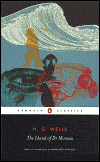
As you've maybe gathered by such an introduction, I responded to The Island of Doctor Moreau on a very personal level. If a person, if an animal, is to suffer by someone's hands in a House of Pain, it had better be for a damned good reason.

Moreau, well regarded in scientific circles in London prior to the publication of a pamphlet that exposed his cruel methods of vivisection, left England for a private island in the Pacific where he could continue his experiments outside the strictures of society. By cutting and mutilating and grafting he molds an assortment of animals into a tribe of Beast People, teaching them rudimentary language and a form of religious law designed to keep them under his control even after he has turned them out for retaining undesired animal characteristics. Imperfection really bums the man out.

Each time I dip a living creature into the bath of burning pain, I say: this time I will burn out all the animal, this time I will make a rational creature of my own.

Moreau isn't driven to mold animals into human shapes out a desire to help either man or creature, but merely because he wants "to find out the extreme limit of plasticity in a living shape." Ethics are not of interest to him: "The study of Nature makes a man at last as remorseless as Nature," he claims. Pain is immaterial; it is animalistic; intellectual desire transforms others into problems to be solved, nothing more or less.

Doctor Moreau is, in short, as psychopathic as they come despite the god-like appearance and demeanor that Wells has given him.

Edward Prendick, our narrator, is no match for him. Because Prendick, a shipwrecked gentleman taking shelter on Moreau's private island, has dabbled in natural history and studied biology under the famed T.H. Huxley, Moreau eventually reveals the truth about his experiments to someone he assumes can appreciate them and will henceforth stop hindering his work due to silly behavior. Instead Prendick is horrified, but offers weak and minimal objection. He reminds me of a journalist who lands an exclusive interview and then is afraid to ask any follow-up questions to the canned nonsense he's given. Time and again I wished the narrator were someone like Patrick O'Brian's Stephen Maturin, someone who both understood the science and was willing to argue the ethics of a situation, to insist that being human means behaving humanely toward those not on your level. Someone who could at least read the Greek and Latin classics shelved near his hammock instead of revealing yet another skill he's lacking.

Poor brutes! I began to see the viler aspect of Moreau's cruelty. I had not thought before of the pain and trouble that came to these poor victims after they had passed from Moreau's hands. I had shivered only at the days of actual torment in the hands. But now that seemed to be the lesser part. Before they had been beasts, their instincts fitly adapted to their surroundings, and happy as living things may be. Now they stumbled in the shackles of humanity, lived in a fear that never died, fretted by a law they could not understand; their mock-human existence began in an agony, was one long internal struggle, one long dread of Moreau--and for what? It was the wantonness that stirred me.

Had Moreau had any intelligible object I could have sympathized at least a little with him. I am not so squeamish about pain as that. I could have forgiven him a little even had his motive been hate. But he was so irresponsible, so utterly careless. His curiosity, his mad, aimless investigations, drove him on, and the things were thrown out to live a year or so, to struggle and blunder and suffer; at last to die painfully. They were wretched in themselves, the old animal hate moved them to trouble one another, the Law held them back from a brief hot struggle and a decisive end to their natural animosities.

In these days my fear of the Beast People went the way of my personal fear of Moreau. I fell indeed into the morbid state, deep and enduring, alien to fear, which has left permanent scars upon my mind. I must confess I lost faith in the sanity of the world when I saw it suffering the painful disorder of this island. A blind fate, a vast pitiless mechanism, seemed to cut and shape the fabric of existence, and I, Moreau by his passion for research, Montgomery by his passion for drink, the Beast People, with their instincts and mental restrictions, were torn and crushed, ruthlessly, inevitably, amid the infinite complexity of its incessant wheels.


I'd like to read more H.G. Wells and I intend to return to this one again as well, possibly in a few weeks with S. My response to it next time may not be quite as visceral. Perhaps I'll see Prendick in a more appreciative light; he does makes an excellent narrator even though his passive nature infuriated me on my first reading.

(Cross posted with pages turned)

Next Book Possibilities...

Although we are in the middle of discussing The Island of Dr. Moreau still, Stefanie has tagged me to choose the next book, and I thought I would throw out a few reading suggestions for next time around for everyone to think about. Since we seem to have read mostly male authors, I thought I would suggest a few female authors. I took a peek through 500 Great Books by Women: A Reader's Guide and found many wonderful books, however many are out of print or hard to find. I highly recommend this book if you don't mind searching for some of the lesser known titles. I added a couple of authors that are more contemporary to my list, which I found in the book, as well as older classics. In no particular order:

I had thought about adding Marguerite Duras to the list, but most of her fiction appears to be out of print here (except The Lover, which is a very slender book and would be quick to read--I had thought of The Vice Counsel with The Lover being extra credit, but oh well).

Originally I was just going to choose international women authors, but was I not looking in the right place? I can't seem the find many foreign classics by women (not contemporary authors)--is not that much translated. There seem to be plenty of male authors out there in translation. Any thoughts?

Cross-posted at Slaves of Golconda

I was talking to my father the other day about invention. From the beginning of history, people conducted their lives in similar ways. For thousands of years, news traveled the same way, wars were fought the same way, food was cooked the same way. Then in the mid-1800s, the world changed. People went to sleep one dreamfilled night in what could have been 1625 and awoke to a world that they didn't recognize. Trains, the telegraph and later indoor electricity. The Victorians were on the doorstep of the modern world. They were the first through the door. And the advent of modern science was the umbrella that covered their contemporary lives.

Yes, Darwin changed the way people thought of humans and therefore thought of themselves. His studies allowed for people to begin experiencing life like never before. Dimensions to worlds unknown opened up. Seances and spiritualism became common. Victorians were expanding their spiritual and religious realm. If what they thought about themselves had been altered by science, then maybe what they thought or knew of the dead and the soul, was different as well.

But it was writers like H.G. Wells, that uncovered hidden truths in them all. Writers like Wells made readers and the public rethink what it was to be human. Not just how they thought, but how the felt. The emotional turmoil pervading society had to be a sort of shell shock. If humans came from apes, then what does that do to our sense of who we think we are? Do we feel like humans? What does that even mean? Or could we be nothing more than wild creatures that wear clothing? What truly distinguishes us from 'them.'

Reading The Island of Dr. Moreau, these were the questions I was dealing with, repeatedly returning to. Rationalization is not the only thing that seperates us. Neither is knowledge or conscience. It must be all.

The narrator of Moreau, Prendick writes, Yet I felt an absolute assurance in my own mind that the Hyena-Swine was implicated in the rabbit-killing. A strange persuasion came upon me that, save for the grossness of the line, the grotesqueness of the forms, I had there before me the whole balance of human life in miniature, the whole interplay of instinct, reason, and fate in its simplest form.

These animal-human hybrids are humans in Prendick's estimation. Their ability to reason has changed them and has made them all too human like. However, I wonder if it was their strange mutation into human like beings that gave them reason or if they had always had reason and were now only able to communicate it. I fall into believing the latter in this case. Moreau had partly succeeded in his dungeon of science.

Prendick's experience on the lost island of mutation and vivisection, changed his way of feeling. It certainly changed the way he thought and what he thought about. Everything he thought he knew before, was turned upside down. He was left grasping.

I fell indeed into a morbid state, deep and enduring, alien to fear, which has left permanent scars upon my mind. I must confess I lost faith in the sanity of the world when I saw it suffering the painful disorder of this island.

A blind fate, a vast pitiless mechanism, seemed to cut and shape the fabric of existence, and I, Moreau (by his passion for research), Montgomery (by his passion for drink), the Beast People, with their instincts and mental restrictions, were torn and crushed, ruthlessly, inevitably, amid the infinite complexity of its incessant wheels. But this condition did not come all at once...I think indeed that I anticipate a little in speaking of it now.


This sentiment still reverberates today. I hear it echoed in Ginsberg's infamous first lines of Howl: I saw the best minds of my generation destroyed by madness, starving hysterical naked, dragging themselves through the negro streets at dawn looking for an angry fix. There's something primitive in Ginsberg's feeling of desolation and I sense the same in Prendick's lament.

As a society, we cope with watershed changes in a myriad of ways, but we have to deal with them nonetheless. But what does it mean to feel this way? Can we always change things for the better? Should we leave life, science, nature, better left untouched? I don't know.

I leave Dr. Moreau with more questions than answers...but I prefer literature that way. It is the discoveries I make on my own that validate my experiences.

Wednesday, August 30, 2006

The Writing of H.G. Wells

In an introduction to one of our many volumes of H.G. Wells, Isaac Asimov finds the earliest examples of science fiction in Johann Kepler, Cyrano de Bergerac, Mary Godwin, Edgar Allan Poe, and Jules Verne, who popularized the genre. The biggest difference for Wells seems that he wrote at a time when the studies of science and technology were increasing, expanding, and gaining more interest and acceptance than in the past. He took many subjects that were hot topics in England and explored them, turning what was then known as scientific romances into what has become the science fiction of today. Though Verne was harshly critical of Wells' work, Wells was the more imaginative, and has proven to be the more prophetic, writer.

For extra credit, in addition to the selected title, we also read The War of the Worlds (the translucent review concerning which has previously been posted) and The Time Machine. This second novel began its existence as early as 1888, and reportedly evolved from three distinct ideas into the final form, in 1895, we know today. The distinctive elements we recognise right away are the theory of time travel, the experiences of a Time Traveler, and a future vision.

Wells begins by laying out the theory of travel through time plainly and believably by comparison to travel through space. The experiences of the Time Traveler follow, recounted to a group of friends, though as an uninterrupted narrative for the reader. The vision comes at the end, when the Time Traveler goes back to the future, and beyond, millions of years hence. Instead of the great technology-driven worlds of microchips and interstellar life, Wells discloses a shrouded desolate landscape inhabited by monstrous crustaceans that, we are led to believe, has come about by some withering of man, first into placid leisure, and then into extinction. Having progressed to conquer all challenges and losing the ability to adapt, mankind doomed itself to atrophy.

In The Island of Dr. Moreau, first published in 1896, when Wells was thirty years old, we find the contemporaneous controversy of vivisection mixed with the future controversy of gene splicing; questions in morality of experimentation on animals; the hazards of sea travel; the evils of empire; evolution and creationism; and we also find the more broader issues of religion and existence. There also is the theme of transformation similar to another of his novels, The Invisible Man. The common thread in all Wells' writing seems to be a sort of debunked utopian outlook. Is the striving to reach beyond ourselves worth the trouble?
Poor brutes! I began to see the viler aspect of Moreau's cruelty. ... Before, they had been beasts, their instincts fitly adapted to their surroundings, and happy as living things may be. Now they stumbled in the shackles of humanity, lived in a fear that never died, fretted by a law they could not understand; their mock-human existence began in an agony, was one long internal struggle, one long dread of Moreau--and for what?
Prendick, the man whose discovered narrative makes up the tale, is considering the creatures that have been born of Moreau's experimentation; yet he may also be addressing Moreau's condition: as a man, Moreau was perfectly adapted to his station in life, but in trying to understand something he could not--creation--he now faced constant fear, of his own handiwork.

The novel has much of the flavor of a writer at odds with religion. Dr. Moreau is referred to by his creatures as Him. We also watched the film version of the novel, starring Marlon Brando and Val Kilmer, in which the point is taken even further, as the creatures call Moreau Father. Prendick even thinks Moreau has hypnotised the creatures into believing he is their god. For humans today who do not understand, are they not the beasts to God's Moreau? Is God nothing but a mad scientist? The screenplay makes a few adaptations to the novel, most notably the addition of a love interest for Prendick (who is also renamed), a young woman he tries to save from reverting to beasthood, a subplot which adds nothing of substance to Wells' story. In the film, Moreau uses electical implants to control his creatures, while in the book they are heeled only by the whip and the Law--a set of rules unnatural to their beastly instincts, as precarious is the Bible and other religious tracts in restraining
men from their most natural instincts of survival: fear, flight, and fight.

At the end of the novel appears a lifeboat of the ship from which Prendick had been cast off. Inside he finds dead the captain and another man from the ship. The irony is, if Prendick had not been cast off the ship and suffered the horrors of Moreau's island, he would have died. Perhaps there is a message there, that only by facing up to the darkness of men can we hope to survive. Though Prendick has seen the worst, he also nows sees hope. Wells realised much that was horrible in human nature, yet the world's worst conflicts were still far in the future. In this and other stories, he reveals the darker shades of humanity, with hope just a glimmer of possibility. That hope is fragile, as if he wishes a better fate, but has little faith in civilization. The Island of Dr. Moreau, The War of the Worlds, and The Time Machine are works of doomsday fiction.

Though not transcendent works, these novels are interesting and thought-provoking, and in many ways remarkable when considering the time during which they were written. For a reader of broad interests ploughing through two thousand pages of A la recherche du temps perdu, some other of Wells' novels, like The Invisible Man, The First Men in the Moon, and The Food of the Gods might be quick intermissions between Swann in Love and Within a Budding Grove. We will keep those books at hand confident of a good story for when the need arises.

Not a Vacation Spot


Cross posted at A Work in Progress

For all my talk of the romance of seaside villages and deserted islands, there is one place I would not like to visit--Noble's Island. H.G. Wells created a horrific place when he wrote The Island of Dr. Moreau (as a small side note, Penguin is reissuing many of Wells's works in lovely new editions with very helpful and detailed introductions).

The story of what happened to Edward Prendick when the ship he was in collided with another and sank, and the events that followed are written down in narrative form for us to read. And a dire story it is from beginning to end. How much shall I tell you? Was Edward lucky when after many days in a boat, starving, he was picked up by the Lady Vain? And what cargo was she carrying? Poor unfortunate creatures. Edward is saved by Montgomery and nursed back to health. When the ship drops Montgomery and his animals off, Edward is forced to go with them, much to his chagrin.

He isn't going to like what he finds there. And as in every story or movie where you know there are nasty things happening, what does our trusty narrator do? For sure he goes off to investigate. Actually what initially sets him off are the cries of utter pain from an animal behind closed doors. Edward cannot take it any longer, and who can blame him. However he is in for more of an education than he bargained for when he sets off across the island in search of peace and quiet. There are the most unusual people inhabiting it. Who are they and how did they come to be the way they are? What he doesn't know is that they are not humans who have been tampered with. They were once animals that have been reconstructed in man's image.
Vivisection. It is one of those words that I have heard and imagined that I knew what it meant.


viv-i-sec-tion (viv-uh-sek-shuh n) - noun.
1. the action of cutting into or dissecting a living body.


2. the practice of subjecting living animals
to cutting operations, esp. in order to advance physiological and
pathological knowledge.


I was actually enjoying this book, frightening though it may be, up until when Dr. Moreau explained and tried to justify his actions.


“But,” said I (Edward), “I still do not understand. Where is your justification
for inflicting all this pain? The only thing that could excuse vivisection to me
would be some application—”


“Precisely,” said he. “But, you see, I am differently constituted. We are on different platforms. You are a materialist.”


“I am not a materialist,” I began hotly.


“In my view—in my view. For it is just this question of pain that parts us. So long as visible or audible pain turns you sick; so long as your own pains drive you; so long as
pain underlies your propositions about sin,—so long, I tell you, you are an
animal, thinking a little less obscurely what an animal feels. This pain—” I gave an impatient shrug at such sophistry.


“Oh, but it is such a little thing! A mind truly opened to what science has to teach must see that it is a little thing. It may be that save in this little planet, this speck of cosmic dust, invisible long before the nearest star could be attained—it may be, I say, that nowhere else does this thing called pain occur. But the laws we feel our way towards—Why, even on this earth, even among living things, what pain is there?”
As he spoke he drew a little penknife from his pocket, opened the smaller blade, and moved his chair so that I could see his thigh. Then, choosing the place deliberately, he drove the blade into his leg and withdrew it.


“No doubt,” he said, “you have seen that before. It does not hurt a pin-prick. But
what does it show? The capacity for pain is not needed in the muscle, and it is not placed there,—is but little needed in the skin, and only here and there over the thigh is a spot capable of feeling pain. Pain is simply our intrinsic medical adviser to warn us and stimulate us. Not all living flesh is painful; nor is all nerve, not even all sensory nerve. There's no taint of pain, real pain, in the sensations of the optic nerve. If you wound the optic nerve, you merely see flashes of light,—just as disease of the auditory nerve merely means a humming in our ears. Plants do not feel pain, nor the lower animals; it's possible that such animals as the starfish and crayfish do not feel pain at all. Then with men, the more intelligent they become, the more intelligently they will see after their own welfare, and the less they will need the goad to keep
them out of danger. I never yet heard of a useless thing that was not ground out of existence by evolution sooner or later. Did you? And pain gets needless.


“Then I am a religious man, Prendick, as every sane man must be. It may be, I fancy, that I have seen more of the ways of this world's Maker than you,—for I have sought his laws, in my way, all my life, while you, I understand, have been collecting butterflies. And I tell you, pleasure and pain have nothing to do with heaven or hell. Pleasure and pain—bah! What is your theologian's ecstasy but Mahomet's houri in the dark? This store which men and women set on pleasure and pain, Prendick, is the mark of the beast upon them,—the mark of the beast from which they came!Pain, pain and pleasure, they are for us only so long as we wriggle in the dust."


And then it made me a tad bit sick. You should be careful what you do in life, sometimes it comes back at you and (well, to be blunt) bites you in the ass. I won't tell you about the demise of Dr. Moreau, or what happens when everyone is dead save Edward and the Beast Folk. You'll need to read the book yourself to find out and fill in the details. And I do recommend this book. While it wasn't always pleasant reading, it was a very good and a very sort of--edge of your seat story.

For a slim, little volume, and a very quick read, this book is packed with ideas. But then Wells, himself was packed with ideas. I would love to read more about him. Last year I read his The Time Machine, which was just as bleak, and now I will have to follow up with War of the Worlds (they were written in this order). This is a book that screams for discussion, which you can follow here (once the forum is set up), and you can read all the Slaves's posts here.

Horrible!

Cross-posted at So Many Books


What a horrible book! That's horrible as in causing horror, not as in the glib way we use it to mean something is bad. The Island of Dr. Moreau made my stomach turn at times. The cries of the puma being vivisected, "such and exquisite expression of suffering," almost made me stop reading, so clearly could I hear them in my head. Prendick's reaction, to escape the cries rather than to do something to stop the animal's suffering, made me so angry I wanted to do something to hurt him, after, that is, I stormed Moreau's fortress, set all of the suffering animals free, and hung Moreau by his toes from the highest tree. What a horrible, excruciating, gut-wrenching book!

The book has a sort of Heart of Darkness feel to it for me. But instead of Kurtz being worshipped by the natives, Moreau makes his own to worship him. Moreau is God on his little island, molding animals into the semblance of humans, giving them The Law, and meting out punishment to those who break The Law. Moreau's level-headed explanation to Prendick of what he is doing is seductive in its cool, scientific reasoning. That Moreau thinks he can, by "dip[ping] a living creature into the bath of pain [...] burn out all the animal" and be left with a rational creature reveals his madness. What is even more frightening is that Moreau has no purpose for his work other than personal. His intentions are not to improve the lives of animals or humans. He wants, but I am not entirely sure what he wants, maybe only to marvel in his own power. He is the scientist we all fear, the one who lives in a self-created, self-driven universe where ethics and morals do not have a role. He is the doctor we are afraid will experiment on us just to see what happens; the scientist who would clone a human being or create a toxin without an antidote. This being a book, we have the satisfaction of Moreau getting what he deserves. The book plays on our fears of science in such a way, however, that I am left with a creepy feeling that there are real-life Moreaus who are, at this moment, far away from justice.

Wells's writing style is reporterly and unadorned. Here are the facts and just the facts. We are not told how we are to think or feel about what is going on. It is like the reader is a jury and the text presents the various sides of the case for our consideration. Everyone gets a turn to speak, Moreau, his assistant Montgomery, Prendick the narrator, even the "beast people." We do not get to decide their fates, they take care of that themselves. We only get to decide their guilt.

The book also asks us to think about what is human. When the book was written, Darwin's theory of evolution was turning society upside down. No longer could we be so certain that we were created by God. Nor could we say for sure that we were not animals. Even in the twenty-first century the repercussions of Darwin continue to play out. What is animal? What is human? When once we were certain we were the top of the pyramid, with evolution we are only one more step in the development of the species and we don't know what is in the future. So what do we do? Do we abdicate, and become animals? Or do we become Moreau-like and attempt to turn ourselves into gods? Wells does not try to suggest an alternative to either and I am glad he didn't, it would have given the novel a false note and tempered the horror. Instead we are forced to look in the mirror and try and answer some tough questions.

Everyone is welcome to joine the Slaves of Golconda discussion of this book at MetaxuCafe

The Island of Dr. Moreau

Cross-posted at Of Books and Bicycles

I’m not sure if I’m supposed to be posting on this today or tomorrow, but I figure that if it’s supposed to be tomorrow, you all can come back and read this then. I’m also not going to do this book justice, since I read it in a rather distracted state of mind. I felt as I was reading that I should re-read in order to fully appreciate it, but I didn’t have the time.

At any rate, I enjoyed the novel very much. This is my first experience of Wells, and I’m tempted to read the two other novels in my edition, The Time Machine and War of the Worlds. I’m curious what people make of the frame narrative – is there something complicated going on here, or is it simply by way of explaining and setting up the narrative to follow? Wells participates in an old tradition of frame narratives, whether it’s the frame story of escaping the plague in Boccaccio’s The Decameron or the multiple frame narratives that encircle the creature’s narrative in Frankenstein, or the explanation Defoe gives at the beginning of Robinson Crusoe that the narrative is a true one that Defoe had stumbled upon and decided to publish. Wells’s use is certainly not as complicated as Mary Shelley’s was, but the frame does give the reader a sense of the mysteriousness to come in the main narrative, and it tells us the interesting fact that Prendick “subsequently … alleged that his mind was a blank from the moment he escaped from the Lady Vain.” Did he find that his attempts to explain what he saw on the island were so impossible that he gave it up and simply said his mind was blank to avoid explanations entirely?

I’m reminded of Hawthorne’s story “Young Goodman Brown” where Brown journeys into the woods, discovers the horrors that (supposedly) exist in the human heart, and returns home a changed man, unable to live at peace with his family again. And also Gulliver, who after his travels becomes a bitter, cynical man. In both of these books, and in Wells’s novel too, one of the central questions is about what it means to be human: are humans like the houyhnhnms or the yahoos, or neither? The ending of the novel is moving; Prendick lives in fear and horror of his fellow humans and isolates himself from people, devoting his time to scientific studies. He writes:

They say that terror is a disease, and anyhow, I can witness that, for several years now, a restless fear has dwelt in my mind, such a restless fear as a half-tamed lion cub may feel. My trouble took the strangest form. I could not persuade myself that the men and women I met were not also another, still passably human, Beast People, animals half-wrought into the outward image of human souls, and that they would presently begin to revert, to show first this bestial mark and then that.

At the heart of the novel, I think, is the conversation between Prendick and Dr. Moreau where Moreau explains the nature of his experiments. This dialogue is all about the relationship of human beings and animals – a topic that has fascinated writers since the time of Gilgamesh, another work that tries to define humanity by considering how people differ from the gods on the one hand and the beasts on the other. The question in Wells’s novel centers around pain – what it means to be able to feel pain and how we should respond to our own pain and that of others. Moreau says:

For it is just this question of pain that parts us. So long as visible or audible pain turns you sick, so long as your own pains drive you, so long as pain underlies your propositions about sin, so long, I tell you, you are an animal, thinking a little less obscurely what an animal feels … A mind truly opened to what science has to teach must see that [pain] is a little thing.

Pain is an aspect of animal experience, not human, according to Moreau; as humans separate themselves from the animal world, pain will carry less and less significance. That he brushes aside Prendick’s objections to his cruelty shows that he has lost something essential to his humanity and has become much less than an animal, which would never behave as cruelly as he has. By working so horribly on animal bodies and denying the significance of the pain they experience, Moreau shows his abhorrence of bodies in general – he desires to leave the body and all its weaknesses behind. But in denying the body, he perverts human nature into something it’s not – the body is as central to human experience as the mind.

Moreau cannot succeed in turning animals into humans to his satisfaction because he misunderstands what it means to be human and animal both. He says of his animal/human creations that:

Least satisfactory of all is something that I cannot touch – somewhere – I cannot determine where – in the seat of the emotions. Cravings, instincts, desires that harm humanity, a strange hidden reservoir to burst suddenly and inundate the whole being of the creature with anger, hate, or fear.

He wants to drive what he sees as the beast out of the human, and yet what he considers “beast” – the body that feels pain and experiences instincts and cravings – is inseparable from the human. Prendick separates himself morally from Moreau when he recognizes the humanity of one of Moreau’s creations:

It may seem a strange contradiction in me – I cannot explain the fact --, but now, seeing the creature there in a perfectly animal attitude, with the light gleaming in its eyes, and its imperfectly human face distorted with terror, I realized again the fact of its humanity.

This is a redeeming moment for Prendick, who, rather than allowing this creature to enter Moreau’s torture chamber once again, shoots it. This is an act of mercy.

Okay – there is so much more going on in this novel, but I’ll leave it up to my fellow Slaves to point those things out.

Tuesday, August 29, 2006

Are we not Men?

Crossposted at Bookworm

I wonder what Darwin would have thought of The Island of Dr. Moreau? That giant of science who showed, among other things, that humans share a common ancestry with "lower animals," might have been interested in a novel about the boundaries between ourselves and our animal cousins. As a nature-lover myself, the idea of being akin to all the wonderful animals on this planet is far from disturbing. I see no malice in predators, as Prendick the unfortunate castaway does, and no shame in an animal's fear of pain, as Moreau the pitiless vivisector does. But reading this book makes me think that a generation after The Descent of Man, English society was still deeply troubled by the thought that they might be of the same substance as creatures they had thought of as soulless, inferior, and created solely for our own use and benefit.

The book gives us three different perspectives on animals. Dr. Moreau, the real monster of the story, clearly possesses a deep hatred for animal qualities, so much so that he is willing to endure exile to continue his horrific experiments.

Each time I dip a living creature into the bath of burning pain, I say, This time I will burn out all the animal, this time I will make a rational creature of my own.

Montgomery, Moreau's right hand man, represents the other extreme. He does not try to control his urges, he befriends and sympathizes with Moreau's creatures, and in the end destroys himself by instigating a sort of anti-human Bacchanalia. Prendick observes:

I felt that for Montgomery there was no help; that he was in truth half-akin to these Beast Folk, unfitted for human kindred.

Prendick represents the middle road between having contempt for animals and becoming one. He shares some of Moreau's scientific curiosity and is not categorically against animal experimentation but, English gentleman that he is, he has his limits. Though he feels the animal in himself rise up in moments of crisis, he is still disgusted by the mixture of animal and human in Moreau's experiments. He does develop some sympathy for the plight of the Beast People, and ends up living with them for a while, but is never truly comfortable around them. He doesn't try to dominate them as Moreau did, but neither does he see them as fit companions for a man, as Montgomery did. When he finally escapes the island and returns to England, he is haunted by the irrational fear that the people around him are not entirely human, especially those of the lower classes. If anything, he clings to the distinction between human and animal even more strongly after his experiences on Dr. Moreau's island.

And what are those distinctions? Two aspects in particular, one mental and one physical, are prominent in the book. The mental distinction is, not surprisingly, rational thought. Though the Beast People do achieve a certain level of intelligence and culture, they eventually revert to their animal nature and instinct reclaims their minds. The physical hallmark of humanity in this book is the human hand. Moreau's only, and surprisingly willing, deference to the pain of his subject is with regards to hands:

…often there is trouble with the hands and claws—painful things that I dare not shape too freely.


Only the Ape Man naturally has five digits, a fact which he takes great pride in as proof of his humanity. Moreau is described as having long, dexterous fingers, with which he performs his surgeries, and which are part of the Beast People's religious litany:

His is the House of Pain
His is the Hand that makes
His is the Hand that wounds
His is the Hand that heals

When he is finally killed by one of his creatures, one of his hands is found nearly severed at the wrist. His companions hands are mentioned too. Montgomery is described as dexterously bandaging Prendicks's arm after it is broken by the escaping Puma Man. Later, Prendick gains respect among the Beast People with the weapons he wields in his hands—a hatchet and stones. They have a deeper bite and longer reach than their natural weapons, teeth and claws. Finally, after returning to England, Prendick takes solace in books, objects that are completely and unalterably human, the work of human hands.

I have withdrawn myself from the confusion of cities and multitudes, and spend days surrounded by wise books, bright windows, in this life of ours lit by the shining souls of men.

Though I don't share the book's views on animal nature, I greatly enjoyed the book itself. This was not my first acquaintance with the story—I saw the 1996 film adaptation recently—so I was not in suspense about the general outline of the story. [MOVIE SPOILER WARNING!!!] There was a significant thematic difference between the book and the movie version I saw. In the film, Moreau's goal is not "to find out the extreme limit of plasticity in a living shape" but to improve the human race by splicing in strong, animal characteristics. This was done more by biochemical than surgical means, as befits today's technological environment. This shifted the story's concern away from the fear of the animal in us to the ethical aspects of genetic engineering. In the film, Moreau's abomination was not miscegenation but playing God. It actually left me with more to think about than the book did. [END OF SPOILERS]

I greatly enjoyed Wells' clear, precise, evocative, and impeccable English. I suspect many readers might find it a bit dull, but it is a natural fit for my scientific mind. Only on one occasion did I find a sentence that didn't just roll off the page. For those who haven't read the book, here is a sample of his style, describing the moment when Prendick fully appreciates what Moreau has done:

Poor brutes! I began to see the viler aspects of Moreau's cruelty. I had not thought before of the pain and trouble that came to these poor victims after they had passed from Moreau's hands. I had shivered only at the days of actual torment in the enclosure. But now that seemed the lesser part. Before they had been beasts, their instincts fitly adapted to their surroundings, and happy as living things may be. Now they stumbled in the shackles of humanity, lived in a fear that never died, fretted by a law they could not understand; their mock-human existence began in an agony, was one long internal struggle, one long dread of Moreau—and for what? It was the wantonness that stirred me.

I haven't read any other Wells so I don't know if he adopted this style because the narrator was an amateur scientist, or if that is always his way of writing, perhaps reflecting the fact that he himself had studied biology for a time. I shall find out as I intend to read more of his work. For now it's off to the Slaves of Golconda blog and the MetaxuCafé forum to see what other readers thought of this scary little gem.

By the way, did anyone read the 1996 Modern Library edition of the book? Isn't it lovely? This is for colophon fans (I know you're out there!):

The principal text of this Modern Library edition was set in a digitized version of Bembo, a typeface based on an old-style Roman face that was used for Cardinal Bembo's tract De Aetna in 1495. Bembo was cut by Francisco Griffo in the early sixteenth century. The Lanston Monotype Machine Company of Philadelphia brought the well-proportioned letter forms of Bembo to the United States in the 1930's.

Thursday, July 27, 2006

Reading Wells

The Island of Dr. Moreau still awaits on the horizon. Meanwhile, I have been sailing towards it on two other short novels by H.G. Wells, The Time Machine and War of the Worlds. Rather than wait to post on these extra credit books, I am going to go ahead now, and I can draw comparisons as needed later.

My first real memory of War of the Worlds was a vague impression of a probably made-for-television version of the 1938 Orson Wells radio dramatization of the book. I remember Wells wrote his script as a series of "Breaking News" interruptions of a fictional musical entertainment, and a great number of people, who had missed the introduction at the top of the program, thought the Martian invasion was real. Stefanie's selection gave me reason to pick up the book and discover the story for myself.

The context of this novel is important. Today astronomy is full of the likelihood of existence beyond our planet, as well as the possibility that life on earth is of extraterrestrial origin. But try to imagine a time before space travel, even before winged air travel. Much science was still just coming into its own, becoming something people could trust and rely upon. England was at the height of its empire, with colonies across the world. Mars had only recently been mapped, and some theorised the linear features of the planet were not naturally made. Wells combined these ingredients--Martian life, hostile colonisation, and flight--into a novel of social commentary that was ahead of its time in plot and treatment.

He begins and ends the book with stunning narrative passages that set the tone and deliver the setting and the message. Between these points we are given the first-hand account of a man who encounters and then must survive the Martian invasion. We are told that humans go about their daily lives without a care and with an air of superiority. When the capsules from Mars crash into England, people are curious but not nervous or wary or frightened. Even when men begin to die, they do not seem to take the threat seriously. Finally the Martian tripods appear and begin their takeover of the country. The narrator goes into hiding, avoids, runs away, and generally survives the ordeal to tell us about it. And when nothing particularly gripping is happening to him, he tells us about how his brother hid, avoided, and ran away. The English war machine is destroyed, and the Martians begin their colonisation of earth by growing a red weed. Imagine, if you can, that England's destiny is not to rule over other peoples from pole to pole, but to be subjugated and overthrown by another life form entirely unknown--the despair of this novel was unprecedented entertainment. Then, just when all hope is lost and total annhilation is imminent, the Martians are suddenly brought down by a germ or virus that they have no tolerance for, but which has ever lived symbiotically with man.

For me, the climax was a bit anticlimactic. This novel has never been out of print, yet I doubt it would be published today as it is written. However, let us remember the context, and the amazing (for the time) possibility that something we cannot even see could save us from certain doom when all our weapons and survival skills and superiority fail. Germs are obvious to us now, but this must have been quite a little twist to Wells' Victorian audience.

To round out my experience, I viewed the 1953 and 2005 films based on the novel. Both took liberties with their source material. In place of a priest who accompanies the narrator for some time, the early film has a helpless screeching woman, and the recent film has children. This change seems to me meant to address the lack of an active hero in the story, for now the narrator must protect the woman or save the child. It doesn't make it, though. Like so many big disaster movies that ultimately disappoint, the main character doesn't actually fight back and defeat whatever threat exists, he simply survives it. Would we ever have applauded Bruce Willis if he had merely hidden and run away from the terrorists in "Die Hard" instead of fighting back? Not bloody likely.

Sunday, July 09, 2006

The Abbess of Crewe by Muriel Spark

Expanded from a short review at Girl Detective.

My copy of The Abbess of Crewe notes it is "a wicked satire of Watergate." The novel opens with a discussion between Alexandra, the newly elected Abbess of Crewe, and Sister Winifrede, "land of the midnight sun." Alexandra cautions Winifrede that their conversation in the avenue of meditation is not private. Winifrede pauses, then speaks.

'You mean, Lady Abbess,' she says, 'that you've even bugged the poplars?'

Very little is private at the Abbey, which Alexandra oversees with a bizarre mixture of medieval religious practices combined with the study of "modern" electronics. Surrounded by her cronies Walburga and Mildred, and advised at a distance by the deep-voiced, traveling Gertrude, Alexandra was not suprised to be elected the new Abbess. She had worked hard to ensure it would be so. Alexandra's rival was Sister Felicity, and a scandal has erupted in the outside world due to the election, and something about a missing thimble of Felicity's. Like other books of Spark's, the story begins near the end, then loops back and forth in time, layering new details until a whole picture is achieved.

I assumed I would dislike tall, attractive Alexandra, who serves fine food and wine to herself and her inner circle, while the rest of the abbey dines on other, less attractive, things:

...a perfectly nourishing and tasty, although uncommon, dish of something unnamed on toast, that something being in fact a cat-food by the name of Mew, bought cheaply and in bulk.

But short, homely Felicity, who is having an affair with a Jesuit and preaching free love to the other nuns, is pathetic, rather than sympathetic. By contrast, Alexandra is sharp and darkly funny, and so wickedly adept at obfuscation, that I couldn't help but root for her as the book progressed.

The Abbess of Crewe is dated, both by its subject and the electronic equipment it references. Spark nevertheless made her story timeless by setting the power struggle in the removed culture of an abbey, and expanding it far beyond a one-to-one analog to Watergate. It is filled with snarky one liners, and is much funnier than the other three Spark novels I read: The Prime of Miss Jean Brodie, The Driver's Seat, and The Finishing School.

Monday, July 03, 2006

Muriel Spark

Better late than never, I suppose! The June 30 due date for Slaves of Golconda submissions coincided with an influx of new work (yay!). As well, I have to confess I didn't find either of the books all that compelling. Gushing or panning, I can do. But what do you say when you just don't have much reaction at all? Part of the problem was my fault, the same problem that led me to abandon My Life as a Fake: the problem of not having nice long stretches of time available for reading, the problem of trying to read and simultaneously care for an energetic three-year-old.

First, The Prime of Miss Jean Brodie. I'm sure by now y'all know what the story is about. Miss Jean Brodie is the schoolteacher, the charismatic schoolteacher with "advanced and seditious" teaching methods, at the Marcia Blaine School for Girls in 1930s Edinburgh. She has carefully selected a "set" (isn't that such a better word than clique?) of girls with whom she spends much time, carefully feeding them the manners, opinions and ideas that will make them the "crème de la crème." She has an affair with one of her colleagues and she tries to engineer an affair between another teacher and one of the girls. Eventually one of the other girls in the set, Sandy, secretly "betrays" her and she loses her job.

The most interesting aspect of this book is the characters, particularly Miss Brodie and Sandy. Miss Brodie: is she for real? Why does she try to set up one of her students to have an affair with a teacher? I mean, it's explained in the book ("Sandy looked at her, and perceived that the woman was obsessed by the need for Rose to sleep with the man she herself was in love with") but why does she actually do it? And Sandy: why does she betray Miss Brodie? I assume Sandy is the autobiographical character here; she has the storyteller's imagination (her flights of fancy are the best part of the book) and later converts to Catholicism, like Spark herself, and becomes a nun.

Second, Memento Mori -- a soap opera about old people! A very funny idea. A group of men and women in their 80s keep getting prank phone calls: a voice intones, "Remember, you must die!" This group of people are all interrelated a set. They're all either the spouses, the illicit lovers, or the maids of each other. As they react in their various ways to the prank calls their moldy old secrets are revealed, including love affairs, blackmail, bigamy. Pure soap opera!

Overall, Memento Mori was a bit disappointing, especially given the spectacular premise. I had trouble keeping track of the characters. I wish Spark had done in this one what she did so nicely in Jean Brodie, cueing the reader with a repeated detail (Rose, who was famous for sex; Mary Macgregor who was stupid and died a gruesome death, etc.). And although one or two characters surmise that the prank caller might actually be Death I wish the idea had been explored more fully.

I will go out on a limb here and complain that Muriel Spark has a way of treating big subjects too lightly. I find it hard to believe that she was a religious person. I know she became an R.C. and was obsessed with Cardinal Newman. Obviously religion must have been important to her, and the themes in her books reflect this (life, death, moral choice, truth, etc.) but she comes across as so callous and cynical. For example, "everyone likes to visit a nun, it provides a spiritual sensation, a catharsis to go home with, especially if the nun clutches the bars of the grille." Yuck! Though I suppose it's also possible that this nice Jewish girl with a not-so-secret infatuation with the Catholic church takes this stuff a just wee bit too seriously?

My other complaint is that none of the characters are particularly likeable. I've now read three books by Spark (here's what I wrote about Loitering with Intent last year) and out of all three books there was a grand total of one (1) character that I actually liked. That would be Fleur from Loitering, whom I liked immensely. Maybe I'm just not one of the crème de la crème, but it's hard for me to appreciate a book when I don't like any of the characters in it.

Sunday, July 02, 2006

The Prime of Miss Jean Brodie

I posted some preliminary thoughts on The Prime of Miss Jean Brodie on my blog a few weeks ago. You can read the post here.

I had originally hoped to write some more regarding this fine book, but so far, because of network connectivity problems for the last week, I've only been able to post on my 'extra credit' book: The Only Problem. I have been reading along when I could steal a few minutes at work, but posting/commenting wasn't an option. The individual posts and the discussion in the MetaxuCafe forum has been great.

Saturday, July 01, 2006

The Only Problem & The Book of Job

cross-posted at Cam's Commentary

To take on the book of Job is a monumental task. To refute the book of Job -- or at least to challenge some of the conventional thinking regarding the work, even suggesting that it shouldn't be part of the Bible -- is an equally daunting task. Yet, Muriel Spark, in The Only Problem does just that.

The Only Problem is a short novel (about 130 pages) about Harvey, a wealthy, self-proclaimed student (as opposed to 'scholar') who is writing a treatise on Job. He has abandoned his wife, Effie, about a year before the narrative begins, and can't be persuaded by either his brother-in-law Edward or sister-in-law Ruth to provide a cash settlement in a divorce that both he & his wife want. Ruth travels to France with Effie's illegitimate child Clara to convince Harvey to do the moral thing, but, instead, separates from Edward and becomes Harvey's lover. Soon, all are caught up in events beyond their control when Effie joins a terrorist group that incites violence throughout the region where Harvey & Ruth are living. Harvey can't reconcile the idea of the wife he used to love with the terrorist she has become; nor can he admit that while he doesn't want to live with Effie, he loves her and while he doesn't love Ruth, he wants to live with her.

Ruth flees the police surveillance and media-frenzy and returns to live with Clara's father. Retreating from the scholarly, intellectual discussions common in her life with Harvey, Ruth adapts to the environment of her new lover, Ernie, even taking on his distinctive lower-class accent. Without Ruth or Effie, Harvey's thoughts about Job become more obsessive, his perception of being tortured more pronounced. In the end, Ruth, about to give birth to Harvey's child, moves back to France to raise Clara and the new child with Harvey. A year after the narrative begins, Edward comes to visit them, Harvey has finished his work on Job, a sense of harmony in the lives of all seemingly has been restored. With his writing on Job completed and his acceptance of Effie's political actions having resulted in her death, he states he will live a 140 years with his 3 daughters -- just like Job.

In the opening pages, Edward has a theory that "people have an effect on the natural greenery around them regardless of whether they lay hands on it or not; some people, he would remark, induce fertility in their environment, and some the desert, simply by psychic force" (p 323-24). Like the comforters in Job, Edward believes that one's actions affect one's fate. Harvey, on the other hand, struggles with the 'only' problem -- how can a loving omnipotent God also be the author of suffering? Why would such a Creator allow his faithful followers to suffer through no fault of their own? It is only Job's faith that redeems him, despite the beliefs of the comforters and Job's wife, that he should turn his back on the god who has abandoned him. This is the antithesis of Edward's view: individuals don't make their environment. As much as we seek to control it, it is out of our control.

Harvey does not 'suffer' in the same way that Job suffers, but he is a 'tortured soul'. Harvey is very wealthy, yet chooses to live with only basic comforts. While he sees injustice in the world, he doesn't take action to prevent it. He regrets losing his wife, yet he is the one who walked away -- literally, on the autobahn -- from his marriage. He doesn't want people to be around him, yet cannot live completely as a hermit. He seeks to control others -- telling Edward to cut his hair; telling a maid that it is her fault that he will not bring his guest to the lunch she has prepared; wanting to be alone, but unable to tell Nathan, an unexpected guest and unknown conspirator of Effie's, to leave. Yet, the more Harvey seeks to control, the more the situation with Effie -- a situation he has no power to control at all - gets out of hand. The fallout from Effie's terrorist activities take over his life with everything from property searches, suspicions of wiretapping, constant police surveillance, lengthy interrogations, and a treatment by the media that makes him look more villainous than his terrorist-wife.

And, yet, Harvey could have controlled some of it, or at least influenced it's effect, if he had taken different actions. If he had simply granted his wife a divorce, the media and police attention would have been different. If he wasn't as self-centered as he is, he might have seen the harm he caused Effie and Ruth. He would have cared less about trivial things like the length of Edward's hair, and would have cared more about inadvertently hurting Anne-Marie's feelings by destroying a bouquet that was meant to cheer him up. If he had talked about Effie and distanced himself from her in a press conference, he wouldn't have been portrayed as he was because he chose to talk about his scholarly work on the book of Job instead of terrorism. As a result, he not only harms himself, but Ruth and Clara as well.

It is difficult for the reader to see Harvey as suffering like Job. He does suffer, but not nearly as much as he thinks he does. But, maybe that is the point -- one's sufferings are one's own. They may not be mythic like Job's, but one's miseries are one's own to endure. And that is where faith comes in.

Spark, a convert to Catholicism, does not hit the reader over the head with her thoughts on Job and religion. Harvey struggles to engage most people he meets in discussion about Job. Mostly, this fails. As Spark often does in her work, she includes in the narrative a clever bit, so brief it almost could be missed, that the French do not understand who Job is. "It was difficult to get across to them what the Book of Job was. Harvey's French wasn't at fault, it was their knowledge of the bible of which, like most good Catholics, they had scant knowledge" (p 359). Elsewhere, there is a discussion regarding the correct translation of the Bible to understand whether Job's wife admonished him to 'bless' or to 'curse' God. What Spark subtly does by including this, is to set up the difference between faith and reason. Harvey tries to figure out the 'only' problem by reason. Others don't understand because of their faith, a belief in things not seen. One can choose to believe that one's actions predetermine or influence one's fate. Or, one can choose to believe that, despite a loving God and one's faith in him, bad things can happen. The solution to the 'only' problem may be to not use Job as a moral yardstick. Rather, be ignorant of Job (or, at least ignore him), of the 'only' problem. Instead,choose to do what is right and moral, and choose to be content with it. As Harvey states at the end, he will live 140 years, like Job. He stated earlier that Job probably continued to suffer. Harvey will too, despite the sense of harmony in the final chapter.

Muriel Spark’s Masterpiece

(Cross-posted from Kate's Book Blog.)

One of the marks of a great book is the extent to which it bears rereading. I was bowled over by Muriel Spark’s The Prime of Miss Jean Brodie on first acquaintance many years ago. I’m now on my fourth read, and my admiration for and appreciation of it increase each time.

Having recently spent three weeks in Edinburgh, it’s no surprise that on my latest read through I was particularly struck by the sense of place that Spark evokes in the novel. You don’t have to know Edinburgh to appreciate The Prime of Miss Jean Brodie, but knowing The Prime of Miss Jean Brodie certainly helps one to more fully appreciate Edinburgh. It’s set primarily in the 1930s in the Morningside district which boasts respectable schools full of middle and upper class pupils whose mothers dress not too ostentatiously in tweed and address their daughters as “dear” rather than “darling” in clipped Edinburgh accents. Yet just a short walk across the Meadows, the squalor of the Old Town slums serves as a counter point, so distinct as to offer Sandy Stranger “her first experience of a foreign country, which intimates itself by its new smells and shapes and its new poor.”

Miss Jean Brodie, we are told, though an arresting presence at the Marcia Blaine School, is not unusual for her time and place:

There were legions of her kind during the nineteen-thirties, women from the age of thirty and upward, who crowded their war-bereaved spinsterhood with voyages of discovery into new ideas and energetic practices in art or social welfare, education or religion.

These progressive spinsters co-exist with other legions, for example, the unemployed men waiting for the dole that Miss Brodie and her girls encounter on their walk through the Old Town:

A very long queue of men lined this part of the street. They were without collars in shabby suits. They were talking and spitting and smoking little bits of cigarette held between middle finger and thumb.

This trip through the Old Town has an enduring impact on Sandy at least:

And many times throughout her life Sandy knew with a shock, when speaking to people whose childhood had been in Edinburgh, that there were other people’s Edinburghs quite different from hers, and with which she held only the names of districts and streets and monuments in common. Similarly, there were other people’s nineteen-thirties.

The Prime of Miss Jean Brodie doesn’t just invoke these multiple Edinburghs of the 1930s; it also situates it in the distant past, the immediate past, the immediate future, and years hence. We get a sense of Scotland’s romantic and dark history (at least the popular version thereof) in Sandy’s references to Robert Louis Stevenson’s novel Kidnapped and also in the kinship that Miss Brodie claims with the infamous Deacon Brodie, a historical figure and also the model for RLS’s Dr. Jekyll and Mr. Hyde. This Edinburgh is shaped by the recent experience of the Great War and by the current experience of the depression. It is an Edinburgh tied to Europe (“We are Europeans,” Miss Brodie proclaims) where the rise of fascism is evident. We also get a peek at a future Edinburgh from which the Old Town “slums have been cleared.”

This brings me to the second aspect of Spark’s writing on which I want to focus here. There was an interesting discussion recently on Dorothy W.’s blog about what qualifies as experimental writing. I don’t know whether Spark is lauded in the critical literature as an experimental writer; if she isn’t, she ought to be. In The Prime of Miss Jean Brodie, first published in 1961, Spark breaks many of the conventions of the novel to brilliant effect.

I’ve already hinted at the way Spark plays with time. In 1963, Frank O’Connor wrote: “[T]he element of Time is [the novelist’s] greatest asset; the chronological development of character or incident is essential form as we see it in life, and the novelist flouts it at his own peril.” Spark flouts it in dramatic fashion in this novel. The girls of the Brodie set are sixteen when the novel opens, but soon we move back to age ten when they first encountered Miss Brodie. Their ten-year-old selves are continually illuminated by what comes later (the various things that they are said to be “famous for” at age sixteen). At intervals we move forward again to sixteen, and still further forward into the girls’ adult lives. For example, as early as page 15, we learn how the entire life of poor Mary Macgregor (“whose fame rested on her being a silent lump, a nobody whom everybody could blame”) unfolds. There are various moments when suspense seems to be building (for example as to the identity of Miss Brodie’s eventual betrayer), then the ending is abruptly given away. Spark swoops back and forth through time at will and it works.

Spark similarly plays with perspective. The third person narration moves in and out like a camera with a zoom lens. The novel begins with wide-angle shot (simply boys and girls talking outside the Marcia Blaine school), zooms in a little closer (the girls in question are revealed to be the Brodie set), then closer still (to deal in turn with the individual girls by name). This is not an uncommon progression at the opening of a novel. But having thus honed in on the individual characters, Spark doesn’t stay there, but continues to move in and out to dazzling effect. To the extent that we get inside any one character’s head, that character is Sandy Stranger. But the novel doesn’t unfold simply from Sandy’s perspective. The effect of the constant shifts is to give us the opportunity to view the characters, foremost among them Miss Brodie, from multiple angles, through the eyes of different characters at different moments in time, as well as from the perspective of a distant omniscient narrator. Consider, for example, these sentences:

This was the first winter of the two years that this class spent with Miss Brodie. It had turned nineteen-thirty-one. Miss Brodie had already selected her favourites, or rather those whom she could trust; or rather those whose parents she could trust not to lodge complaints about the more advanced and seditious aspects of her educational policy, these parents being either too enlightened to complain or too unenlightened, or too awed by their good fortune in getting their girls’ education at endowed rates, or too trusting to question the value of what their daughters were learning at this school of sound reputation.

With each qualification, yet another perspective is opened to us.

Given Spark’s penchant for very short novels, it's tempting to describe her writing as spare or minimalist. Certainly she gets a lot of mileage out of a very few words. But the effect is not one of spareness or minimalism. On the contrary, she manages to accumulate an extraordinary level of detail. One of the ways that she does this in The Prime of Miss Jean Brodie is through repetition of key words or phrases: “the boys and their bicycles,” what each of the Brodie set is “famous for,” Miss Brodie’s “prime,” the “crème de la crème.” Each time these words and phrases are repeated, they serve to conjure up again all that has gone before and somehow add to it. The repetition gives Spark’s prose a wonderful rhythm, and also gives the novel great depth and richness.

In a 1996 interview, Spark expressed some frustration over the extent to which the success of The Prime of Miss Jean Brodie had overshadowed her other novels. She did not consider it her best work. I won’t venture to rank it against her other novels. But I have no hesitation in describing it as a masterpiece that is entirely worthy of all of the attention it has been accorded.

Friday, June 30, 2006

Miss Brodie and The Finishing School

“You begin,” he said, “by setting your scene. You have to see your scene, either in reality or in imagination. For instance, from here you can see across the lake. But on a day like this you can’t see across the lake, it’s too misty. You can’t see the other side.” Rowland took off his reading glasses to stare at his creative writing class whose parents’ money was being thus spent: two boys and three girls around sixteen to seventeen years of age, some more, some a little less. “So,” he said, “you must just write, when you set your scene, ‘the other side of the lake was hidden in mist.’ Or is you want to exercise imagination, on a day like today, you can write,’The other side of the lake was just visible.’ But as you are setting the scene, don’t make any emphasis as yet. It’s too soon, for instance, for you to write, ‘The other side of the lake was hidden in the fucking mist.’ That will come later. You are setting your scene. You don’t want to make a point as yet.”

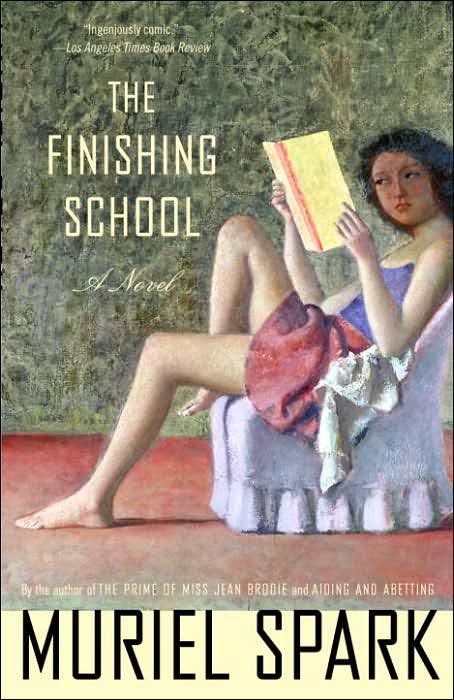
So begins Muriel Spark's last novel, The Finishing School,
a satiric look at a private progressive institution that Miss Jean Brodie in her prime would have been quick to deem a “crank” school and would have been loathe to be associated with.

Rowland Mahler and his wife Nina Parker operate College Sunrise, a school where parents with “dire wealth” consent to send their teenagers for a year or two to get them out of the way. College Sunrise could not in any way compete with the famous schools and finishing establishments recommended by Gabbitas, Thring and Wingate in shiny colored brochures. Indeed, College Sunrise was almost unknown in the more distinctive educational circles, and in cases where it was known, it was frequently dismised as being rather shady. The fact that it moved house from time to time, that it seldom offered a tennis court and that its various swimming pools looked greasy, were the subject of gossip when the subject arose, but it was known that there had so far been no sexual scandals and that it was an advanced sort of school, bohemian, artistic, tolerant. What they smoked or sniffed was little different from the drug-taking habits of any other school, whether it be housed in Lausanne or in a street in Wakefield.

When the novel opens College Sunrise is in operation on the lake at Ouchy after previously being located in Brussels and Vienna. Nina conducts “casual afternoon comme il faut talks” with the school’s eight students ("'Be careful who takes you to Ascot,' she said, 'because, unless you have married a rich husband, he is probably a crook.'") while Rowland teaches creative writing. In fact, one of the students, 17-year-old Chris Wiley, red-haired, handsome, annoyingly self-assured, has enrolled in College Sunrise specifically so that he can write his historically inaccurate novel on Mary, Queen of Scots.

Rowland reads the opening pages of Chris' novel, finds them "quite good," and then experiences a debilitating case of writer's block where his own novel is concerned. Most of Spark's novel is thereafter concerned with the uneasy relationship between Rowland and Chris: Rowland's jealousy at first amuses Chris, who taunts Rowland with his hidden-away work-in-progress and thrives on reports that Rowland has been searching his belongings in a desperate attempt to find it. Later, after Nina is finally able to convince Rowland that his obsession with Chris' novel is bordering on insanity and he seeks a cure by temporarily checking into a monastery, Chris finds he requires Rowland's presence or else he is unable to write. Clearly, the madness goes both ways.

Nina wants Chris gone but realizes his tuition is needed less the school go under. She begins an affair with an art historian who lives in a neighboring villa. Rowland knows and doesn't care; he's busy attempting to sleep with the servant who is sleeping with Chris.

Nina, her lover, and the students all speculate whether Rowland's obsession with Chris' novel is actually a case of misplaced homosexual desire.

Finally, two of the publishers Chris has sent his novel to come to Ouchy and begin to offer a bit of perspective on Chris's talent and prospects. Chris' confidence is momentarily shaken, but he's quick to once again manipulate those around him, especially when he sees Rowland's chances at literary success wax considerably. I won't say who or how, but someone almost dies.

Now, while I loved The Prime of Miss Jean Brodie, I remained largely indifferent to The Finishing School. I read it twice to see if I could put my finger on what kept it from being a more enjoyable, a more memorable read. The best I could come up with is that Spark’s natural inclination to omit all but of vital import undercut her efforts here. Chris and Rowland discuss whether they feel their characters take on a life of their own; Chris maintains that his are firmly under his control and can do nothing he does not will. Spark’s characters here definitely fall under strict authorial control; she pushes them about to advance her story without bringing them fully to life. And why she chose to have the character whose writing is called "actually a lot of shit" by a prospective publisher, who recognizes that Chris' approaching success is based on his youth, not his talent, be the one whose methods most mimic her own is definitely beyond my understanding.

I also thought that the use of flash forwards, which I am, in general, exceedingly fond of, and found most effective in Jean Brodie (and in The Driver's Seat, which I read last month), undercut my concern in The Finishing School. While knowing that Miss Brodie is to be betrayed, that Sandy will become a nun, that Mary will be killed in a fire (or that that strange Lise is going to be murdered before morning comes), heightens the suspense and keeps me engaged with how future events are to come about, foreknowledge here deflated my interest. Why should I care now about the state of Rowland and Nina's marriage when I know she's going to be much happier as an art historian married to someone else? Why should I care now that Chris' novel is no good if he's still going to manage to get it published? Why should I care now about any of the students at the Sunrise School when I know they all have enough money or family prestige to take the rough edges off their years to come?

Based on these two books, I'd have to say that if an author can't or isn't willing to vary her style and technique from book to book, she ought to take care that the stories she has to tell will work with her style rather than against it.

I'm late getting this posted compared to everyone else, so I'll wait to discuss Jean Brodie in the Metaxu Cafe forums. I will say I'm glad this Slaves of Golconda reading gave me reason to read it again--I read it back in high school and retained very little--and that I do intend to read more by Spark. I'm going to chose titles for the most part, though, from the first half of her career when her style is economical, but not yet miserly. I don't have a problem meeting a writer halfway, but I'm not willing to do more than that.

(cross posted at pages turned)

In the Prime of Her Hubris

Cross posted at So Many Books

Where to start with The Prime of Miss Jean Brodie? On the surface the book is simple, Jean Brodie, teacher, a woman in her prime, and the six girls who are the Brodie set. Miss Brodie's methods of teaching are unorthodox but the girls are loyal to her even when headmistress Miss MaKay begins inviting the girls to tea to pump them for information she can use to get Miss Brodie fired. Eventually, when earnest encouragement has stopped, one of the girls betrays Miss Brodie.

Underneath the simple story with the simple style, is a surprising depth: the power a teacher has to shape the lives of her students and the disillusionment of the student when she realizes the teacher is only human. The book takes small leaps into the future now and then so the reader knows fairly early on that Miss Brodie will be betrayed and by whom it will be done. The how and why is left to develop with the progression of the narrative.

Miss Brodie never finds out who betrays her. She never knows the betrayal came from the one she trusted most, and still trusts after it is all over. I don't know if Miss Brodie genuinely doesn't know, or if she just doesn't want to know, refuses to believe in the truth that is before her. Miss Brodie is a likable character. I feel bad for the end of her prime. It ends, I think, because of a certain amount of hubris, too much belief in her power to hold her girls' loyalty forever. She forgets that even though the girls are young and impressionable, they grow up and they learn different ways of looking at the world--Miss Brodie cannot control their thoughts, she cannot control who the girls become. She thinks she can. And that is her downfall.

While I feel sorry for Miss Brodie I also found myself wondering how she could be so stupid. The book takes place in the 1930s. Mussolini and Hitler are just coming into power. Miss Brodie thinks fascism will make the world a better place. Maybe it is because I have the hindsight of history that her thinking makes me cringe.

I felt throughout the book an underlying sense of menace. I have tried to put my finger on it, but I am not sure what it is exactly. Perhaps it is the early knowledge that Miss Brodie will be betrayed by one of her own. Perhaps it is the personal details of her life, real and imagined, that she imparts to the girls. Maybe it's both, or something else. Whatever it was, it gave me a creepy feeling now and then.

How does Miss Brodie compare to my extra credit book, A Far Cry From Kensington? Both have the same wry humor. Sandy, one of Miss Brodie's girls, reminded me a little of Mrs. Hawkins in A Far Cry. It also had a touch of menace in it. Both books also focus on a sort of closed community--the school in Miss Brodie and a boarding house in A Far Cry. Each of them is peopled with delightfully quirky individuals. Miss Brodie, however, is definitely a deeper read.

I enjoyed both Spark books very much and after a bit of a break, plan to read more of her.

This is a Slaves of Golconda group read. All are welcome to joint the discussion at the MetaxuCafe forum.

The Prime of Miss Jean Brodie

(Cross-posted at Of Books and Bicycles)

I liked this book well enough to read it twice, one time right after the other. It was well worth the re-read.

The story is about the “Brodie set,” six girls whom Brodie, a schoolteacher, takes under her wing, nurturing them and teaching them her version of culture – and sometimes the regular school lessons too. Spark sums up each of the girls in a few phrases which she repeats throughout the book. There is Monica Douglas, “famous mostly for mathematics which she could do in her brain, and for her anger which, when it was lively enough, drove her to slap out to right and left.” There is Rose Stanley, “famous for sex,” Eunice Gardiner, “small, neat and famous for her spritely gymnastics and glamourous swimming,” Jenny Gray, who will become an actress and is “the prettiest and most graceful girl of the set,” and Mary Macgregor “whose fame rested on her being a silent lump, a nobody whom everybody could blame.” Most importantly, though, there is Sandy Stranger, whom the book will follow most closely. She is famous for her squinty, disconcerting eyes.

Brodie is an unconventional teacher; she spends much class time telling stories, some of which are about her love life, and while she tells stories she sometimes asks students to hold up their books so that if the headmistress walks into the classroom they will look like they are working. She doesn’t balk at instilling her particular eccentric opinions and biases, and while she claims the sciences have their place, she makes it clear that art is what really matters.

Most importantly, she forms her “set,” the girls she cultivates particular relationships with, and who remain loyal to her even once they have passed through her classroom and moved on to higher grades. Her unconventional teaching and the loyalty of this set upset the other teachers and the headmistress, who spend the book scheming to get rid of Miss Brodie. This forms part of the tension of the novel: will she lose her job? Will the girls remain loyal to her? Who is it who finally betrayed her?

The nature of Brodie’s relationship with the girls is what’s really at the center of the novel, and this relationship changes – at first they admire her and follow her almost unthinkingly, and as the novel progresses, the girls grow up, and begin to question her, Sandy especially. And Brodie herself changes, from an idealistic, independent role model, dedicating the “prime of her life” to the girls, to something much more sinister. Sandy must separate herself from Brodie in order to figure out who she is and to become an adult. Sandy struggles with the feeling that she is too-closely identified with Brodie quite early on; in one scene when Sandy is tempted to be nice to Mary, a girl to whom almost no one is nice, she stops when she realizes Brodie is nearby:

The sound of Miss Brodie’s presence, just when it was on the tip of Sandy’s tongue to be nice to Mary Macgregor, arrested the urge. Sandy looked back at her companions, and understood them as a body with Miss Brodie for the head. She perceived herself, the absent Jenny, the ever-blamed Mary, Rose, Eunice and Monica, all in a frightening little moment, in unified compliance to the destiny of Miss Brodie, as if God had willed them to birth for that purpose.

She was even more frightened then, by her temptation to be nice to Mary Macgregor, since by this action she would separate herself, and be lonely, and blameable in a more dreadful way than Mary who, although officially the faulty one, was at least inside Miss Brodie’s category of heroines in the making.

And, ominously, Brodie admires Mussolini and the fascists. The novel is set in the 1930s, and we as readers understand just what it means to admire Mussolini. And here are Sandy’s thoughts, shortly after the passage quoted above:

It occurred to Sandy, there at the end of the Middle Meadow Walk, that the Brodie set was Miss Brodie’s fascisti, not to the naked eye, marching along, but all knit together for her need and in another way, marching alone. That was all right, but it seemed, too, that Miss Brodie’s disapproval of the Girl Guides had jealousy in it, there was an inconsistency, a fault. Perhaps the Guides were too much a rival fascisti, and Miss Brodie could not bear it. Sandy thought she might see about joining the Brownies. Then the group-fright seized her again, and it was necessary to put the idea aside, because she loved Miss Brodie.

So Sandy’s struggle with Brodie – her love for her, her admiration for her, her suspicion of her, and eventually her feeling of suffocation because of her – becomes a way of thinking about the larger cultural lure of and struggle with fascism.

The girls’ curiosity about sex is a part of the story too; they try to imagine Brodie with her lovers and figure out the mechanics of sex, and then they observe in fascination as she begins an affair with one instructor, Mr. Lowther, and falls in love with another, Mr. Lloyd. They are both thrilled and horrified. But Brodie crosses a line when she starts scheming to turn the now late-adolescent Rose into Mr. Lloyd’s lover, as a proxy for herself. Sandy is fully aware of what is going on, and reacts in her own, completely unexpected way. Near the end of the novel, she tries to come to terms with what is happening:

She thought of Miss Brodie eight years ago sitting under the elm tree telling her first simple love story and wondered to what extent it was Miss Brodie who had developed complications throughout the years, and to what extent it was her own conception of Miss Brodie that had changed.

It is when Sandy realizes that Brodie “thinks she is Providence … she thinks she is the God of Calvin, she sees the beginning and the end” that she is able to separate herself fully. Sandy is a mysterious character; I’m intrigued by her decision to become a nun, and I’m not sure I fully understand it, except that she has a longing for order, inspired in part by Brodie:

All the time they were under her influence she and her actions were outside the context of right and wrong. It was twenty-five years before Sandy had so far recovered from a creeping vision of disorder that she could look back and recognize that Miss Brodie’s defective sense of self-criticism had not been without its beneficent and enlarging effects …

Sandy seems to shuttle back and forth between longing for order and feeling stifled by an order too powerfully imposed on her. It takes her a long time, and perhaps it also takes the experience of being a nun, to learn to value a fruitful disorder. But this is something that as an adolescent she is not prepared to deal with.

The writing style is spare and economical, and Spark uses repetition – of the girls’ defining characteristics, of the phrase “the prime of life,” – which creates a sense of an incantation, as though she can conjure up a sense of her characters, not through the accretion of detail, but by dwelling on the most telling details over and over again. And she moves around in time, skipping back and forth while the story slowly reveals itself. It’s as though she’s circling around the main point, approaching it from many angles, giving us the story in a disjointed way that over time begins to come together.

I found Sandy’s artistic interests intriguing; here Spark dwells on the way the artist seeks out patterns and creates patterns out of life. Sandy realizes after a while that Brodie embellishes her stories and changes them to suit her moods. In this example, the girls are thinking about Brodie’s retelling of the story of her love affair with Hugh, an event that predates the novel:

This was the first time the girls had heard of Hugh’s artistic leanings. Sandy puzzled over this and took counsel with Jenny, and it came to them both that Miss Brodie was making her new story fit the old. Thereafter the two girls listened with double ears, and the rest of the class with single.

Sandy was fascinated by this method of making patterns with facts, and was divided between her admiration for the technique and the pressing need to prove Miss Brodie guilty of misconduct.

This is the same conflict we saw in Sandy’s response to Brodie’s “group-think,” the lure of Brodie’s cult of personality and the fear of chaos she evokes. Sandy is attracted and repelled by Brodie’s disorder, the willingness to play with facts if this makes a better story, the impulse to shape the world to meet the demands of art.

Spark’s own shaping of the raw materials of life is obvious in the novel; she draws attention through the repetition and the shifts in time to the fact that the novel is a constructed, made thing. She is not straightforwardly “realistic.” Her characters have life and interest, but she is more concerned with locating the patterns of their lives and interactions than with accumulating detail about them, in the way most novels do. Spark does brilliant things with her short form; using just a few details, she creates the sense of real, complete human beings, but her economy of detail also allows the underlying lines and patterns to shine through.

Thursday, June 29, 2006

"The Prime of Miss Jean Brodie" by Muriel Spark

Cross-posted from Bookworm

It was a bit distracting reading The Prime of Miss Jean Brodie right after reading Muriel Spark's autobiography. Just about every page of the book contains some object, setting, or event that was part of Spark's own schoolgirl experience in 1930's Edinburgh. Certainly they have been transposed, modified, reworked to fit the fiction, but it was hard not to notice them as I went along—the musquash coat, the smashing saucer, the poor of Edinburgh, the charismatic teacher enamoured of art and Mussolini.

I found myself wondering which parts not mentioned in her autobiography were also from her real life and which were invented. Spark calls her school years "the most formative years of my life" and devotes a great deal of space to them in her memoir. It's no wonder that the environment that made such an impression on her has made such an impression on readers, even in its rearranged form.

What is this book about? That is the question I had in my mind after reading it, and I confess I can't come up with a good answer. The explanations in the book, mainly given through Sandy, just seem too easy. Or am I mistaken in thinking that a good book must be difficult? Is it as it appears, a story about the dethroning of a frustrated, fascistic, self-deluded woman who wrought havoc among men and girls during her "prime"?

After reading Muriel Spark's autobiography and her descriptions of the various "utterly abnormal" people she had known, it is certainly possible that Spark just wished to create her own species of mental case (inspired by one of her own teachers) and see what would happen when she was unleashed on a variety of vulnerable people. That would be very much like the obsessive observer of human idiosyncracies that Spark was.

Though broader issues—Calvinism, fascism, Catholicism—feature in the story, I am inclined to believe that the book is more about people than ideas, or, at most, what happens when ideas impinge on personalities formed by nature and distorted by experience. Would Miss Brodie have come to admire Mussolini and Hitler had her lover not died in the war? Would Sandy have become a nun and psychologist were it not for Miss Brodie? How is that Rose was able to "[shake] off Miss Brodie's influence as a dog shakes pond-water form its coat" and the others were not?

As you can see, I seem to have more questions than answers, so I think I'd better go read the other Slaves' posts and learn a thing or two about this book. But before I do that, I'd like to announce that the next Slaves of Golconda read will be chosen by Stefanie of So Many Books. Anything but Clarissa, OK Stefanie?

For more Brodie questions, see ReadingGroupGuides.com.