Tuesday, July 31, 2007

Tales from the Life of an Observer


I read Elizabeth Hardwick’s novel Sleepless Nights (New York Review Books Classics) for the Slaves of Golconda this month. If I had to give the book a subtitle, it would be "Tales from the Life of an Observer." This book is probably the novel least like a novel that I have ever read. There’s not a real way to summarize the plot, because it doesn’t really have a plot. Instead it is a novel of fragments, snatches of memory from a woman’s life. The narrator seems to be Elizabeth Hardwick, and not Elizabeth Hardwick. It is an autobiographical novel, but Hardwick is cagy even about categorizing it thus. And she reminds us in the first paragraph of the book that memory is not to be trusted. She writes from the perspective of an old woman looking back on her life, and calls this story “work of transformed and even distorted memory”. And then she says, “If only one knew what to remember or pretend to remember.”

The back jacket copy of the book calls the book a “scrapbook of memories, reflections, portraits, letters, wishes, and dreams”, and I like this description. It is this, and it is a portrait of a woman as seen out of the corner of the eye. The narrator doesn’t really tell us about her life, she tells us about the lives of the people around her, and we have to read between the lines to figure out who she is. So it seems that we are the ones assembling a scrapbook or collage, sifting through the details that seem to make up this woman’s life. It is an odd experience, reading this way, but I don’t think it’s unpleasant, just different for me. I’m used to a more straightforward narrative, and though it can be frustrating, it is also sometimes like reading poetry.

And as I got to know the narrator, I found that she is, like many writers, an obsessive observer. She is distracted from her own life by watching others, and finds meaning in her own life by watching others. She observes these peripheral characters in her life--people like a young prostitute in her Kentucky town, her homosexual roommate in New York, a guilty, sad woman with a mentally ill son, a neighbor who was an opera singer but becomes a bag lady, even Billie Holliday—she watches them and comments on their pain (mostly their pain, as this is not a book about happy people), and we can tell that she is compelled to do so, and defines herself by doing so.

Hardwick’s minimalist descriptions often pack a real punch. What seems at first to be a mere list of words could eventually bring tears to my eyes.

Here’s a description of life in New York for those of a certain class:

How pleasant the rooms were, how comforting the distresses of New Yorkers, their insomnias filled with words, their patient exegesis of surprising terrors. Divorce, abandonment, the unacceptable and the unattainable, ennui filled with action, sad, tumultuous middle-age years shaken by crashings, uprootings, coups, desperate renewals. Weaknesses discovered, hidden forces unmasked, predictions, what will last and what is doomed, what will start and what will end. Work and love; the idle imagining the pleasure of the working ones. Those who work and their quizzical frowns which ask: When will something new come to me? After all I am a sort of success.
She goes on to say: “There was talk about poverty. Poverty is very big this year, someone said.”

But then she goes on to describe poverty on the streets of New York, a very personal description of the bag ladies, who seem somehow emblematic of all women, to Hardwick:
A woman’s city, New York. The bag ladies sit in their rags, hugging their load of rubbish so closely it forms a part of their own bodies. Head, wrapped in an old piece of flannel, peers out from the rubbish of a spotted melon. Pitiful, swollen sores drip red next to the bag of tomatoes. One lady holds an empty perfume bottle with a knuckle on top of it indistinguishable from her finger. They and their rubbish a parasitic growth heavy with suffering; the broken glass screams, the broken veins weep; the toes ache along with the ache of the slashed boot. Have mercy on them, someone.
Hardwick's descriptions are always raw, always thought-provoking. As Geoffrey O'Brien says in the introduction to the novel, "The experiences that are evoked, described, brought to life, are at the same time shown to be words, tokens, emblems." I felt that the words, tokens, emblems were beautiful, but sometimes hard to decode.

This is a novel about a woman’s thoughts and observations, and through those thoughts and observations, we get glimpses of her life, but it’s a picture we have to put together ourselves. I found this plotlessness at times frustrating and at times mind-expanding. Sometimes her observations would send my thoughts off on surprising tangents. And the writing was often poetic and beautiful, so I enjoyed reading it, though I didn’t feel it always held together as a narrative.

Memory, Truth, and Fiction

Reading Sleepless Nights by Elizabeth Hardwick was at times like reading poetry. The quality of the writing is meditative and episodic. There is no beginning-middle-end plot. The book is what you might find yourself thinking of if you couldn't sleep at night. Not the worried about this and that stuff but the, I wonder how so-and-so is doing? And whatever happened to--? And I remember when--.

The novel is about a lot things but for me what stood out were the ideas about memory, truth, and fiction. These Hardwick sets up in the second paragraph of the book:
If only one knew what to remember or pretend to remember. Make a decision and what you want from the lost things will present itself. You can talk it down like a can from a shelf. Perhaps. One can would be marked Rand Avenue in Kentucky and some would recall the address at least as true. Inside the can are the blackening porches of winter, the gas grates, the swarm.
Statements of certainty followed by words that throw everything into doubt. Nothing is sure in this book. The narrator is named Elizabeth and her life is like the author's but it isn't. Elizabeth is writing about her life in letters to someone named M but the novel is not epistolary. She is telling about her life but she isn't, instead giving us stories about maids and Billie Holiday and other people.

Everywhere sprinkled throughout the book are references to memory and truth and fiction and how little or how much we know about ourselves and each other. At one point she writes, "Marie, I do not understand your fear of disillusion. Don't you see that revision can enter the heart like a new love?" And in the end:
Sometimes I resent the glossary, the concordance of truth, many have about my real life, have like an extra pair of spectacles. I mean that such fact is to me a hinderance to memory.
Facts getting in the way of memory, in the way of revising the past to suit your memories. If others know the facts it gets in the way of your revisions.

But the narrator isn't against everyone knowing the truth. There are some, the ones she cares for, who she "love[s] to be known by" and is always talking to them either by phone or letter. I can't help but wonder, however, with Elizabeth's penchant for revision, for making her life a fiction, how well she knows herself and how well she can really be known by anyone. Perhaps it is not the facts that matter but what one does with the facts? The story one makes out of them can be more revealing than the reality.

For such a short book there is much to think about. This is a book that would benefit from a re-reading. Like poetry, it will only get richer with familiarity.


Cross posted at So Many Books

Sleepless Nights by Elizabeth Hardwick

I’ve been trying to decide what to say about Sleepless Nights by Elizabeth Hardwick for quite a while now, and I’m still not sure. I feel conflicted not so much about the book itself but about what I actually feel and what I think I should feel about this book. I want to like non-traditional, experimental fiction. And I’d really like not only just to like it but to unequivocally enjoy the reading of it. But that doesn’t always happen. With Wittgenstein’s Mistress I appreciated it and thought about it a lot and am glad I read it, but I didn’t savor the experience. I didn’t mind putting it down after a while.

With Sleepless Nights I felt something similar. I appreciate what she’s doing, and I enjoyed the reading of it — more than I enjoyed Wittgenstein’s Mistress — but I also didn’t mind putting it down after a while. I read this book in short chunks — and the structure of the book makes that easy, with short “parts” and shorter sections within those parts — and I don’t think I could have read it fast if I’d tried.

Maybe the most damning thing I have to say about it (in my mind) is that I find myself not having a whole lot to say about it. With Wittgenstein’s Mistress, at least, I felt like I had a lot to say. As I sit here and try to pull together my thoughts on Sleepless Nights, what comes into my mind most often is the question of how I felt as I was reading it. I have already forgotten many of the book’s details, and I don’t have a strong sense of the book’s mood or atmosphere or a strong sense of character that might make me look back on my reading experience with pleasure.

But — enough of this navel-gazing. The book is short, about 130 pages, and is a collection of the thoughts and memories of a woman named Elizabeth. This is way the book opens:

It is June. This is what I have decided to do with my life just now. I will do this work of transformed and even distorted memory and lead this life, the one I am leading today ….

…..

If only one knew what to remember or pretend to remember. Make a decision and what you want from the lost things will present itself. You can take it down like a can from the shelf.

This makes a suitable introduction to the book, as it introduces the narrator and her task — to gather her memories and write them down. But it also warns us that what she remembers may be distorted, that she is not giving us a history of her life, but rather a picture of her life as she remembers it now. Everything is filtered through her present consciousness.

The narrative doesn’t follow chronological order, skipping around from place to place and year to year, as our memories do. So we get glimpses into her life — a youth spent in Kentucky and adulthood in New York City, Boston, Maine, and Amsterdam. She describes lovers, friends, and acquaintances, events and observations. There isn’t any connective tissue to any of this, no transitions that tell us how one story relates to another; instead they are simply bump up against one another, again, as our memories tend to do.

The narrator’s mother haunts many of the pages; early on she describes her life:

My own affectionate, tireless mother had nine children. This fateful fertility kept her for most of her life under the dominion of nature. It was a thing, a presence, and she seemed to walk about encased in the clear globe of it. It was what she was always doing, and in the end what she had done.

The narrator makes sure that she does not share this fate; instead her own story is of freedom and independence, of writing and travel and experience. She rejects her mother’s femininity (”an ineffable femininity, tidal”), and yet she’s aware of how it shapes her writing:

Tickets, migrations, worries, property, debts, changes of name and changes back once more: these came about from reading many books. So, from Kentucky to New York, to Boston, to Maine, to Europe, carried along on a river of paragraphs and chapters, of blank verse, of little books translated from the Polish, large books from the Russian — all consumed in a sedentary sleeplessness. Is that sufficient — never mind that it is the truth. It certainly hasn’t the drama of: I saw the old, white-bearded frigate master on the dock and signed up for the journey. But after all, “I” am a woman.

She is not writing an adventure tale of the type that men can much more easily experience and record; rather, her life and therefore her book are shaped by the domestic and by the reading she has done in those domestic spaces. This passage declares her refusal to write a traditional novel with a clear beginning and end and with action and adventure and drama; the novel that will portray her experience as a woman cannot be traditional. Instead it experiments with the elements of storytelling that have been passed down to her, in an attempt to write something new that can capture the memories circling around in her head.

There were moments when I read with pleasure, enjoying a portrait of a character Hardwick drew with skill. Her description of Billie Holiday, for example, is devastating. The book didn’t sustain that level of interest or pleasure, however. I’m very curious to hear what other people thought!

Words steeped in the conditional

Elizabeth Hardwick is the possessor of an amazing life: founder of the New York Review of Books, married to Robert Lowell, critic, novelist, essayist. Sleepless Nights, an odd hybrid of genres and ontological stances, may be her account of that life.

Or perhaps not - she did say, as Geoffrey O'Brien recounts in his introduction to the NYRB edition, that "A good deal of the book is, as they say, made up." This "as they say" is a bit of brilliance; it plays off the convention that memoirs are as much exercises in the weaving of fictions as novels are devices for sublimating personal demons, but it also asserts Hardwick's nearly infinite capacity to inhabit two stances at once. There is the fictional character Elizabeth, the protagonist of Sleepless Nights, and the outsider observing her fraught fictionality. Creating a protagonist who is both you and not-you is innovative, but it also reveals the anxiety of fiction writing, which demands a complex dance of revealing and concealing from the author.

In these identity games, Sleepless Nights reminds me of Martin Crimp's play Attempts on her Life, in which various efforts at the creation of a central character (via the lenses of screenwriting, celebrity, journalism, autobiography, archeology, fiction, and performance) reveal their inner violence as well as the multiplicity of identity. Attempts on her Life, famously, can mean either efforts at the ineffable holistic understanding of identity, or murderous attempts to eradicate it. But Hardwick's novel/memoir/genre-cracking performance also reminded me strongly of Adrienne Kennedy's work, perhaps because of the strong presence of New York as an environmental character, and perhaps because Kennedy chooses both writing and the stage as a means of negotiating the relationship between art and personal trauma, fiction and biography.

It seems strange to me that Sleepless Nights should fall into dialogue (in my mind) primarily with dramatic texts when, for all its generic experiments, it is fairly clearly prose. It is a novel of fragments, in which the events of Elizabeth's life are recounted as through the diffusing impulse of memory, an impulse which seems centrifugal, but in fact connects disparate elements as no linear narrative could do. Time never presents a problem for memory: associations skip freely over the years on thematic or imagistic lines, outlining a character, a relationship or a place without any reference to temporal development, to the arcs or lines of a well-made play or a realist novel.

Oddly, the novel begins with an assertion of time, the time of writing, before establishing memory's power to transform the order of history: "It is June," goes the first line, "This is what I have decided to do with my life just now. I will do this work of transformed and even distorted memory and lead this life, the one I am leading today." Living and writing cannot be separated. Both are actions that irrevocably transform everything that came before, as well as everything that comes after.

In one very famous section, Billie Holiday's bold and shattered life kisses up against Elizabeth's, and yet these encounters are no more or less formative than the quasi-marital relationship she develops with her gay roommate in roughly (always roughly!) the same period. Elizabeth lives life as an experiment in hybridity; a relationship cannot simply be friendship, but must partake in complexities of eros and convention that confuse the received wisdom on sexuality.

Some of the novels fragments are set out in letters, some as reflections on character (it is primarily a work about character, rather than about plot), some as responses to epigrammatic interjections from other famous writers. In fact, Sleepless Nights is considerably more aphoristic than it is novelistic, as you can probably tell from this unusually abstract review. Any attempt to summarize the plot of Sleepless Nights seems to me to be a flirtation with madness (Susan Sontag spoke beautifully to the subtlety of its shifts when she called it "a novel of mental weather"), but there are passages from every part of the short work which make this a thrilling read.

Hardwick on travel:
I took a journey, and of course, immediately everything was new. When you travel, your first discovery is that you do not exist. (5)

Travel as self-annihilation, as an exercise in proportion. How very different from the common assumption of tourism, that travel means having the world conform to your comfort, your wishes. Touristic travel is a way to bring back the whole world in convenient, manageable, diminished photographs. To reassert the reality of your quotidian life.

Speaking of photographs:
Photographs of marriage. records of blood, decisions, sacraments observed. In my apartment, around us, in the old fading red-pine chest, in the mahogany desk, in the Swedish desk too, in the fumed oak blanket chest, in manila envelopes marked "trip to Europe" are my own photographs, three hundred or more, that bear witness to form; pictures in the drawer, in the old box, photographs that make one his own ancestor. Of others I have cared about, cared for years - not a trace, not a fingerprint. As it should be. Those who leave nothing behind cannot be missed for long. (60)

And, perhaps my favorite, Hardwick on possessions, family, and sharing:
Of course these things are not mine. I think they are usually spoken of as ours, that tea bag of a word which steeps in the conditional. (6)
Here we are back to social hybridity, the double-stance of the "usually spoken of," cousin of "as you say" - myself/not-myself.

This is a fairly extraordinary document of a life and a character. Sleepless Nights feels as if someone had written the most vivid and witty of diaries for several decades, then ripped out all the pages and tossed them into the air. The reader wanders into this experiment in Dada with Hardwick, picking up a moment here, an encounter there, trying to make meaning out of seemingly random conjunctions. And how, after all, does one make meaning out of a life?

[The original version of this review can be found at Sycorax Pine.]

Characters on the periphery


There came a point in Sleepless Nights when I began to think of a bit of dialogue from Anne Tyler's Searching for Caleb:

You want to hear about my movie?"

"Yes."

"I'm going to buy a camera and walk around filming to one side of things, wherever the action isn't. Say there's a touchdown at a football game, I'll narrow in on one straggling player at the other end of the field. If I see a purse-snatcher I'll find someone reading a newspaper just to the right of the victim."


"What's the point?" Justine asked.

"Point? It'll be the first realistic movie ever made. In true life you're never focused on where the action is. Or not so often. Not so finely." He stopped and looked at her. "Point?" he said. "You don't usually ask me that."


This isn't exactly what Elizabeth Hardwick does in Sleepless Nights, but it is close enough to give me pause. Much of this novel--"this work of transformed and even distorted memory," as the narrator calls it in the opening lines--is concerned, to a great extent, with characters who would have been more on the periphery of her life than at the center, the "unfortunate ones" she has known, who live "surrounded by their own kind."

Perhaps here began a prying sympathy for the victims of sloth and recurrent mistakes, sympathy for the tendency of lives to obey the laws of gravity and to sink downward, falling as gently and slowly as a kite, or violently breaking, smashing.

The narrator, a woman named Elizabeth like the author, who has lived a life similar to that of the author, has landed as "a broken old woman in a squalid nursing home." She chooses to remember people and places from her past, from the Lexington, Kentucky, of her youth, to the cities of her adulthood, Boston, Amsterdam, New York, and put her memories into a type of order. But she omits most of what would provide the reader with a solid ground for understanding how and why she's come to this and what has happened to those who would have been at the center of her life, other than that they have died:

Sometimes I resent the glossary, the concordance of truth, many have about my real life, have like an extra pair of spectacles. I mean that such fact is to me a hindrance to memory.

Readers learn the distilled life stories of a maid, a laundress, an Appalachian communist. We catch glimpses of an uncle who writes letters to Elizabeth's mother from a mental hospital and various roommates, constructing lives out of Arthur Murray dancing classes or phonied-up prior job experience. We learn of Elizabeth's gay friend J., who dies young, the offstage Billie Holliday, a carpet sweeper and the residents of the squalid Hotel Schuyler, instead of the relationship that caused her to need an abortion, dealt with in two brief paragraphs that focus on the abortioners and their wives. Misdirection.

Elizabeth has lots of sex, not all of it enjoyable, but does not allow herself to become a victim of "fateful fertility" as her mother did, although she says she has always, "all of my life, been looking for help from a man." She and her childhood girlfriends learned "the tangled nature of bribery" via a predator who paid their way into movie theaters and fondled them as they ate chocolates.

To think, that is to wonder what I would be forgiven for remembering or imagining. What do those of my flesh and blood deem suitable, not a betrayal? Why didn't you change your name? Then you could make up anything you like, without it seeming to be true when all of it is not. I do not know the answer.

Narrator or author speaking here?

All we know for sure is is that Elizabeth, who "loves to be known by those" she cares for, writes down her memories of those she dares "not ring up until morning and yet must talk to throughout the night."

I'm definitely looking forward to discussion of this one.

Wednesday, June 06, 2007

And the winner is...

Sleepless Nights by Elizabeth Hardwick.

It came close but one of the founders of the New York Review of Books and reputable critic won over the prize-winning Japanese author. I've read Hardwick's critical works but not her fiction so this should be something of an adventure. Hopefully we'll have a lot of people reading and, more importantly, enjoying the novel. The deadline is July 31st.

Monday, June 04, 2007

What's next?

I was a bit surprised but pleased at being tagged to pick the next book. I decided to put it up for a vote and hopefully the selection is generally pleasing.

Captain Blood - Rafael Sabatini

The Woman in the Dunes - Kobo Abe

The Pornographer - John McGahern

Mr. Fortune's Maggot - Sylvia Townsend Warner

A Season in Rihata - Maryse Conde

Sleepless Nights - Elizabeth Hardwick

Sunday, June 03, 2007

The Next Vein

Thank you all for your quality reading of The Good Soldier. I thought the discussion was revealing, and, as always, it seems, there is much more depth to the novel than at first glance. Any lingering or future comments can still be made at the Metaxucafe forum.

The next vein to be mined will be chosen by the dreamy Imani. I am thankful for her insightful participation, and look forward to her choice. Slaves will reconvene on 31 July. Until then, enjoy your freedom!

Friday, June 01, 2007

A Distinctive Experience

Like some other SoC participants I approached The Good Soldier with negligible expectations. I knew that it had a brilliant first line and I had skimmed enough of the first page, before I checked it out at the library, to assume it could be an absorbing read. My early thoughts bore out -- it was a brilliant novel and an absorbing read, primarily because of the aesthetic experience it provided rather than for any revelations or insights. As Karen posted in the Metaxucafe forum thread, at heart it was about two couples comprised of individuals who, at the end, did not love each other and not even themselves. On the surface that can make for an aimlessly depressive read and it is only Ford's skill as a writer and his unconventional narrative choices that made it something memorable, if not ageless.

I only came to this conclusion firmly about a week after I had finished it. For a great deal of the first part of the book I wasn't sure if I had a handle on precisely what was going on. The jumps back and forth were disorienting and I worried that my mind was more focused on the sensation rather than the practical details of the story. In some parts when John would refer to Edward being with that "girl", the one that he hinted was Ashburnhaum's true love, I would not be sure who precisely he was speaking of -- it could not have been the young woman he kissed on the train and it seemed equally unlikely that the soldier's wife Maisie Maiden, with whom he had dallied with and whom Leonora had slapped. When Leonora attempted to share her grievances with John at the castle tour, apparently under the impression that John knew of his wife's infidelity, he departed from the story to personally reflect on what he felt now about the matter, being better informed. He described a dream he had.

...upon an immense plain, suspended in mid−air, I seem to see three figures, two of them clasped close in an intense embrace, and one intolerably solitary. It is in black and white, my picture of that judgement, an etching, perhaps; only I cannot tell an etching from a photographic reproduction...And they are in the sight of God, and it is Florence that is alone...I pray God that he [Edward] is really at peace, clasped close in the arms of that poor, poor girl!

I had no idea at the time who this "poor girl" was as Nancy Rufford had not been then properly introduced. That was only one of the times he alluded to her and I would often skip back to see if I had missed something. Ford's technique of jumping back and forth in the story time line also forced me to often skip back a few pages to see if I had a real grasp of where the previously rendered event settled into the overall sequence of events. Even the bits of dialogues were separated by these digressions, and so were minor servings, a few lines told of here and there and never lasting for long. Essentially it read as though he took from a pile one image, described it at length, include his own observations, and on sudden recall of something else drop the first and dig around for another. To take that further the end product was a collage made up of assorted images placed helter skelter on the background of Provence, the estates in England and New England.

I got the hang of it by the time I reached the section that fleshed out Leonora's personal history, but what crystallised it for me was Ford's essay "On Impressionism".

The point is that any piece of Impressionism, whether it be a prose, or verse, or painting, or sculpture, is the record of the impression of a moment; it is not a sort of rounded, annotated record of a set of circumstances -- it is the record of the recollection in your mind of a set of circumstances that happened ten years ago -- or ten minutes. It might even be the impression of the moment -- but it is the impression, not the correlated chronicle.

In the Broadview edition's introduction much was made about the well crafted construction of the novel but at the beginning it all seemed something more fluid. "Construction" seemed to rigid and definite a word to describe a narrative that appeared so permeable. (Or do I mean malleable?) This was heightened by Dorrell's detached and at times nakedly manipulative narration of the entire affair. As a reader I had nothing but my own faculties to conclusively decide just what the heck was going on, how I should be reacting to things. Ford took a deliberate, pronounced departure from the proceedings on one level and ironically this made me unsure as to whether I was truly enjoying the experience. Ironic because, if its anything I hate, it's a nosy, moralising author who can't help but clumsily interject his/her opinions into the narrative, or use characters as mouthpieces for her irrelevant opinions. But usually, even when a writer isn't boorishly judgemental, the way events play out usually and intentionally guides your feelings on way or another, whether or not your opinion is the one the author expected. Not so here as just about everyone lead a miserable existence, though Leonora's end was mildly less miserable than the others (and she deserved it).

It took a lot of thinking and a pair of Ford essays but I'm happy to say that I appreciated The Good Soldier. Not passionately, in the way Mrs Dalloway entranced and uplifted, I could not say that I loved The Good Soldier but I found it distinctly affecting, its style meaty and complex, and effortlessly re-readable.

Cross-posted at The Books of My Numberless Dreams. Dewey's interview with me about the novel at The Hidden Side of a Leaf.

Thursday, May 31, 2007

Bad Hearts

Where to begin with The Good Soldier by Ford Madox Ford? For some reason I was surprised by the complexity of the book. It seemed like it was going to be a straightforward story, but it isn't. The narrator, John Dowell, sucks you in from the very beginning. John appears to be a charming man who tells us that he's going to tell this sad story, the saddest story he has ever "heard" as though we were siting in a comfortable chair by the fireside with a glass of brandy in one had and a cigarette in the other. It quickly becomes evident that the story is not one he heard but one he participated in.

The story is about John and his wife Florence, both Americans, and their friendship with Edward and Leonora Ashburnham, both British. Florence and Edward both have bad hearts and both couples are staying at Nauheim when they meet. The course of the story takes place over twelve years, but John doesn't tell it in order. He digresses, jumps forward and backward, hints, keeps secrets, drops surprises and is, generally an unreliable fellow when it comes down to it. Both couples are rather well to do, "good people," with the "good" part turning out to be rather ironic. We learn fairly early in the book that Florence and Edward are having an affair. It is not Edward's first affair, nor it turns out, is it Florence's.

Leonora knows immediately that Edward and Florence are having an affair. She has put up with Edward's affairs; she is the classic long-suffering wife. She is Catholic and Edward is not. Divorce is not an option for her. She loves Edward and wants him to love only her but fails time and time again. She is portrayed by John as being heartless while Edward (the good soldier) has a generous heart. John blames Leonora for what eventually happens to Edward. He also blames her for not telling him that Florence was having an affair. The affair went on for years and I wonder how John was so stupid not to notice anything. He is lost in his own little world, isn't even upset when Florence dies, and he calls Leonora heartless. John is the one with the real bad heart.

John expresses surprise early in the story about not be able to truly know anyone: "After forty-five years of mixing with one's kind, one ought to have acquired the habit of being able to know something about one's fellow beings. But one doesn't." Then toward the end of the story he asks, "Who in this world knows anything of any other heart--or his own?" But consider the source. John is so emotionally disconnected from everyone, including himself, that he would not be able to know anyone. One must make the effort to be at least somewhat engaged with life and people on more than a surface appearance level to be able to know anything. And since John isn't, he blames others for what he doesn't understand and takes some hefty swipes at women and Catholics.

John is right, it is a sad story. It is sad because when John has opportunities to change outcomes, he doesn't. He made me angry with his passivity. By the end of the book I was actively cursing him. I wonder though, how much of John's ignorance is real and how much feigned? There is no way to know for certain and it infuriates me in a delightful, bookish way.


Cross-posted at So Many Books

A Tale of Dispassion

This book reminded us of another selection by the Slaves, The Prime of Miss Jean Brodie, in the way it shifts back and forth in time to tell the story. At several points in the book the narrator Mr. Dowell remarks that he has brought his story up to a point that he has already referenced. In the introduction, Mark Schorer likens the style to a hall of mirrors. The beginning of Part Four makes this explicit:
I have, I am aware, told this story in a very rambling way so that it may be difficult for anyone to find his path through what may be a sort of maze. I cannot help it. I have stuck to my idea of being in a country cottage with a silent listener, hearing between the gusts of the wind and amidst the noises of the distant sea the story as it comes. And, when one discusses an affair--a long, sad affair--one goes back, one goes forward. One remembers points that one has forgotten and one explains them all the more minutely since one recognizes that one has forgotten to mention them in their proper places and that one may have given, by omitting them, a false impression.
We don't quite know what to make of this book. It was certainly not as smashing as we had expected. The story concerns two conventional, mostly sterile, marriages, and an affair between one of the women and the other man. Dowell does not find out his wife has been involved with his friend until after she dies. Through it all Dowell takes pains to assure his silent listener that the other man, Mr. Ashburnham, is a fine gentleman, a good soldier. Mrs. Dowell, however, is only one in a line of women with whom Ashburnham dallies.

The four major characters all seem as if they are wandering without moral compass. All that seems to matter is the pretence of happiness. Perhaps today, with the rampant popularity of divorce, we look back at such marriages differently. In order to find Ashburnham "the model of humanity," Dowell must have suspended certain standards. In spite of everything, he says,
It is impossible for me to think of Edward Ashburnham as anything but straight, upright, and honourable."
Yet we must take Dowell's word for it, because he never describes any of the innumerable wonderful deeds Ashburnham performs.

Dowell idolizes Ashburnham, wants to be like him, and indeed, he even comes to mimic Ashburnham's desire for a young lady. Perhaps he harbors a secret love for Ashburnham. His unwavering esteem for Ashburnham makes his judgement suspect. And he certainly relates many details about his wife's affair for having been oblivious to it until her death. These things make him seem an unreliable narrator. This begs the question: What is the point of an unreliable narrator? Without the balance of another point-of-view, how is the reader to understand the degree of the narrator's delusions? Or the reason?

Mr. Ford thought this his best work. We have not read anything else by him, so we cannot offer any comparison. This book is certainly well-written, with correct grammar and sentence structure and punctuation. This book also presents us with another narrator who feels nothing, and so the reader feels nothing as well.

Since the book began at the time of the ending, the ending seemed to come all at once. The characters lived on, but there was simply no more story to tell. All the change and lessons learned had come along the way, and all that remained was anticlimax. We have a decided preference for stories that end dramatically, with a conclusion that we suddenly realise has been pointed to from the very beginning. Though this novel is subtitled "A Tale of Passion," it could be better described as reserved. And though the narrator calls it the saddest story he has ever heard, there is more consolation than sadness.

Discussions about this book can be engaged at the Metaxucafe forum.

...cross-posted at Necessary Acts of Devotion.

Friday, April 20, 2007

MLLE LECHAT TO LADY SUSAN VERNON

Saint-Fargeau.

Ma chère Susan,--I do hope my missive will reach you in time. I am afraid it takes at least two or three weeks for letters to cross to Dover in these troubled times. Would you believe I have come across a recent publication which apparently is a faithful copy of your correspondence exchange with Alicia Jonhson over the period when you were staying with Charles and Catherine at Churchhill? Seemingly, Jane had learnt --probably from Catherine-- about your mildly successful endeavour, and had bargained from the family the assent to make copies of all the letters shuttled between Churchhill and Parklands at that time.

The story would not have developed any further had she not made another even more audacious move. As she was staying in London for some other business, she met with Alicia, and in circumstances that are still not clear to me but which I am inclined to believe involved some amount of dupery, she also managed to get hold of your letters to her as well as the draft versions of Alicia's replies to you.

You may or may not know that Jane fancies herself a famous writer, and your unfortunate state of affairs when you had to depart from Langford and bury yourself at Churchhill is now published as an epistolary novel under her signature! I hope I am mistaken, but I am quite certain she did not have your approval to act so. Obviously, all names are disguised, still I wager that some of our acquintances will find it easy to make the appropriate connections, and I doubt this would advance your current entreprise in any desirable way.

I must confess I read the book with great interest, not only because you have an incredibly sharp quill, but also because the letters that Jane selected and the order in which she presents them create a veritably romanesque atmosphere that had me captivated. From your first letter to Charles, I did recognize the force de caractère that makes you such a unique woman, and I gather the readers will feel some sympathy towards you, as I did when we first met; especially men, who are so often inclined to yield to loveliness, and will forgive all manner of conduct when the defence is a fair face that even women are drawn to admire.
The book does however gradually draw an ever darker portrait of you, simultaneously tarnished by Catherine's calumny and your continuous bad habit of opening your heart to Alicia in ways that you would never voice in the flesh. Your frankness of writing, which I believe reaches even beyond your true intentions, unveils elements about you that I would probably have preferred to remain ignorant of.

Yet, I could not help siding with you all along, as you seemed the only one that made things happen, for good or bad. I do not personally know Reginald and therefore am no judge as to whether he had deserved to fall victim of your manoeuvers, but even when I was convinced that you were probably pushing your draughts too far in that game -- because it was a game, ma chère, as it always is with you --, I was invariably drawn to admire you, apparently against my own reason.

I do not know if you have met Madame de Merteuil. She earned quite a réputation on this side of the Manche over the years. I am almost sure that although she would chuckle and call you an amateur in public, she would probably agree in private to take you under her wing should you issue such a request. Please be assured that you are la bienvenue here in Saint-Fargeau, in case you need to take some distances with London while the scandal of the publication subsides, or just for the palette of pleasures and adventures that France can offer.

Chaleureusement,

Mandarine.

Sunday, April 08, 2007

The Envelope Please

Well, there is overwhelming support for The Good Soldier by Ford Madox Ford. For me, this is another of those books I picked up some time ago for some specific reason that I can no longer recall, so it will be interesting to read. If you have already read it, consider rereading it, or skimming it to refresh, and at the very least participate in the final discussion.

Buy it, mooch it, borrow it from the library, or download it from Project Gutenberg. Just read it and have your thoughts ready to share on Thursday 31 May. I would greatly appreciate if someone with greater knowledge than me could set up a discussion page at Metaxucafe for this book. I will add links to the left side as well. Please feel free to post any other information you find relevant to the discussion at any time.

I hope everyone enjoys the book!

Thursday, April 05, 2007

Next Up

Participation this last time seemed a little thin, while we still maintained our devoted core. This surprised me, because it seemed last time there was a lot of response, and many new readers, commentors, and would-be enthusiasts. I am going to offer up a few titles from my collection, and ask for votes on which should be the next selection. I haven't read any of these, just heard good things or have been wanting to read them for some time.

I would also like to hear from other Slaves about which of you wants to choose the next book. Putting nominations to a popular vote is not required, so if you want to decree what next we read, please tell me why you should be so honored. Comments or email are accepted.

Now, the titles:
1. The Wood Beyond the World by William Morris. The cover calls it the first great fantasy novel ever written.
2. The Good Soldier by Ford Madox Ford. A Tale of Passion
3. The Curious Incident of the Dog in the Night-Time by Mark Haddon. A Whitbread Book of the Year.
4. A Canticle for Leibowitz by Walter M. Miller, Jr.
5. Thunder on the Left by Christopher Morley.
6. The Road by Cormac McCarthy.

A wide range of offerings, I think. Shout out your vote. By Sunday evening I will announce the final tally and decision, and we can all start reading. Thanks!

Wednesday, April 04, 2007

The next Slaves read?

I've asked Quillhill to choose the next Slaves of Golconda book, so be on the look-out for his choices -- I believe he will be offering up a few titles for a vote.

I hope you all enjoyed Lady Susan -- I, for one, am very glad I read it, and I certainly enjoyed reading everybody's posts.

Saturday, March 31, 2007

Lady Susan by Jane Austen

In her introduction to Jane Austen's Lady Susan (my edition also includes The Watsons, and Sanditon), Margaret Drabble writes that Lady Susan is the least satisfactory of the three unfinished works by Austen. Personally, an "unsatisfactory" work by Jane Austen is still pretty darn good. Lady Susan was written early in her career, about the time that she was working on Sense and Sensibility, Pride and Prejudice and Northanger Abbey. Lady Susan is her only epistolary novel, though Sense and Sensibility started out as an epistolary novel as well.

I thought it was quite interesting that Drabble called Lady Susan much more a product of the eighteenth century than the nineteenth (it is thought she initially wrote it in 1793-94 and was transcribed in 1805). Her later works definitely move forward from this, and she seems much more at ease in her later works--much more like Jane Austen than someone writing in the style of the eighteenth century (if that makes sense). The novel is made up of 41 letters and a conclusion. You can read the novel online here, and there is also a helpful family tree. Initially I was confused by the letter writers. I had to pay close attention to who was writing who (I printed out the family tree, which helped me keep everyone in order) as some characters share last names. However, once everyone was straight in my mind I could enjoy the story unfolding and Austen's writing voice.

Drabble calls Lady Susan Machiavellian. Although she is really quite wicked, she comes off as worldly, intelligent and polite. We know nothing of her past--only that she was married and has a daughter of 16 called Frederica. She calls her daughter stupid and is trying to marry her off to an utter bore of a man, which of course Frederica wants no part of. Lady Susan is definitely not your usual Austen heroine. She seems more like an anti-heroine. She is manipulative and just wants her own way and knows how to get it. She is having an affair with a married man and flirts with her sister-in-law's younger brother. If nothing else you have to admire her for being a strong character--if not a particularly nice one. You never really get to know Frederica, and I felt rather sorry for her.

I do like epistolary novels, though I can see what their limitations can be. You don't always get all the details you'd like, though Austen really did quite an admirable job in conveying her story. Only once or twice did she give lengthy dialogs in the letters, which seemed a bit unwieldy. I did feel a bit let down towards the end. It all seemed a bit anticlimactic. There was all this build up, and then you expect Lady Susan to get her "comeuppance". And well, it just sort of ended. She did tie up the loose ends, but I guess I wish there had been more explanation. Of course this was a novel she decided she didn't want to publish. Had she done so, she might have made changes.

I do plan on reading the other two unfinished novels, The Watsons and Sanditon. The Watsons, which I plan on reading next is called "a delightful fragment, whose spirited heroine Emma Watson finds her marriage opportunities restricted by poverty and pride." It was written later in her career. Sanditon "is set in a newly established seaside resort, with a glorious cast of hypochondriacs and speculators, and shows the author contemplating a changing society with a mixture of skepticism and amusement." She was working on Sanditon at the time of her death at age 42. This, of course, puts me in the mood to read the rest of her novels. I have only read Persuasion and Pride and Prejudice. I think reading these unfinished works will make me appreciate even more the artistry of her other novels.

You can also join the Slaves in the discussion of the novel at The Metaxu Cafe.

Cross posted at A Work in Progress.

Jane Austen, the Early Days

Cross-posted at So Many Books


The Slaves of Golconda pick this time around is Lady Susan by Jane Austen. This is early Jane, composed (probably) in 1795 and revised (probably) in 1805. I've read the book before, in a Jane Austen seminar in grad school, but I had absolutely no recollection of it. Obviously it made a huge impression on me, heh. The only evidence I have of reading it before is a few really dumb marginal notes and one or two underlined passages. This time around made more of an impression on me.

The book starts off lively enough with a letter from Lady Susan, widowed 8 months, to her brother-in-law, inviting herself very graciously to his house because she feels she can no longer impose on the kindness of her friends the Manwarings. It is a nice, polite letter and Lady Susan seems such a lovely person until, that is, you get to the next letter Lady Susan writes to her best friend Mrs Johnson. Here we find the truth of Susan's departure and understand that what Lady Susan says is never the complete truth. It is as Mrs. Johnson says late in the book, "Facts are such horrid things!"

This is a short book but Lady Susan still has time to become engaged, cause a divorce, break off an engagement, and marry someone else. The whole story takes place in letters written by the various people involved. Lady Susan is only 35, old by her time's standards, but she still has her beauty and charm to make up for not having any money. She is at the mercy of others and hates it. She schemes and charms and flirts and all the men fall in love with her and all the women hate her for it. If she were a man she would be a wealthy businessman with skills like hers. But she is only allowed to operate in the domestic sphere and she must have a living somehow. She must either marry her sixteen year old daughter to a wealthy gentleman over whom she can have some control, or she must find a wealthy gentleman to marry her. Lady Susan reminded me a little of Becky Sharpe in Thackeray's much later Vanity Fair.

Lady Susan is a finished book but it doesn't feel finished. The first letter starts in the middle of things which does provide a bit of mystery over whether Lady Susan's reputation is as bad as everyone says it is so it's not a bad place to start, I just think it could have been better. And the letters end before the story is actually done. Austen wraps it all up with a straight narrative conclusion of several pages which brings the excitement and liveliness provoked by the letters to a screeching halt. It's like she didn't know what to do to finish it so makes up an excuse for the narrative by saying the correspondence could not continue because the rest of the letters really weren't that interesting.

I found Lady Susan entertaining, but nowhere near the caliber of Austen's later, famous works. If you are not interested in Austen, the book is probably one to skip. However, if you want to see how her skill developed, how she was playing around with character and structure and dialogue before she hit her stride, then Lady Susan is worth a read.

Everyone is welcome to join in or just eavesdrop on the Slaves discussion at Metaxucafe.

Friday, March 30, 2007

Lord Quillhill to Ms. Austen

Thank you for allowing me to read your novel Lady Susan. I think it is the first novel of yours I have ever read. Let me tell you about the experience.

I was slow to sort out who was who, when characters have the same last names, and relations by marriage are referred to as blood. Even once I had this fairly sorted out in my mind, I had to pause at the start of each letter and think who exactly is writing to whom?

The epistolary novel is a form that is rather pleasing to me. I often marvel at how much story can be conveyed, and here I felt you did a good job. You are clearly in control of this story, evidenced first by your selection of letters--leaving out some of the non-essential correspondence--and your authorial conclusion at the end. Despite the letters that are not included, the events are still easy to follow, showing a skillful composition of the others. What I did not learn--and if I simply missed this information somewhere in my reading, I beg your pardon--is what happened in Lady Susan's past. If I understand, she has lost her husband and seduced another woman's husband. When other characters allude to what happened, though, I do not recall any details being given. The good thing is this does not detract from the story for me. What is interesting and important in the best fiction is not what happens, but how characters react and respond. You have done this, my dear, to your great credit.

I found the letters sounded similar in tone and style; if each character had a more distinctive voice, the novel may have been improved. I also beg of you an eclaircissement to understand the word eclaircissement. Never had I heard of the word before, and it seemed to come in this story completely out of left field. But these are minor gripes coming from someone who has been unable to get published himself, so what must I really know?

Lady Susan began as sympathetic for me. Through all she remains strong, and never a victim. By the end, when her plots and cabals have been revealed, I felt no malice toward her, but my initial sympathy had bled away. She remained a most interesting character. Your novel does not stand like a rock in the middle of nowhere, but tells of one adventure in the life of Lady Susan, and I am convinced that there are many others. Had you been published by one of our modern houses, I am sure your publisher would have begged for a sequel, and even a prequel.

The novel reminded me of Choderlos de Laclos' Les Liaisons dangereuses. Obviously the form is the same, but the way Lady Susan plotted and tricked and used her wiles to influence and control others is, in a more subdued manner, exactly what the Marquise de Merteuil does. Both characters are absolutely fascinating, and it is a wonder to witness their talents in action, and try to understand how they are able to wield such power over others.

Though I voted for your novel because it was the one I least didn't want to read, I was pleasantly surprised, and enjoyed it. Perhaps one day our paths will cross again, and I may be treated to another of your classic works. Until then, I will remember this novel and think of you fondly.

Your most sincerely obliged Slave,

Quillhill
[this letter is cross-posted in a slightly modified form at Necessary Acts of Devotion]

Lady Susan

I enjoyed this book very much; it was a pleasure to read something by Jane Austen I hadn’t read before. I’m very familiar with her six major novels, but there is still a lot of shorter stuff I haven’t yet gotten to. My edition of Lady Susan includes The Watsons and Sanditon, the first of which I’ve now finished and the last of which I’m going to read next.

I’ve heard many people talk about the limitations of the epistolary form, and it’s probably true that there’s a limited number of things you can do with it, but I do like the form anyway. Perhaps it’s all the reading in the 18C I’ve done, a time when the epistolary novel flourished. What I like about it is the way you can see different versions of a character in the letters written to different audiences, and the way reading an epistolary novel gives one the sense of the importance of words and writing and how people can do battle with language — and other, less violent things, of course. But I think of doing battle with language when I think about Lady Susan, as Susan seems to be at war with much of the world.

Here is what she says in the very first letter of the novel:

I can no longer refuse myself the pleasure of profiting by your kind invitation when we last parted, of spending some weeks with you at Churchill … I impatiently look forward to the hour when I shall be admitted into your delightful retirement.

And this is what she says in the second letter of the novel:

I take town in my way to that insupportable spot, a country village, for I am really going to Churchill. Forgive me, my dear friend, it is my last resource. Were there another place in England open to me, I would prefer it.

Already we know so much about Lady Susan. She presents herself in very different ways in these letters, but even within one letter, her language can be interpreted in multiple ways. She writes the following to her brother-in-law, the owner of Churchill:

I am determined you see, not to be denied admittance at Churchill. It would indeed give me most painful sensations to know that it were not in your power to receive me.

As this is the novel’s first letter, we might interpret this to mean that Lady Susan wants to visit Churchill very much because she is genuinely interested in seeing those who live there, and this is the meaning she expects her brother-in-law to find. Upon knowing something more about Lady Susan, however, we can see that these sentences hint at her real feelings: she must leave her current residence, Langford, home of the Manwarings, because she has gotten herself into trouble there, and if she cannot stay at Churchill, she will experience “painful sensations” because her escape route will be blocked.

It’s this kind of facility with language that makes Lady Susan a very fun heroine — or villain, rather, except that, as Margaret Drabble, author of the introduction to my edition, points out, there really is no satisfactory heroine here, so Lady Susan steals the show. She prides herself on her ability to talk herself into and out of any situation (”If I am vain of anything, it is of my eloquence”); this is how she keeps Reginald, her gullible young admirer, by her side for so long. When Lady Susan can no longer convince people to believe her version of events, the novel ends — there is no more story.

The difference between appearance and reality, and the time and trouble it takes to learn to tell the two apart is a very common plot line in 18C fiction, and Lady Susan has much going for her as she tries to fool nearly everybody. She’s beautiful, and even Mrs. Vernon, her most serious enemy, is susceptible to it:

She is delicately fair, with fine grey eyes and dark eyelashes; and from her appearance one would not suppose her more than five and twenty, though she must in fact be ten years older … Her address to me was so gentle, frank and even affectionate, that if I had not known how much she has always disliked me for marrying Mr Vernon, and that we had never met before, I should have imagined her an attached friend.

Lady Susan is a symptom of a larger problem:

One is apt I believe to connect assurance of manner with coquetry, and to expect that an impudent address will necessarily attend an impudent mind; at least I was myself prepared for an improper degree of confidence in Lady Susan; but her countenance is absolutely sweet, and her voice and manner winningly mild.

We expect people’s insides to match their outsides, in other words — to be beautiful only if their hearts and minds are beautiful, and to act mildly and kindly only if they have mild and kind minds. Someone who combines a beautiful appearance and pleasant manners with lying and deceit is dangerous.

So Lady Susan depends on her pleasing appearance and behavior to keep her out of trouble and to get her whatever she wants. Besides the appearance vs. reality theme, there’s the juxposition in the novel between public reputation and the impression a person makes in private. Lady Susan counts on the power of private impression to overrule reputation; of her enemy Mrs. Vernon she says:

I hope [she is] convinced how little the ungenerous representations of any one to the disadvantage of another will avail, when opposed to the immediate influence of intellect and manner.

The novel shows, however, that reputation does mean something, and that the “ungenerous representations” of Lady Susan are a better source of truth than anything she herself says or does. You are better off trusting public concensus than trusting your own instincts — collective wisdom outweighs the individual’s insights.

Opposed to Lady Susan’s doubleness and deception is her daughter Frederica, whose simplicity Lady Susan cannot stand:

Her feelings are tolerably lively, and she is so charmingly artless in their display, as to afford the most reasonable hope of her being ridiculed and despised by every man who sees her. Artlessness will never do in love matters, and that girl is born a simpleton who has it either by nature or affectation.

Frederica’s artlessness is held up for praise in the novel; her mother’s criticism is a sign that we are to admire her, and yet she is a boring and lifeless character. All the interest in the novel belongs to Lady Susan. So we are left to deplore Lady Susan’s cruelty and deceitfulness, and yet we can’t help but admire her energy and intelligence and, yes, her artfulness and artifice. After all, Lady Susan’s skill with language is a skill she shares with her creator.

Sunday, February 25, 2007

History of the Slaves

Since Stefanie's discovery of Emerson's association with the eminent group, there has been a widespread clamouring for more information. Much scholarship is needed to uncover the details, buried under years of lies and fears. A few people throughout the years have claimed the existence of a Secret History, though such a document has never been found. Absent of that, we can only piece together fragments and fill in the blank spots with educated guesses. In order to satisfy some of the curiosity, we plan to offer occasional posts concerning the history of the Slaves. Perhaps this will also draw out others who have additional information, and a great deal more will be learned. Until that definitive history is written, we will continue to read after Coleridge's definition, and honor the true purpose and mission of the group.

Though the Slaves of Golconda were originally and always dedicated to studied reading, the stigma that was attached to them arose by a mistaken connection to a story of romance. Stanislas Jean, chevalier de Boufflers, was studying for the priesthood at Saint-Sulpice in 1760 when he met the renowned Latin poet François-Joseph Desbillons, also a Slave. Desbillons told Boufflers a story about a young nobleman and a girl of humble origins, which Boufflers wrote down and began circulating as Aline, reine de Golconde. When the story reached Jean Couturier, director of the Society of Saint-Sulpice--evidence strongly suggests that he never read the story himself, but was told about it by an underling known by the somewhat odd name Sous-Fifre, which is sometimes translated as "slave" in Dutch--he removed Boufflers, who sought refuge with the Knights of Malta. Sous-Fifre alleged the story was a sort of manifesto for a sex cult, the worship of a woman who exercised power over the most noble of men, something the church superiors could not abide. For hundreds of years, the Slaves were maligned and persecuted as misinformation about them was widely disseminated. In some places and circles Aline is still regarded as a modern Eve. Some scholars have even suggested that Coleridge was first attracted to the group because of its association with illicit love.

Monday, February 12, 2007

Illustrious Members

Stefanie posted this on her blog today:
I was reading Emerson: The Mind on Fire and came across this passage:

Coleridge notes that there are four kinds of readers: the hourglass, the sponge, the jelly bag, and the Golconda. In the first everything that runs in runs right out again. The sponge gives out all it took in, only a little dirtier. The jelly bag keeps only the refuse. The Golconda runs everything through a sieve and keeps only the diamonds. Emerson was not a systematic reader, but he had a genius for skimming and a comprehensive system for taking notes. Most of the time he was the pure Golconda, what miners call a high-grader, working his way rapidly through vast mines of material and pocketing the richest bits.

So there we have it, Emerson was a Slave of Golconda.

Though it is not widely known, there have in fact been many other illustrious members, some whose names cannot be revealed. During the middle ages membership most likely meant death, so the Slaves had to keep a low profile. Pope Silvester III was deposed because of his alleged membership. In some areas there is still a stigma attached to the group, and so certain people wish to have their affiliation kept secret.

If you would like to join, leave your email address to receive a proper invitation. Of course, you may still participate without assuming the bonds of membership, but you will be denied the honor of identifying yourself with the revered group, and engraving your name on the Ages.

Thursday, February 08, 2007

Vote on the next Slaves of Golconda book!

It’s my turn to choose a book for the next Slaves of Golconda read, and what else can I do but pick something from one of my favorite centuries, the 18th? I thought I’d pick three things and let people vote. The group is open to everyone, so if you haven’t participated before you are free to join — all you have to do is read the book and post on it on your blog and/or participate in the discussion at Metaxu Cafe and in comments on other people’s posts. If you plan on participating let me know in the comments which book you’d like to read by, say, Sunday night (Feb. 11), and I’ll tally the votes then (you can also vote on my blog here).

So here are the possibilities I’m thinking of:

  1. Samuel Johnson’s Rasselas. I’ve read this before, but I’m happy to read it again, especially since I’m learning so much about Johnson through Boswell’s Life. Here’s the first sentence: “Ye who listen with credulity to the whispers of fancy, and pursue with eagerness the phantoms of hope; who expect that age will perform the promises of youth, and that the deficiencies of the present day will be supplied by the morrow; attend to the history of Rasselas, Prince of Abissinia.”
  2. Maria Edgeworth’s Castle Rackrent. This work is very short (it looks like about 60 pages), but if you get the edition I linked to, it comes with another novel Ennui, which could make a good bonus read. I’ve read Edgeworth’s most famous novel, Belinda, and liked it a lot, so I’m eager to read more of her work. Here’s what Wikipedia says about the book: “Castle Rackrent, a short novel by Maria Edgeworth published in 1800, is often regarded as the first true historical novel and the first true regional novel in English. It is also widely regarded as the first family saga, and the first novel to use the device of a narrator who is both unreliable and an observer of, rather than a player in, the actions he chronicles.”
  3. Jane Austen’s Lady Susan. I’ve read all of Austen’s major novels but have yet to read her earlier work. This one is also very short, and the edition I linked to includes The Watsons and Sanditon, an unfinished novel, which would also make good bonus reads. Here’s a description from Amazon: “Beautiful, flirtatious, and recently widowed, Lady Susan Vernon seeks an advantageous second marriage for herself, while attempting to push her daughter into a dismal match. A magnificently crafted novel of Regency manners and mores that will delight Austen enthusiasts with its wit and elegant expression.”

What do you think?

If we keep our current pattern, posts on the chosen book will be due on Saturday, March 31st.

Wednesday, January 31, 2007

A fencing master of imagination


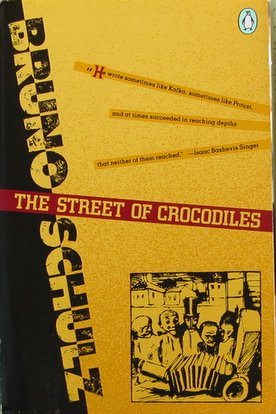
The Street of Crocodiles is a collection of semi-autobiographical short stories (or novel, depending on who you talk to) originally published in 1934 under the title Cinnamon Shops, set in the small town of Drohobycz in southern Poland, where Bruno Schulz, its author, lived his entire life. The collection quickly won the Golden Laurel of the Polish Academy of Letters. Schulz died in 1942, at the age of 50, gunned down in the street by an SS agent. No one knows where he was buried. An unfinished manuscript titled The Messiah that he was known to be working on was either destroyed or lost.

The description "semi-autobiographical short stories" seems a misnomer. "My soul sings of metamorphoses," Ovid tells us; Schulz's does as well. An uncle can become an electric bell. A calendar can "grow a thirteenth freak month," one that is "a hunchback month, a half-wilted shoot, more tentative than real." A father can transform into a cockroach, one that merges completely with the "crazy black zigzag of lightning" that pours from the cracks and chinks in the floor; a bird; a miracle worker, a "fencing master of imagination," and a grand heretic pontificating on the need for a second race of men "in the shape and semblance of a tailor's dummy." In short, the surreal permeates this more mythologized than remembered year of childhood, waging war, as the father did, as Schulz himself does, "against the fathomless, elemental boredom that strangled" their lives and their town. Banality is the true evil, the commercial Street of Crocodiles, for Schulz's characters. The cinnamon shops, as a counterpoint, represent the exotic, the extraordinary, the fantastic.

Schulz wrote in a letter to a friend: "It seems to me that the world, life, is important for me solely as material for artistic creation. The moment I cannot utilize life creatively--it becomes either terrible and dangerous, or morally vapid for me."

As someone who constantly found faces and creatures in linoleum patterns and knotty pine paneling while growing up, I delighted in passages such as this:

"Who knows," he said, "how many suffering, crippled, fragmentary forms of life there are, such as the artificially created life of chests and tables quickly nailed together, crucified timbers, silent martyrs to cruel human inventiveness. The terrible transplantation of incompatible and hostile race of wood, their merging into one misbegotten personality.

"How much ancient suffering is there in the varnished grain, in the veins and knots of our old familiar wardrobes? Who would recognize in them the old features, smiles, and glances, almost planed and polished out of all recognition?"

and I marvelled at the mind who could create a character who would glorify matter and creativity in such a provocative, perverse manner:

"Deprived of all initiative, indulgently acquiescent, pliable like a woman, submissive to every impulse, it is a territory outside any law, open to all kinds of charlatans and dilettanti, a domain of abuses and of dubious demiurgical manipulations. Matter is the most passive and most defenseless essence in cosmos. Anyone can mold it and shape it; it obeys everybody. All attempts at organizing matter are transient and temporary, easy to reverse and to dissolve. There is no evil in reducing life to other and newer forms. Homicide is not a sin. It is sometimes a necessary violence on resistant and ossified forms of existence which have ceased to be amusing. In the interests of an important and fascinating experiment, it can even become meritorious. Here is the starting point of a new apologia for sadism."

(Also interesting in light of that passage is knowing that Schulz, who made his living as an art teacher in a high school, often drew himself in positions of submission and humiliation with women.)

This is a book read for its poetic language and imagery. I'm looking forward to reading Sanatorium under the Sign of the Hourglass, which continues the story of Schulz's family, and then returning to Street of Crocodiles; I don't believe I can possibly grasp all that Schulz intended on a first (or second attempt); it's much too rich.

I was cautiously happy to discover that The Drawing of Bruno Schulz was in our library (I say cautiously because I was afraid the masochism alluded to in articles about Schulz might be a little more than I could stomach--that didn't prove to be the case).

I learned that Schulz made a series of drawings to illustrate Cinnamon Shops and considered placing woodcuts within the text as was done in the early 19th century, but the collection was published without embellishment to keep production costs down. Schulz glued his original drawings into a copy of the book and presented it to his friend, the Polish novelist Zofia Nalkowska, who had first brought Cinnamon Shops to the publisher's attention. Unfortunately, this copy of Cinnamon Shops was destroyed. Schulz's pen and ink drawings were included in Sanatorium under the Sign of the Hourglass when it was published three years later; stories and illustrations from the work were published in magazines as well.

Schulz began mailing manuscripts, letters, engravings and drawings from the ghetto in Drohobycz to others elsewhere Poland who he considered under less threat from the Nazis mere months before he was killed. Most of the work that survived has been gathered at the Museum of Literature in Warsaw. Much was undoubtedly destroyed, but there's still a possibility that some of his lost material will still be recovered.

Below are two illustrations from Sanatorium:

Father Jacob, at times dead or transformed into a cockroach in The Street of Crocodiles, is alive (or in limbo) in Sanatorium, as are the other main characters. Here he is, flying over a table, in a story called "Eddie."


And here's Joseph, the narrator, with his father in a sketch for the story "Spring." The automobile-telescope that's on the cover of the most recent edition of The Street of Crocodiles --the one I believe most of us have--is also from Sanatorium.

My apologies for such a choppy post--I hab a cold and wondered for awhile if I'd manage one at all.

(Cross posted at pages turned)

The Street of Crocodiles

I have very mixed feelings about this book; at times I hated it and at others I laughed or admired the writing or felt I could appreciate what Schulz was doing. Sometimes I was horrified by it.

It’s a series of short stories, sort of — I think of the chapters as being on the boundary line between stories and sketches. Some of them actually told a story with a plot, while others were more descriptive, without much, or any, narrative. They are about a young boy’s family and his city; I think we are safe in assuming that the main character is at least partly based on Schulz himself.

These stories are often fantastical. They might start off in a realistic mode, but most of them eventually veer off into the dream-like and the impossible. I wasn’t expecting this, and so I spent a lot of time figuring out what Schulz was doing and how I supposed to approach his stories. I found the reading experience to be disorienting — which isn’t a bad thing, really, although it wasn’t purely pleasure, either. As I was describing the stories to the Hobgoblin, he asked if they might be called “magical realism,” and I thought not, because to me magical realism is more about describing the fantastical or the magical as though it were real — to treat it matter-of-factly — when what Schulz does is the opposite; he takes the real and makes it strange and otherworldly.

My favorite chapters were the ones that had more narrative, such as “Birds” or “Cinnamon Shops.” The more descriptive chapters drove me crazy; I felt like I was drowning in Schulz’s incredibly dense language. As I look over the book trying to find a passage to show you what I mean, I realize that this isn’t bad writing really, not bad in the sense that Schulz loses control of it and his meaning gets away from him. Here’s an example:

Once Adela took me to the old woman’s house. It was early in the morning when we entered the small blue-walled room, with its mud floor, lying in a patch of bright yellow sunlight in the still of the morning broken only by the frighteningly loud ticking of a cottage clock on the wall. In a straw-filled chest lay the foolish Maria, white as a wafer and motionless like a glove from which a hand had been withdrawn. And, as if taking advantage of her sleep, the silence talked, the yellow, bright, evil silence delivered its monologue, argued, and loudly spoke its vulgar maniacal soliloquy. Maria’s time — the time imprisoned in her soul — had left her and — terribly real — filled the room, vociferous and hellish in the bright silence of the morning, rising from the noisy mill of the clock like a cloud of bad flour, powdery flour, the stupid flour of madmen.

I’m fine with the passage for the first two sentences, and even the third, although I do wonder what kind of “chest” Maria is lying in. I like the description of her as “white as a wafer and motionless like a glove.” Then we get the silence talking, and I feel like we’re entering into deeper waters, but I like the idea of silence talking, and even arguing and being loud. The last sentence begins to lose me, though — Maria’s time is filling the room? I sort of get it, if I stretch a bit. I like the image of the cloud of flour filling the room, but why the “stupid flour of madmen”? This book is full of language you can struggle with for a long time, if you want. Or, I suppose, you can refuse to struggle with it and just let it wash over you.

The sections that describe the father were the most powerful; it was these sections that horrified me. He goes back and forth between sanity and insanity, and during his insane times, he does things like keeping a flock of birds in the attic and crawling across the floor like a cockroach. And the family can’t really do anything about it. They often act as though he’s not there, as though there weren’t a completely insane man living in their midst. I wonder if some of the book’s mixing of fantasy and reality is the boy’s response to his father’s madness; in the world the boy lives in, how is he supposed to distinguish what is real and what is not? What does he have to hold on to that’s solid and certain?

The Street of Crocodiles

Cross-posted at So Many Books


Where to begin in writing about The Street of Crocodiles by Bruno Schulz? It is a beautiful and amazing book filled with joy and sorrow, mystery and wonder. It is poetry disguised as prose. It is imagination changing the everyday into something more.

The book is composed of stories told by a boy about his family and life. The central character in the boy's life is his father, a merchant who sells fabric that, in the story of "The Night of the Great Season," turns into a natural landscape as shoppers call for, unroll, and drape fabric on themselves and around the shop. The father, we are given to believe, is also not quite sane. He disappears for days in some part of the house and no one misses him until he turns up looking smaller, and then they all realize he's been gone. But oh, how I love this father character who discourses on the genesis and rights of tailors' dummies and raises exotic birds in the attic. Everyone thinks him daft, but the boy later comes to realize something else:
Only now do I understand the lonely hero who alone had waged war against the fathomless, elemental boredom that strangled the city. Without any support, without recognition on our part, that strangest of men was defending the lost cause of poetry. He was like a magic mill, into the hoppers of which the bran of empty hours poured, to re-emerge flowering in all the colors and scents of Oriental spices. But, used to the splendid showmanship of that metaphysical conjurer, we were inclined to underrate the value of his sovereign magic, which saved us from the lethargy of empty days and nights.
Magic and poetry fill this book. And always there is the father who is engaged in an argument with God:
But at night these voices rose with greater passion. The demands were made more clearly and more loudly, and we heard him talk to God, as if begging for something or fighting against someone who made insistent claims and issued orders.
This argument might have something to do with creative will:
For too long the perfection of his creation has paralyzed our own creative instinct. We don't wish to compete with him. We have no ambition to emulate him. We wish to be creators in our own, lower sphere; we want to have the privilege of creation, we want creative delights, we want--in one word--Demiurgy.
As the father's curiosity and experiments and ideas get wilder and wilder, the family reaches a point when they can't take it any longer:
It was not because there was no grain of truth in Father's discoveries. But truth is not a decisive factor for the success of an idea. Our metaphysical hunger is limited and can be satisfied quickly. Father was just standing on the threshold of new revelations when we, the ranks of his adherents and followers began to succumb to discouragement and anarchy...we were fed up with miracles and wished to return to the old, familiar, solid prose of eternal order. and Father understood this. He understood that he had gone too far, and put a rein on the flights of his fancies.
One of the many things I loved so much about this book is the fantastic descriptions and events that suddenly take flight from mundane reality. One of my favorite of these is in the story "The Gale" where the wind as it gathers up its forces and fury is partly described thus:
There, in those charred, many-raftered forests of attics, darkness began to degenerate and ferment wildly. There began the black parliaments of saucepans, those verbose and inconclusive meetings, those gurglings of bottles, those stammerings of flagons. Until one night the regiments of saucepans and bottles rose under the empty roofs and marched in a great bulging mass against the city.
Brilliant writing, this. You will guaranteed find nothing even vaguely approximating a cliche in this book.

I feel as though I have quoted too much, but I couldn't help myself. I read this book for the latest Slaves of Golconda discussion. You can read what the other Slaves thought in one convenient location, and either eavesdrop at the forum at metaxucafe or, better yet, give your two-cents worth.

Monday, January 29, 2007

Bruno Schulz: Three Self-Portraits

A reminder that we'll begin discussing Schulz' The Street of Crocodiles on Wednesday.


ca. 1919


ca. 1920


ca. 1920

(Artwork taken from The Drawings of Bruno Schulz, edited by Jerzy Ficowski, and published by Northwestern University Press.)

Saturday, November 11, 2006

Manumission

The surest way to incite revolt is to neglect one's slaves. I haven't driven any of you nearly hard enough, and so have failed as a good slavedriver. Though I enjoy this endeavor, I find it difficult to keep up in the manner fitting--see how the blog still mentions HG Wells as the current read. Therefore you are all granted your freedom. I hope to continue to participate, and that the group may carry on in the same manner. What I will do, then, is to grant administrative functions to the Slave who is making the next book selection, so that Slave may remodel the blog accordingly, with updated links and all the decorative stuff that should rightfully appear in the sidebars. Be crazy and make it your own! SFP, the whip is now in your hands.

Thanks all for your good service. We will meet again in January on the Street of Crocodiles. Now go and be free.

Friday, November 03, 2006

A modern classic next time?

I've been tagged by Danielle for the next Slaves selection, but before I throw out a few titles for the group's consideration, I wanted to say that I hope we can modify our schedule and put off discussion until late January instead of at the end of December. That would give us all time to make some headway with our own out-of-control reading lists between now and the end of the year, and maybe, possibly some of our errant members or others who'd like to read along with us for the first time will resolve to take part if they have a bit more time to plan for it.

At any rate, there are three books I'd enjoy reading with the group: Bruno Schulz's The Street of Crocodiles; L.P. Hartley's The Go-Between; and Elspeth Huxley's The Flame Trees of Thika. I assume we're all considering taking part in the Classics Challenge in January and February, and any of these titles count would count toward that as a modern classic.


The Street of Crocodiles is a novella by a Polish writer who was killed by the Nazis during WWII. If you're a fan of Calvino or Garcia Marquez, if you like your stories Kafkaesque, if you're in the mood for something poetic and odd, then this appears to be your baby. I've wanted to read it since Nicole Krauss referenced it in The History of Love last year.

First paragraph:

In July my father went to take the waters and left me, with my mother and elder brother, a prey to the blinding white heat of the summer days. Dizzy with light, we dipped into that enormous book of holidays, its pages blazing with sunshine and scented with the sweet melting pulp of golden pears.


The prologue to The Go-Between begins with a line I'm sure you've heard before: The past is a foreign country: they do things differently there.

An old man looks back half a century to the adolescent summer that changed the course of his life. Proustian memories triggered by the unearthing of an old diary. The loss of innocence at the height of Empire. An Ian McEwan plot and an Evelyn Waugh setting. The Heinemann Foundation Prize of the Royal Society of Literature and an internationally successful film.

'Has the twentieth century,' I should ask, 'done so much better than I have? When you leave this room, which I admit is dull and cheerless, and take the last bus to your home in the past, if you haven't missed it--ask yourself whether you found everything so radiant as you imagined it. Ask yourself whether it has fulfilled your hopes. You were vanquished, Colston, you were vanquished, and so was your century, your precious century that you hoped so much of.'

Elspeth Huxley's family moved to Kenya when she was six to start a coffee plantation.

We were going to Thika, a name on a map where two rivers joined. Thika in those days--the year was 1913--was a favorite camp for big-game hunters and beyond it there was only bush and plain. If you went on long enough you would come to mountains and forests no one had mapped and tribes whose languages no one could understand. We were not going as far as that, only two days' journey in the ox-cart to a bit of El Dorado my father had been fortunate enough to buy in the bar of the Norfolk hotel from a man wearing an Old Etonian tie.

Have any of you already read this memoir? I can't remember. I read Huxley's novel Red Strangers a couple years back and loved it.

Leave your preferences in comments.